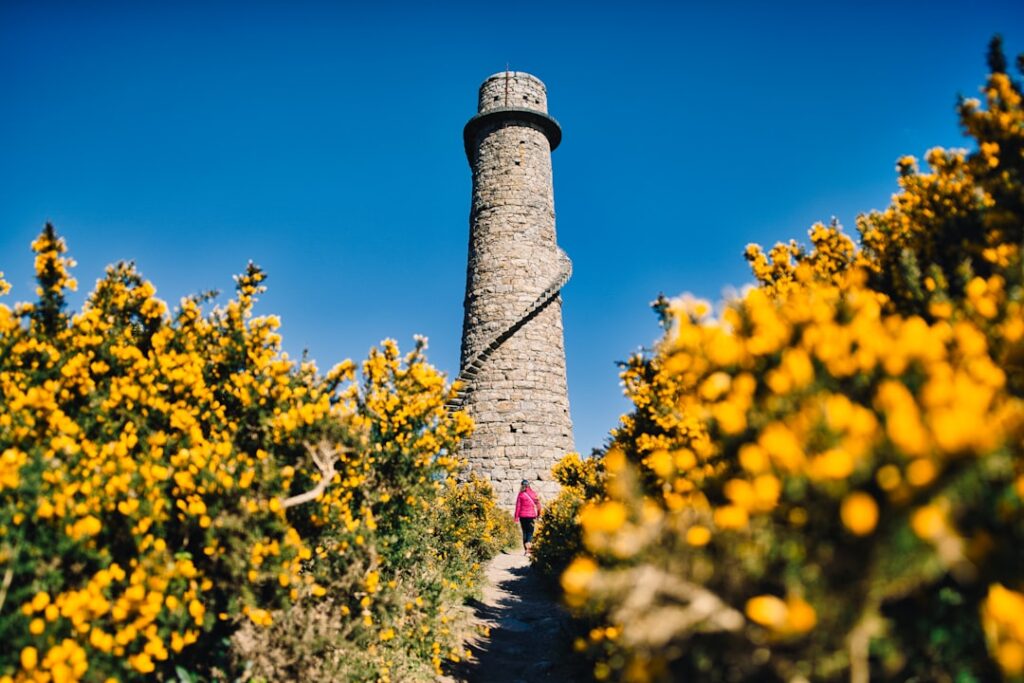
Stand anywhere in Ireland’s ancient monastic sites—Glendalough in County Wicklow, Clonmacnoise in County Offaly, or Devenish Island in County Fermanagh—and you’ll see them: slender stone towers rising skyward, their conical caps reaching heights of up to 100 feet. These round towers are among Ireland’s most distinctive medieval structures, and their story connects us to an era when Ireland was known as the land of saints and scholars.
Built to Protect and Proclaim
Between the 9th and 12th centuries, Irish monks constructed more than 65 of these towers across the island, though only about 25 survive in reasonably complete condition today. The timing wasn’t coincidental. This was the age of Viking raids, when coastal monasteries faced regular attacks from Norse longships seeking gold, silver, and precious manuscripts.
The towers served multiple purposes. Primarily, they were bell towers—the Irish word for them is cloigtheach, meaning bell house. The bells called monks to prayer and marked the rhythm of monastic life. But they also functioned as treasuries and refuges. When raiders approached, monks could climb inside through the single elevated doorway (typically 10 to 15 feet above ground, accessible only by ladder) and pull up the ladder behind them, securing the community’s most valuable possessions inside.
The architectural precision is remarkable. Built entirely of stone without mortar in many cases, these towers have withstood centuries of Atlantic storms. Their slight inward taper and careful placement of windows at cardinal points speak to sophisticated engineering knowledge.
Where to Visit Ireland’s Finest Round Towers
Glendalough’s round tower stands 103 feet tall and remains one of Ireland’s most photographed landmarks. Set in the Wicklow Mountains’ glacial valley, the tower rises beside the ruins of St. Kevin’s 6th-century monastery. The site draws thousands of visitors annually, but arrive early morning and you might have the place nearly to yourself, with mist clinging to the valley floor and the tower emerging like something from a medieval manuscript.
At Clonmacnoise, perched on the banks of the River Shannon, two towers once stood. The larger of the surviving structures, O’Rourke’s Tower, reaches 62 feet and offers a stunning silhouette against the wide Midlands sky. This was one of Ireland’s greatest centers of learning, where monks produced magnificent illuminated manuscripts and welcomed scholars from across Europe.
For something more remote, take the boat to Devenish Island in Lower Lough Erne. The round tower here stands perfectly preserved at 81 feet, and the island location gives you a sense of the isolation these monastic communities sought. The tower dates to the 12th century and features intricately carved windows that demonstrate how the builders’ skills evolved over time.
The round tower at Ardmore in County Waterford offers coastal drama, standing on a clifftop overlooking the Celtic Sea. Nearby, the remains of St. Declan’s cathedral include spectacular stone carvings. Legend holds that St. Declan brought Christianity to this corner of Ireland even before St. Patrick arrived.
What the Towers Tell Us
These structures reveal much about medieval Ireland’s sophistication. This was a society that valued learning, preserved classical knowledge through Europe’s Dark Ages, and developed distinctive artistic and architectural traditions. The towers required substantial resources, skilled labor, and years to complete—evidence of stable, wealthy monastic communities.
The craftsmanship varies by period and region. Earlier towers feature simpler construction, while later examples display more elaborate stonework and decorative elements. The Kilmacduagh tower in County Galway leans more than two feet from vertical—Ireland’s answer to Pisa—yet has stood for nearly a millennium.
Some towers bear scorch marks from ancient fires, whether set by raiders or accidental blazes. Others show evidence of lightning strikes that split the stone but failed to topple the structure. Each tower carries its own history in the weathered stone.
Experiencing the Towers Today
Most round towers aren’t open for climbing (structural preservation is paramount), but standing at their base still inspires awe. Visit Glendalough on a summer evening when the crowds have thinned, and you can understand why these sites were chosen for contemplation and prayer. The towers seem to anchor the landscape, connecting earth and sky.
Many towers stand on the Wicklow Way, St. Declan’s Way, and other walking trails, making them accessible to hikers exploring Ireland’s countryside. Combine a tower visit with walks through the surrounding monastic settlements, where you’ll find high crosses, church ruins, and ancient graveyards that complete the picture of medieval Irish Christianity.
Heritage sites with round towers typically charge modest admission fees (around $5-8 USD for adults at managed sites like Glendalough), though many towers stand in open countryside with free access year-round.
These mysterious sentinels continue to mark Ireland’s skyline, silent witnesses to centuries of history. They remind us that Ireland’s story stretches back through ages of scholarship, artistry, and resilience—stories worth preserving and sharing.
Want more stories celebrating Ireland’s history, landscapes, and culture delivered to your inbox? Subscribe to the Ireland Moments newsletter—a daily celebration of the Emerald Isle.