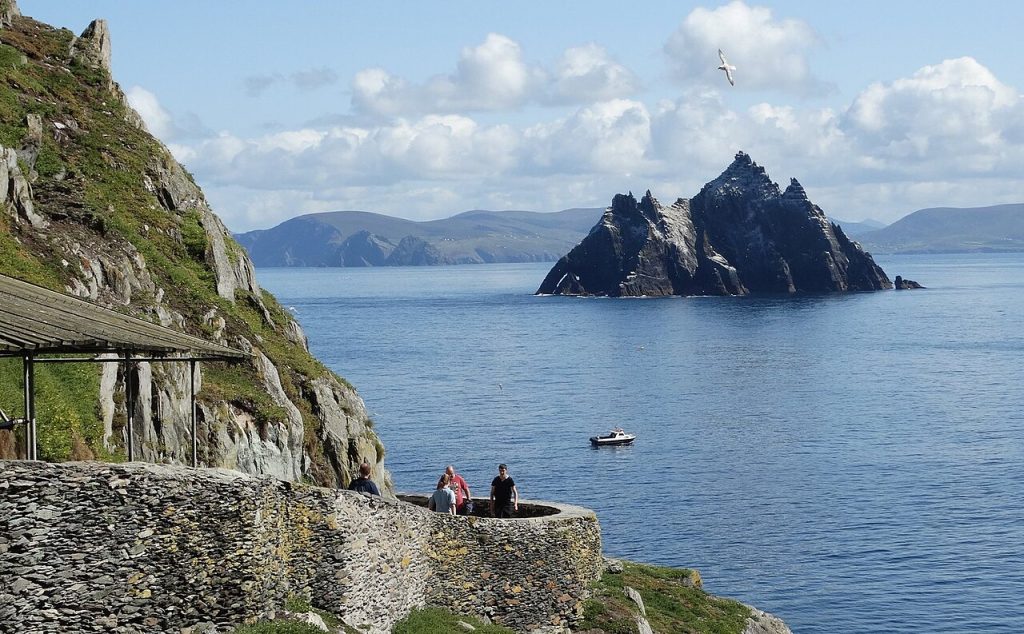
Eight miles off the coast of County Kerry, a jagged pyramid of rock rises 714 feet from the Atlantic. Skellig Michael—Sceilg Mhichíl in Irish—isn’t just one of Ireland’s most dramatic landscapes. It’s one of the most remarkable places of human endurance and faith anywhere in the world.
This UNESCO World Heritage site was home to a community of monks who built a monastery on its steep terraces sometime between the sixth and eighth centuries. They carved more than 600 stone steps into the rock, constructed beehive huts from unmortared stone, and survived on a windswept outcrop where the nearest land was a distant smudge on the horizon.
Visiting Skellig Michael today feels like stepping into another time—and another world entirely.
The Monastery at the End of the Earth
The monks who settled on Skellig Michael were seeking solitude, prayer, and a life stripped to its essentials. What they built is astonishing. Six beehive-shaped stone huts, two oratories, and several stone crosses remain intact after more than a millennium. The dry-stone construction is so precise that the interiors stay remarkably dry despite the island’s exposure to Atlantic storms.
The monks lived on fish, seabirds, eggs, and whatever vegetables they could coax from small garden plots. They prayed, copied manuscripts, and endured isolation that would break most modern people. Viking raids eventually forced them to abandon the island in the twelfth century, but the monastery they left behind stands as one of the finest examples of early Christian settlement in Europe.
Standing among those ancient stone huts, with the ocean crashing hundreds of feet below and gannets wheeling overhead, you can feel the weight of that devotion—and the raw courage it took to make a life in such a place.
Getting There Is Half the Experience
Skellig Michael isn’t easy to reach, and that’s part of its power. Weather permitting, licensed boats depart from Portmagee and Ballinskelligs between May and October. The crossing takes about an hour, and the Atlantic doesn’t make promises. Swells can be significant, and landings are frequently canceled due to conditions.
Only a limited number of visitors are allowed on the island each day—around 180—to protect the fragile site. Permits are required for boat operators, and advance booking is essential. Expect to pay around $100 to $120 per person for the boat trip.
Once you land at the small stone pier, the real journey begins. The climb to the monastery involves more than 600 uneven, ancient steps with no handrails. It’s steep, exposed, and not suitable for anyone uncomfortable with heights or unsteady on their feet. But for those who make it, the reward is unmatched.
Why It Feels Different
Skellig Michael has a presence that goes beyond its physical drama. Maybe it’s the remoteness, or the knowledge that monks prayed here for centuries. Maybe it’s the sheer improbability of the place—that humans not only survived here, but built something beautiful and enduring.
The island became famous again in recent years as a filming location, but its real magic predates any screen. It’s in the silence between waves, the cry of seabirds, the way the stone huts seem to grow from the rock itself. It’s in the realization that this place has stood, largely unchanged, while empires rose and fell.
Visitors often describe the experience as spiritual, even if they’re not religious. There’s something about standing at the edge of the known world, where monks once stood, that puts everyday concerns into perspective.
What to Know Before You Go
Wear sturdy, waterproof footwear with good grip—the steps can be slick. Bring layers, even in summer. The island is fully exposed, and weather changes fast. There are no facilities on Skellig Michael—no restrooms, no shelter, no food or water. Come prepared.
The visit lasts about two and a half hours on the island, with an hour each way by boat. Some tours also circle Little Skellig, a neighboring island that’s home to one of the world’s largest gannet colonies—over 30,000 pairs. The sight and sound of tens of thousands of seabirds is unforgettable.
If weather cancels your trip, don’t despair. The Skellig Experience Centre on Valentia Island offers exhibits and a boat cruise around the islands (without landing) as an alternative. But if you get the chance to set foot on Skellig Michael itself, take it. Not everyone does.
Some journeys change how you see the world. Skellig Michael is one of them. It’s a place that reminds you what humans are capable of, and how small we are against the ocean and the sky.
Want more stories from Ireland’s most remarkable places? Subscribe to the Ireland Moments newsletter—a daily celebration of Ireland, delivered to your inbox.