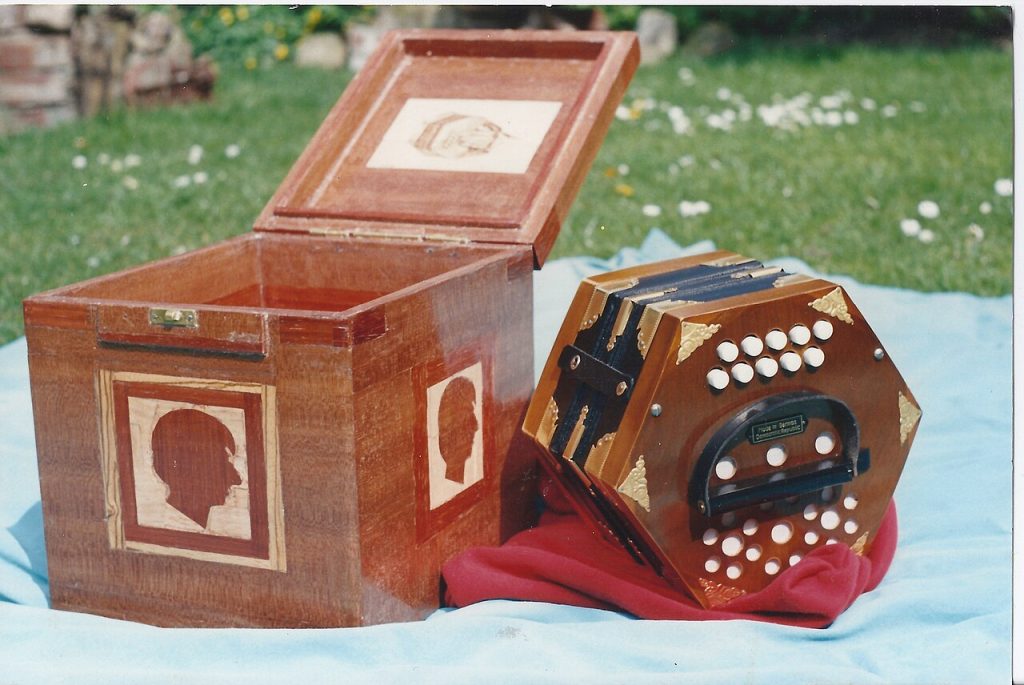
Walk into any pub in County Clare during a traditional music session and you’ll hear it: the sweet, reedy voice of the concertina weaving through reels and jigs with an almost vocal quality. While the fiddle and tin whistle might be Ireland’s best-known instruments, it’s the Anglo concertina that’s become synonymous with Clare’s distinctive musical character.
This small, hexagonal bellows instrument didn’t originate in Ireland. It arrived in the mid-1800s from England, brought by sailors and travelers. But in the hands of Clare musicians, the concertina found its true calling, evolving into something unmistakably Irish.
The Clare Style: Fast, Ornamental, and Utterly Distinctive
What makes Clare concertina playing different is the speed and ornamentation. Players like Noel Hill, Mary MacNamara, and the legendary Mrs. Crotty developed a style that’s breathtakingly fast yet incredibly articulate. The instrument’s push-pull action on the Anglo system creates a natural pulse that fits Irish dance music perfectly.
Unlike the English concertina (which plays the same note on push and pull), the Anglo concertina plays different notes depending on bellows direction. This limitation became an advantage in Irish music, forcing players to develop techniques that give the music its characteristic bounce and drive.
In Clare, concertina players ornament heavily with rolls, cuts, and triplets that make every tune shimmer. The instrument’s ability to play chords also allows players to add harmonic depth, something that sets it apart from purely melodic instruments like the whistle or flute.
From Kitchen to Concert Hall
The concertina’s golden age in Clare began in the early 20th century, when it became the instrument of choice in kitchen céilís and house dances. Families like the Crottys of Kilrush kept the tradition alive through generations. Mrs. Elizabeth Crotty, who ran a pub in Kilrush, became one of the most recorded and celebrated players, her 1950s recordings still studied by players today.
The Willie Clancy Summer School in Miltown Malbay, held every July since 1973, has become the world’s premier gathering for concertina players. Named after the great uilleann piper from Miltown Malbay, the week-long festival draws hundreds of musicians from around the world, with concertina classes always among the most popular.
Today, you can hear world-class concertina playing at sessions in Gus O’Connor’s in Doolin, Linnane’s Lobster Bar in New Quay, and Cooley’s House in Miltown Malbay. These aren’t tourist shows—they’re real working sessions where locals still gather to play the music their grandparents played.
Where to Find a Clare Session
If you want to experience the concertina in its native habitat, head to East Clare. The villages around Feakle, Tulla, and Crusheen host some of the most authentic sessions in Ireland. Pepper’s Bar in Feakle is legendary, especially during the Feakle Festival each August.
In West Clare, McGann’s Pub in Doolin hosts nightly sessions year-round, and you’ll often hear visiting concertina players sitting in alongside locals. The music starts around 9:30 PM most nights, and in summer, you might catch three or four concertinas in conversation, trading phrases and pushing each other to greater heights.
For those serious about the instrument, several Clare-based makers craft handmade Anglo concertinas. These instruments start around $3,000 and can exceed $5,000 for a fully customized model. Waiting lists often stretch years—testament to both the craftsmanship involved and the instrument’s enduring popularity.
Learning the Tradition
The concertina isn’t an easy instrument to master. Its button layout takes time to internalize, and achieving the speed and ornamentation of Clare-style playing requires years of dedicated practice. But the reward is an instrument capable of extraordinary expression.
Several music schools in Clare offer concertina instruction. The Ennis Traditional Music Centre runs year-round classes, and many established players offer private lessons, especially around Miltown Malbay and Ennis.
What makes the Clare concertina tradition so vital is that it’s still evolving. Young players like Cormac Begley are pushing the instrument in new directions, using bass and baritone concertinas to create soundscapes that honor tradition while exploring new territory. The concertina that arrived as a Victorian novelty has become an Irish treasure, and nowhere more so than in Clare.
Want to discover more about Ireland’s musical heritage, hidden sessions, and the traditions that make the Emerald Isle unforgettable? Subscribe to the Ireland Moments newsletter for a daily celebration of Ireland delivered to your inbox.