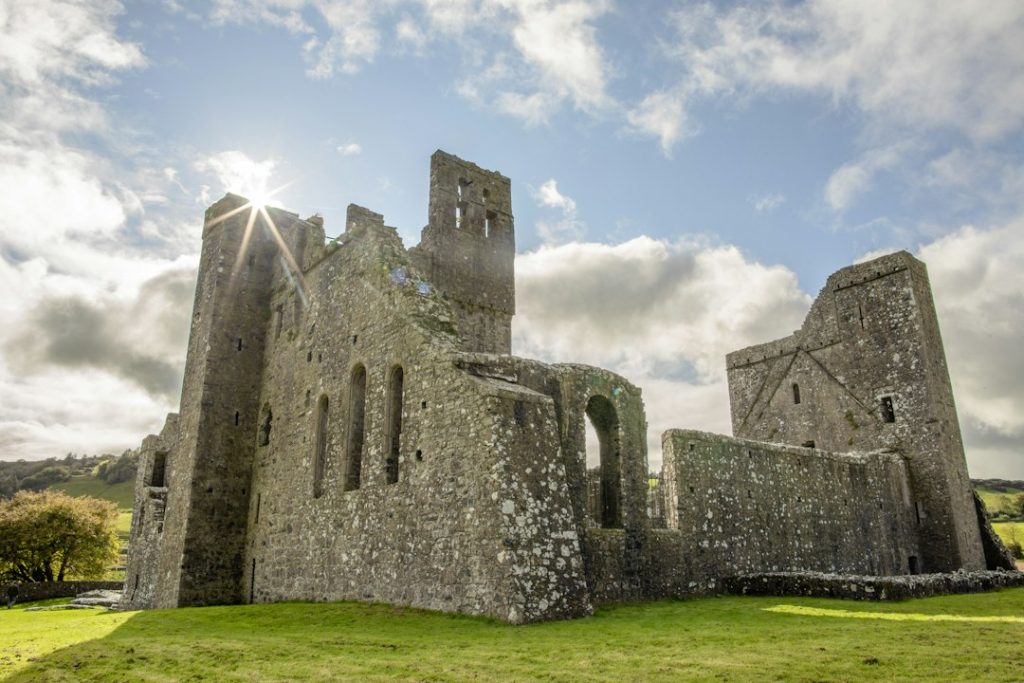
From almost anywhere in County Tipperary’s Golden Vale, you can see it: a limestone outcrop crowned with medieval towers and chapels, rising 200 feet above the pastures like something out of a dream. The Rock of Cashel—also known as St. Patrick’s Rock—is one of Ireland‘s most spectacular heritage sites, where centuries of kings, bishops, and builders left their mark in stone.
Unlike many Irish ruins tucked into valleys or hidden along coasts, Cashel commands the landscape. It was meant to be seen, and for more than a millennium, it announced power, faith, and ambition to everyone who approached.
From Pagan Fortress to Christian Stronghold
The Rock has been a seat of power since at least the 4th century, when it served as the stronghold of the Eóghanachta dynasty, the kings of Munster. Legend claims St. Patrick himself baptized King Aengus here in 450, accidentally driving his crosier through the king’s foot—though Aengus, thinking it part of the ritual, never complained.
In 1101, King Muirchertach Ua Briain handed the Rock over to the Church, transforming it from a royal fortress into one of Ireland’s most important ecclesiastical centers. What followed was three centuries of ambitious building: a round tower, a Romanesque chapel, a soaring Gothic cathedral, and a 15th-century hall that once hosted feasts and councils.
By the time Cromwell’s forces arrived in 1647, the complex had already weathered raids, fires, and political upheaval. The cathedral roof was removed in the 1700s, leaving the interior open to the sky—but that only added to its haunting beauty.
What You’ll See on the Rock
The Round Tower, built around 1100, is the oldest structure still standing and one of the tallest and best-preserved round towers in Ireland. At 92 feet, it rises above the complex like a stone sentinel, its doorway positioned well above ground level for defense.
Cormac’s Chapel, completed in 1134, is a jewel of Irish Romanesque architecture. Its twin towers, carved tympanum, and ribbed barrel vault make it one of the finest examples of 12th-century stonework in the country. Inside, you can still see traces of medieval frescoes—rare survivors of Ireland’s turbulent history.
The Cathedral of St. Patrick dominates the skyline. Built in the 13th century, its Gothic arches, lancet windows, and roofless nave create a dramatic silhouette against Tipperary’s big sky. Walking through the nave feels like stepping into both ruin and reverence—the stone still echoes with centuries of prayer and politics.
Don’t miss the Hall of the Vicars Choral, a restored 15th-century building that now houses the original St. Patrick’s Cross and a collection of medieval artifacts. The cross itself, dating to the 12th century, features a carved crucifixion scene that’s remarkably intact after nearly 900 years.
The View That Kings Knew
Standing on the Rock, you understand why this spot was chosen. The Golden Vale spreads out in every direction—some of the richest farmland in Ireland, dotted with hedgerows, ruins, and distant hills. To the north, the Devilsbit Mountain cuts a notch in the horizon. To the south, the Galtee and Knockmealdown ranges rise in layers of blue and green.
It’s a view that belongs to centuries of Irish kings, abbots, and warriors. And on a clear evening, when the light turns the limestone walls to gold and the shadows stretch long across the grass, it’s one of the most beautiful sights in Ireland.
Visiting the Rock of Cashel
The site is open year-round, with guided tours available daily. Admission is around $9 for adults, with discounts for seniors and students. The visitors’ center offers a short film that provides helpful context before you explore the grounds.
Give yourself at least 90 minutes to walk the complex, climb the round tower (if open), and take in the views. The town of Cashel sits at the base of the Rock and offers good pubs, cafés, and a few excellent spots for traditional music.
If you’re driving between Dublin and Cork, Killarney, or the southwest, Cashel sits conveniently along the route—and it’s worth building your day around. This is one of those places that stays with you long after you’ve left.
Love stories like this? Subscribe to the Ireland Moments newsletter and get a daily celebration of Ireland’s places, culture, music, and history delivered to your inbox.