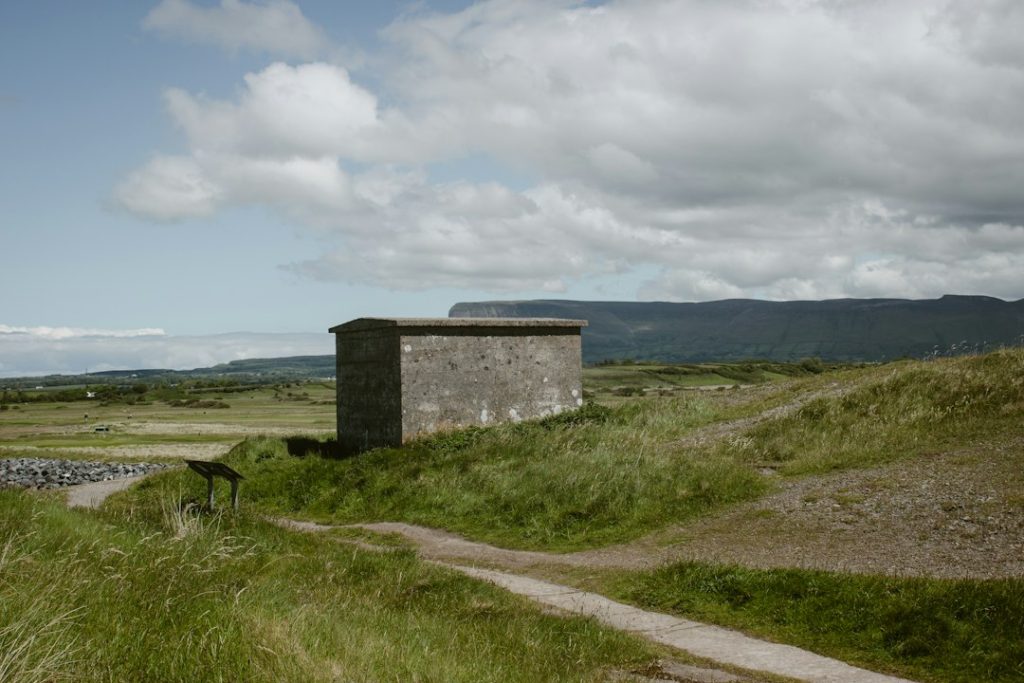
In the shadow of Ben Bulben’s limestone face, where the Atlantic wind cuts across County Sligo‘s green fields, lies Drumcliff Churchyard. This is where William Butler Yeats chose to rest, beneath a simple headstone that carries some of the most famous lines in Irish poetry: “Cast a cold eye / On life, on death. / Horseman, pass by!”
But Yeats is only the latest chapter in a story that reaches back more than 1,500 years. Drumcliff is one of Ireland’s most layered burial grounds, where Viking raids, monastic scholarship, and literary genius meet in a single windswept acre.
Where St. Colmcille Founded a Monastery
In 574 AD, St. Colmcille established a monastery at Drumcliff, part of the great flowering of Irish Christianity that would see monasteries become centers of learning across Europe. The site was chosen for its position along ancient routes through Sligo, where pilgrims, traders, and scholars passed.
What remains of that early foundation is a remarkable 11th-century round tower, standing 65 feet tall despite losing its cap centuries ago. Round towers like this were built as bell towers, lookouts, and places of refuge during Viking raids. Drumcliff’s tower is one of only two in County Sligo and one of about 70 still standing across Ireland.
Even more striking is the high cross near the churchyard entrance. Dating to the 10th or 11th century, it shows carvings of biblical scenes including Adam and Eve, Cain and Abel, and Daniel in the lions’ den. The weathered stone tells you how long this ground has been sacred.
Why Yeats Chose Drumcliff
William Butler Yeats died in France in January 1939, but he had already written his epitaph and chosen his resting place. He wanted to lie in Drumcliff because his great-grandfather had been rector of the Church of Ireland parish there in the 19th century. Yeats spent childhood summers in Sligo and considered it his spiritual home, even though he was born in Dublin.
His body was finally brought back to Ireland in 1948 and buried in Drumcliff Churchyard, beneath Ben Bulben, the mountain that appears again and again in his poetry. The grave is simple: a limestone headstone with his name, dates, and those three stark lines from “Under Ben Bulben,” the poem he wrote as his own farewell.
Visitors come from around the world to stand at the grave. Many leave stones, flowers, or handwritten lines of poetry. It’s a pilgrimage site for anyone who loves Irish literature, and on any given day you’ll see people reading quietly from dog-eared copies of his collected works.
What Else to See at Drumcliff
The current Church of Ireland building dates to 1809 and stands where medieval and earlier churches once stood. Inside, there’s a small exhibition about Yeats, the monastic history, and the surrounding area. The churchyard itself is still active, with graves spanning centuries, from worn 18th-century stones to recent burials.
Across the road, the Drumcliff Visitor Centre offers more context, with displays on Yeats’s life, his connection to Sligo, and the landscape that shaped his imagination. There’s also a café and a good bookshop specializing in Irish poetry and local history.
But the real experience is simply standing in the churchyard with Ben Bulben rising to the north, the wind coming off the ocean, and the sense that this place has held memory for longer than most of us can fathom. It’s a 10-minute stop that can easily become an hour if you let the place work on you.
Visiting Drumcliff
Drumcliff is located on the N15, about 4 miles north of Sligo town, on the road toward Donegal. There’s free parking at the site, and the churchyard is open to visitors year-round during daylight hours. Entry is free, though donations are welcome to help with maintenance.
The visitor center is open daily from March through October, with reduced hours in winter. If you’re driving the Wild Atlantic Way or exploring Sligo, Drumcliff pairs naturally with visits to nearby Lissadell House (the Gore-Booth family estate Yeats knew well), Mullaghmore, and the beaches at Streedagh and Rosses Point.
Sligo town itself is worth a day or two. The Yeats Society and Yeats Memorial Building host readings, exhibitions, and events, and the Model arts center and Niland Collection hold one of the world’s largest collections of works by Jack B. Yeats, the poet’s painter brother.
Drumcliff is a place where Ireland’s deep past and its literary present exist side by side. It’s not grand or loud. It’s quiet, windswept, and real—exactly the kind of place that produces poetry worth remembering.
Love stories like this? Subscribe to the Ireland Moments newsletter and get a daily celebration of Ireland’s places, culture, music, and heritage delivered to your inbox.