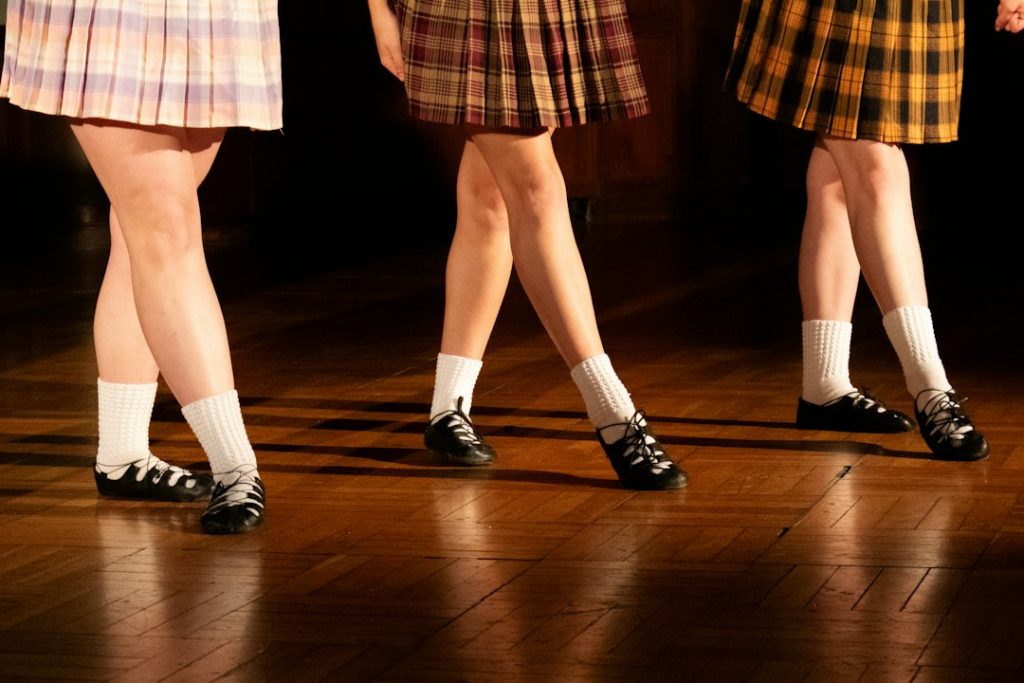
Irish step dancing looks like nothing else. Dancers hold their arms rigid at their sides while their feet blur in rapid, percussive patterns that sound like drums. The upper body stays eerily still while the legs execute movements so fast they seem impossible. It’s a dance that demands both iron discipline and explosive power, and it comes from a tradition that’s equal parts rebellion, ingenuity, and pride.
Step dancing has roots in the social dances of 18th-century Ireland, when traveling dance masters moved from village to village teaching steps on kitchen floors, at crossroads, and in barn lofts. The stiff upper body may have originated from confined spaces or from dancing on tabletops and half-doors, though some say it was a way to hide dancing from disapproving landlords peering through windows. Whatever the origin, the style became distinctly Irish: all the expression channeled downward into the feet.
The Competitive Tradition That Sharpened the Steps
Modern Irish step dancing owes much to the feis (pronounced “fesh”), the competitive dance festivals that began in the late 1800s as part of the Gaelic Revival. These competitions standardized certain steps and costumes, creating the elaborate solo dances — reels, jigs, hornpipes, and slip jigs — that dancers spend years perfecting. A feis can draw hundreds of competitors, from tiny beginners in their first soft shoes to championship-level seniors executing moves like trebles, clicks, and drum rolls with astonishing speed and precision.
The costumes evolved too. Early dancers wore simple parish colors, but by the mid-20th century, the dresses became ornate works of art: hand-embroidered with Celtic knotwork, adorned with Tara brooches and spirals inspired by the Book of Kells, and designed to catch the light as dancers leap and turn. A custom solo dress can cost upward of $2,000 and weigh several pounds, covered in hundreds of Swarovski crystals.
Riverdance and the Revolution
Everything changed in 1994 when Riverdance debuted as a seven-minute interval act during the Eurovision Song Contest. Choreographed by Michael Flatley and Jean Butler, the performance was electric: a line of dancers moving in perfect unison, their synchronized footwork thundering like a heartbeat. It was traditional step dancing reimagined for a global stage, and it became a cultural earthquake.
Riverdance grew into a full-length show that toured the world and inspired millions to take up Irish dancing. Suddenly, step dancing wasn’t just for the feis circuit or the parish hall — it was on Broadway, in arenas, and in living rooms where kids watched VHS tapes on repeat. The show proved that Irish dance could be both deeply rooted and wildly contemporary, honoring tradition while pushing it forward.
What It Takes to Dance Like That
Irish step dancing is brutally hard. Dancers train for years to develop the strength, speed, and endurance required. Soft shoes (called ghillies for girls, reel shoes for boys) are worn for lighter dances; hard shoes, with fiberglass tips and heels, are used for percussive hornpipes and treble jigs. The sound of hard shoes on a wooden stage is part of the performance — rhythm made visible.
Good step dancers make it look effortless, but behind every flawless treble reel is countless hours in the studio: practicing on wooden boards at home, building leg strength, and drilling timing until the body knows the steps without thought. Turnout — the outward rotation of the legs from the hips — is essential, and injuries are common. Ankles, knees, and hips take a beating. But dancers keep going, driven by the music, the competition, and the unmistakable thrill of nailing a difficult step.
Where to See It Today
You can catch Irish step dancing almost anywhere in Ireland if you know where to look. Céilí houses and cultural centers in Galway, Cork, and Dublin often host performances, especially during summer. The Comhaltas Ceoltóirí Éireann branches around the country offer regular music and dance nights where you’ll see both solo step dancing and the older set dances performed in groups.
If you’re visiting in spring, the All-Ireland Irish Dancing Championships (known as the Worlds) rotate locations but draw the planet’s best dancers. Watching the senior championship soloists is like seeing athletes and artists collide — dancers who’ve spent a lifetime perfecting an eight-hand reel or a set dance that tells a story through feet alone.
And if you want to try it yourself, many towns offer beginner classes. Don’t expect to master a reel in one session, but you’ll gain instant respect for what those dancers make look so easy. The first time you attempt a simple hop-step-step-hop pattern, you’ll understand why Irish step dancers are among the fittest, most focused performers in any tradition.
Irish step dancing is a living art, still evolving. It honors its roots in crossroads and kitchens while embracing stages and screens worldwide. It’s both ancient and electric, disciplined and daring — and unmistakably, unforgettably Irish.
Love stories like this? Subscribe to the Ireland Moments newsletter and get a daily celebration of Ireland — its music, places, culture, and soul — delivered straight to your inbox.