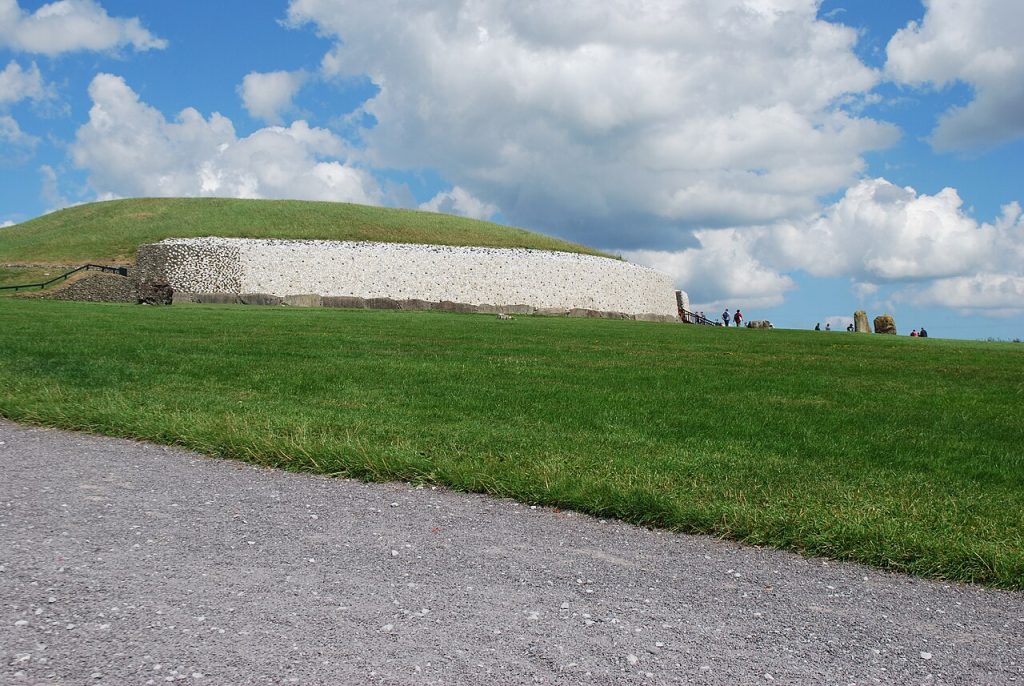
In the Boyne Valley of County Meath, about an hour north of Dublin, stands a monument so old it makes the pyramids look young. Newgrange was built around 3200 BC—roughly 600 years before the Great Pyramid of Giza and a millennium before Stonehenge took its final form. Yet this massive passage tomb still does exactly what its builders designed it to do more than five millennia ago.
Every year on the winter solstice, December 21st, sunlight creeps through a carefully positioned roof box above the entrance and illuminates the inner chamber for exactly 17 minutes. It’s a feat of astronomical precision and engineering genius that continues to astound archaeologists, astronomers, and the thousands who enter an annual lottery for the chance to witness it firsthand.
A Monument Built to Last Millennia
Newgrange is enormous. The circular mound covers more than an acre and is ringed by 97 massive kerbstones, many decorated with the swirling triple spirals, lozenges, and concentric circles that have become synonymous with ancient Ireland. The most famous is the entrance stone, covered in megalithic art so intricate and intentional it feels like a language we’ve only begun to understand.
The mound itself is constructed from approximately 200,000 tons of stone and earth, with a façade of sparkling white quartz that would have gleamed across the valley when it was new. Inside, a 62-foot passage leads to a cruciform chamber topped with a corbelled roof that has remained waterproof for over 5,000 years—without mortar.
The people who built Newgrange had no metal tools, no written language, and no wheels. They quarried stones from miles away, transported them by river and sledge, and raised a structure aligned with celestial precision. It’s older than writing, older than the bronze age, and it survives almost perfectly intact.
The Winter Solstice Phenomenon
Newgrange isn’t just a tomb—it’s an astronomical calendar carved in stone. At dawn on the winter solstice, the shortest day of the year, the rising sun aligns perfectly with a small opening called the roof box, positioned above the main entrance. For roughly 17 minutes, a golden shaft of light travels down the passage and floods the inner chamber, illuminating the back recess where cremated human remains were once placed.
The solstice event was rediscovered in 1967 by archaeologist Michael J. O’Kelly, who witnessed it firsthand and confirmed what had long been local legend. Today, only a handful of people are allowed inside the chamber each solstice morning, chosen by lottery from thousands of applicants worldwide. But even standing outside at dawn, watching the light emerge from the ancient roof box, is a moment of profound connection to Ireland’s distant past.
Who Built Newgrange and Why?
We don’t know the names of the Neolithic farmers who built Newgrange, but we know they were highly organized, deeply spiritual, and obsessed with the movement of the sun. The tomb was a communal project that likely took decades and required coordination across the Boyne Valley, where two other great passage tombs—Knowth and Dowth—also stand.
Inside Newgrange, archaeologists found the cremated remains of at least five individuals, along with grave goods like bone pins and pendants. But the tomb was more than a burial site. It was a temple, a ceremonial center, and a statement of cosmological belief. The spirals carved into the stones may represent the sun, the cycle of life and death, or journeys between worlds. We may never know for certain, but the artistry and intention are unmistakable.
Visiting Newgrange Today
Newgrange is part of Brú na Bóinne, a UNESCO World Heritage Site that also includes Knowth and Dowth. All visits begin at the Brú na Bóinne Visitor Centre on the south side of the River Boyne, where you’ll board a shuttle to the monument itself. Guides lead small groups into the passage and chamber, explaining the structure, the art, and the solstice alignment. At the end of the tour, they turn off the lights and simulate the solstice sunrise—a brief, humbling glimpse of what our ancestors built.
Tickets are timed and can sell out quickly, especially in summer, so book ahead online. Admission is around $15 USD for adults, with discounts for seniors and children. Plan to spend at least two to three hours exploring the visitor center and the monuments.
If you can’t visit on the solstice itself, don’t worry. Newgrange is breathtaking any day of the year. The walk around the exterior, the sight of the white quartz façade against green fields, and the knowledge that you’re standing in the presence of one of humanity’s oldest intact buildings is more than enough.
Why Newgrange Still Matters
Newgrange reminds us that Ireland’s history reaches far deeper than castles and saints. Thousands of years before Christianity, before the Celts, before bronze or iron, people lived here who understood the sky, honored their dead, and built for eternity. Their monument still stands, still functions, and still inspires awe.
It’s a humbling and thrilling place—a link to ancestors whose names are lost but whose vision endures in stone and light.
Want more stories from Ireland’s ancient past, hidden landscapes, and living traditions? Subscribe to the Ireland Moments newsletter and get a daily celebration of the Emerald Isle delivered to your inbox.