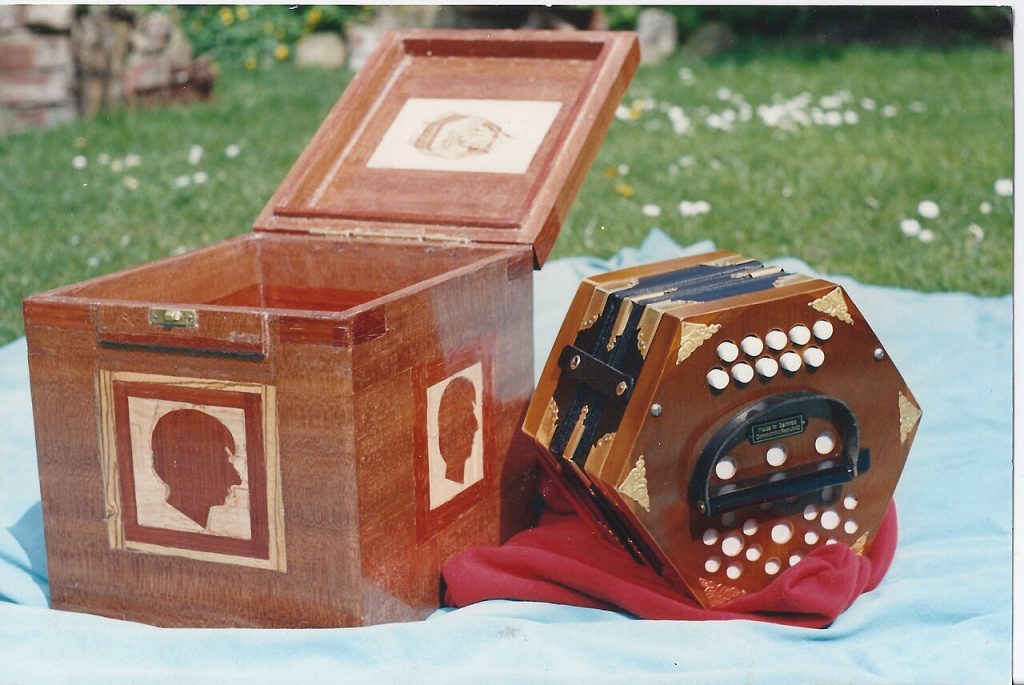
Walk into any pub in Ennis, Feakle, or Miltown Malbay on a Tuesday night and you’ll hear it—the bright, reedy voice of the concertina weaving through reels and jigs with a nimbleness that seems almost impossible. This small hexagonal box, held between two hands and breathing in and out like a living thing, has become so synonymous with County Clare that you can’t separate the instrument from the landscape.
While the fiddle, flute, and uilleann pipes might claim older roots in Irish music, the concertina carved out its own irreplaceable place in the tradition. And nowhere did it flourish more brilliantly than in the towns and villages of Clare, where generations of players turned a Victorian parlor instrument into the backbone of Irish trad.
How a German Invention Became an Irish Treasure
The Anglo concertina arrived in Ireland in the mid-1800s, invented by Sir Charles Wheatstone in England and refined by German craftsmen. It was portable, affordable, and loud enough to be heard over the chatter of a crowded kitchen or crossroads dance. Irish musicians, particularly in Clare, took to it immediately.
Unlike the English concertina, which plays the same note on the push and pull, the Anglo system produces different notes depending on the direction of the bellows—a feature that gives it a rhythmic, percussive quality perfect for dance music. Clare players exploited this fully, developing a style that was fast, ornamented, and unmistakably their own.
By the early twentieth century, the concertina had become as common in Clare as the spade or the kettle. Families passed down instruments and tunes together. Mrs. Crotty, born Elizabeth Markham in Kilrush, became one of the most celebrated concertina players of her generation, her recordings in the 1940s still studied and admired today.
The Clare Style: Fast, Tight, and Full of Life
What makes Clare concertina playing distinct is its precision and drive. Players like Paddy Murphy, Chris Droney, and later Noel Hill and Mary MacNamara developed a style marked by tight ornamentation, rapid fingerwork, and a rhythmic pulse that keeps dancers on their toes.
The concertina in Clare isn’t a solo showpiece—it’s a team player. In sessions, it locks in with the fiddle and flute, filling out the melody and adding percussive accents with the bellows. The push and pull of the instrument mirrors the ebb and flow of the music itself, breathing life into centuries-old tunes like “The Pipe on the Hob,” “The Maid Behind the Bar,” and “The Banshee.”
Noel Hill, from Caherea outside Ennis, brought the Clare style to international stages and became one of the instrument’s greatest ambassadors. His playing is both deeply rooted in tradition and adventurous, proving that the concertina could be as expressive as any instrument in the tradition.
Willie Clancy Week and the Concertina’s Living Tradition
Every summer, the village of Miltown Malbay swells with musicians from around the world for Willie Clancy Summer School, a week-long celebration of traditional music, song, and dance. The concertina is front and center.
Classes, workshops, and late-night sessions give students—from beginners to seasoned players—the chance to learn from masters and absorb the Clare style in its native habitat. You’ll hear concertinas in every corner: in the pubs, on the street, in slow airs and flat-out polkas.
The event honors piper Willie Clancy, but the concertina holds court just as proudly. It’s a reminder that this instrument, once dismissed as a Victorian novelty, became a cornerstone of Irish musical identity.
Where to Hear the Concertina Today
If you want to hear the concertina played the Clare way, head to Ennis. Brogan’s on O’Connell Street and Cruise’s Pub on Abbey Street host regular trad sessions where concertina players hold their own alongside fiddles and flutes. In Doolin, sessions at Gus O’Connor’s and McGann’s often feature visiting concertina players mixing with the local talent.
Head inland to Feakle during the August bank holiday weekend for the Feakle Traditional Music Festival, where concertina classes and sessions celebrate the village’s deep musical heritage. Or visit Tulla, home to the Tulla Céilí Band, where the concertina has been a driving force since the 1940s.
You can also catch concertina recitals and masterclasses at the University of Limerick’s Irish World Academy of Music and Dance, where the tradition is studied, documented, and passed on to the next generation.
The concertina may have been born in a London workshop, but it found its soul in the stone walls and windy roads of County Clare. It’s an instrument that breathes with the music, dances with the tune, and holds centuries of memory in every note.
Want more stories celebrating Ireland’s music, culture, and traditions? Subscribe to the Ireland Moments newsletter—a daily celebration of the Emerald Isle delivered straight to your inbox.