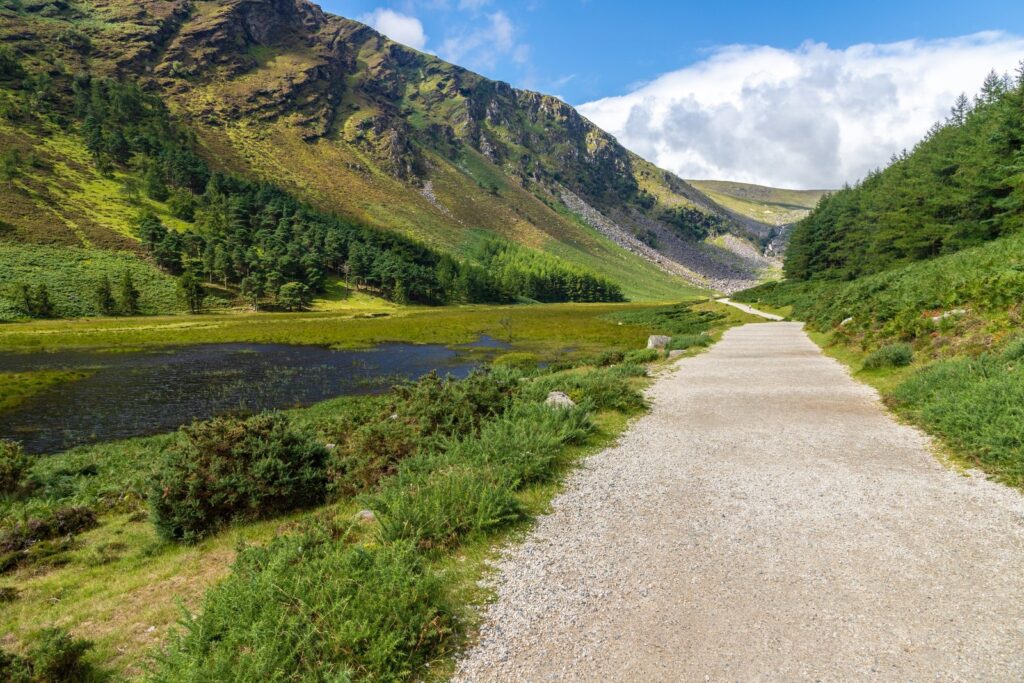
The Wicklow Way doesn’t announce itself with dramatic fanfare. It begins quietly in the Dublin suburb of Marlay Park, where families walk dogs and kids kick footballs. But within an hour of leaving the city behind, you’re climbing into the Wicklow Mountains, trading pavement for heather and the hum of traffic for the cry of curlews.
At 81 miles from start to finish, the Wicklow Way is Ireland‘s oldest waymarked trail and one of its most accessible. You don’t need to be an experienced trekker to tackle sections of it, and you don’t need a car to reach the trailhead. That combination makes it one of the finest ways to experience the wild beauty of Ireland without straying far from civilization.
Mountains, Glens, and the Garden of Ireland
Wicklow is often called the Garden of Ireland, but that nickname undersells its rugged character. The Wicklow Way threads through some of the most varied terrain in the country: open moorland dotted with bog cotton, dense oak and pine forests, glacial valleys carved by ancient ice, and mountain passes that open onto views stretching all the way to the Irish Sea.
The trail climbs over the flanks of Djouce Mountain and skirts the base of Lugnaquilla, Wicklow’s highest peak at 3,035 feet. It passes through Glenmalure, one of the county’s most dramatic glacial valleys, where sheer granite cliffs rise on either side of the narrow road. And it winds through Glendalough, the monastic settlement founded by Saint Kevin in the 6th century, where round towers and stone churches stand among two serene lakes.
Each section of the trail has its own character. The northern stretches feel remote and exposed, with vast stretches of blanket bog and weather that can turn in minutes. The southern portions roll through gentler farmland and forest, with welcoming villages like Roundwood and Tinahely offering warm beds and hot meals.
A Trail Built for Walkers of Every Stripe
One of the Wicklow Way’s greatest strengths is its flexibility. You can walk the entire route over six or seven days, camping or staying in hostels and guesthouses along the way. Or you can cherry-pick day hikes that suit your schedule and fitness level.
A popular option is the stretch from Glendalough to Glenmalure, roughly nine miles of stunning mountain scenery that showcases the best of Wicklow without requiring a week-long commitment. The boardwalks built across the boggy sections keep your boots relatively dry, and the trail is well marked with the familiar yellow walking man signs that guide hikers across Ireland.
Guided walking tours are available for those who prefer not to navigate alone or carry a heavy pack. Companies arrange baggage transfers between accommodations, so you can walk each day with just a light daypack. Expect to pay around $800 to $1,200 for a week-long self-guided package including lodging, maps, and luggage logistics.
What to Bring and When to Go
Wicklow weather is famously unpredictable. You can start the day in sunshine and end it in sideways rain, even in summer. Layered clothing, a waterproof jacket, sturdy boots, and a good map are non-negotiable. Mobile coverage is patchy in the mountains, so don’t rely solely on your phone for navigation.
The trail is walkable year-round, but spring and autumn offer the best conditions. May and June bring wildflowers and longer daylight hours. September and October paint the hillsides in gold and rust, and the crowds thin out after the summer rush. Winter walking is possible but demands more experience and preparation, especially if snow or ice is on the ground.
Water sources are plentiful along the route, but carry enough to stay hydrated between refills. Pack snacks with substance—oat bars, nuts, cheese—and don’t underestimate how much energy those climbs will demand.
More Than Just a Walk
The Wicklow Way isn’t just about the miles underfoot. It’s about the conversations struck up in small-town pubs after a long day’s walk, the satisfaction of earning a hot dinner, and the quiet pleasure of waking to birdsong in a valley far from any city.
It’s a trail that reminds you why people have been walking Ireland’s hills and glens for centuries—not to conquer them, but to be welcomed by them.
If you love stories like this and want a daily dose of Ireland delivered to your inbox, subscribe to the Ireland Moments newsletter. We celebrate the places, traditions, and experiences that make the Emerald Isle unforgettable.