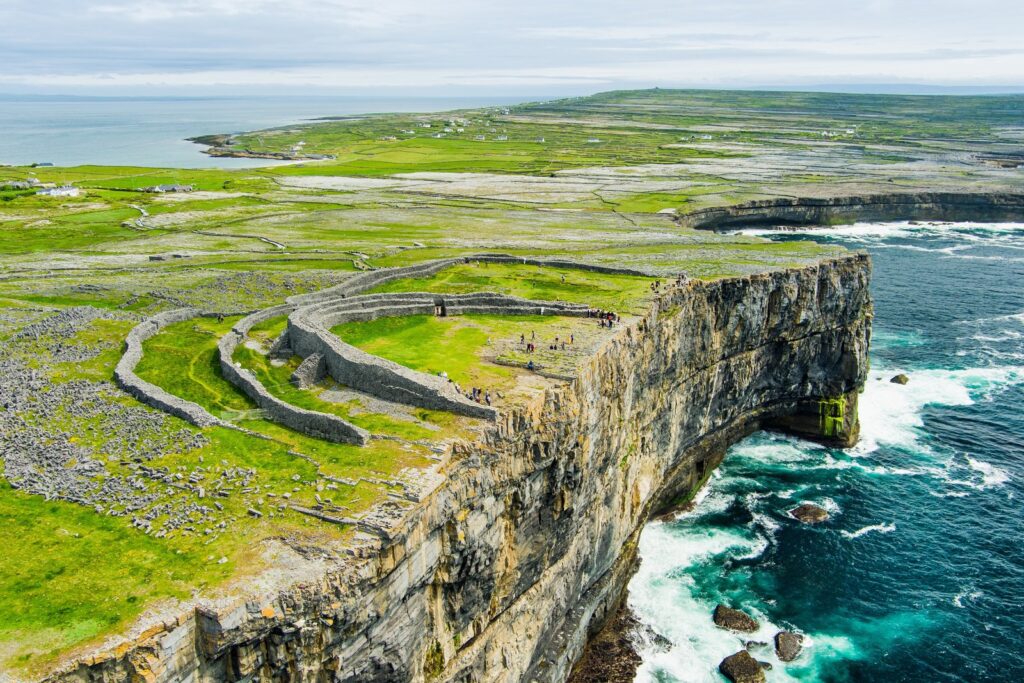
There are few places in Ireland where history and landscape collide quite like Dún Aonghasa. Perched on the western edge of Inis Mór, the largest of the Aran Islands, this ancient stone fort sits 300 feet above the Atlantic Ocean, its walls ending abruptly at a sheer cliff face that plunges straight into the churning sea below.
Built more than 3,000 years ago, Dún Aonghasa is one of the finest prehistoric sites in Europe. But what makes it truly unforgettable isn’t just its age—it’s the raw drama of its location, the mystery of its purpose, and the visceral experience of standing at the edge of the world.
A Fort Built at the Edge of Everything
Dún Aonghasa—sometimes spelled Dún Aengus—is a semi-circular stone fort with four concentric walls. The innermost enclosure is the most dramatic: a massive drystone wall up to 13 feet thick and 18 feet high, built without mortar and still standing strong after millennia.
The fort’s outer defenses include a band of sharp limestone spikes known as chevaux de frise, designed to slow attackers. But here’s the puzzle: the fort has no wall on its western side. Instead, it opens directly onto a cliff edge so sheer and so exposed that some archaeologists believe the fort may have been ceremonial rather than purely defensive.
No one knows exactly who built Dún Aonghasa or why, but the effort required to haul and stack these enormous stones on this windswept plateau speaks to its significance. This wasn’t just a lookout post. It was a statement.
The Walk to the Fort
Reaching Dún Aonghasa requires a walk of about 45 minutes from the village of Kilronan, where the ferry from Doolin or Rossaveel arrives. The path climbs steadily across the karst limestone landscape that defines Inis Mór—a moonscape of cracked stone, wildflowers, and low stone walls that have divided fields for centuries.
As you approach the fort, the Atlantic wind picks up. The landscape flattens. And then, suddenly, the stone walls of Dún Aonghasa rise before you, grey and massive and impossibly old.
The final approach is steep, but the visitor center at the base offers context and exhibits on the fort’s history, construction, and the people who once lived here. From there, it’s a short but steep climb to the inner enclosure.
Standing at the Edge
Once inside the fort, the real magic begins. Walk carefully toward the western edge, where the stone floor simply ends and the cliff drops away into nothing. There’s no barrier, no railing—just you, the wind, and the Atlantic stretching to the horizon.
On a clear day, the view is staggering: the Cliffs of Moher to the north, the hills of Connemara in the distance, and the waves crashing 300 feet below. On a stormy day, the wind is so strong you have to crouch or lie flat to avoid being pushed back. Either way, the sensation is elemental.
Standing here, it’s easy to imagine why this site was sacred. The scale, the exposure, the meeting of earth and sky and sea—it feels less like a fortress and more like a threshold.
Visiting Dún Aonghasa
Dún Aonghasa is open year-round, with seasonal hours. Admission is around $5 USD and includes access to the visitor center. The site is managed by the Office of Public Works, and guided tours are available in summer.
Reaching Inis Mór requires a ferry from Doolin (seasonal) or Rossaveel in Connemara, which runs daily. The crossing takes 40 to 90 minutes depending on your departure point. Once on the island, you can walk to the fort, rent a bike, or take a minibus tour.
Wear sturdy shoes—the limestone is uneven and can be slippery. Bring layers and a windproof jacket, even in summer. And take your time at the cliff edge. This isn’t a place to rush.
Dún Aonghasa isn’t just one of Ireland’s most dramatic ancient sites—it’s one of the most powerful. A place where stone and wind and sea converge, and where the past feels closer than anywhere else on the island.
Want more stories like this delivered to your inbox? Subscribe to the Ireland Moments newsletter—a daily celebration of Ireland’s places, culture, history, and heart.