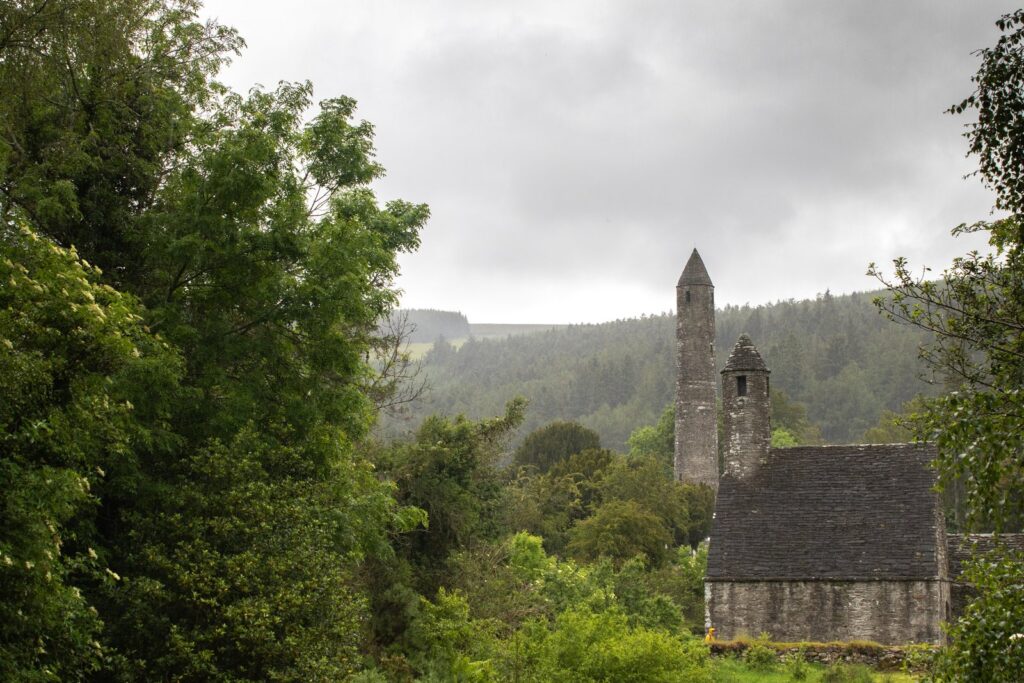
There are places in Ireland where history doesn’t feel distant—it breathes through the stones, whispers in the wind, and settles into your bones. Glendalough, the Valley of the Two Lakes, is one of those rare spots where a sixth-century monastic settlement still commands reverence, not as a ruin but as a living presence.
Nestled deep in the Wicklow Mountains, about an hour south of Dublin, Glendalough draws visitors not just for its famous round tower or ancient churches, but for something harder to name: a sense of peace that seems built into the landscape itself.
The Monastery That Survived a Thousand Years
Saint Kevin founded Glendalough in the sixth century, seeking solitude in a glacial valley flanked by steep forested slopes. What began as a hermit’s retreat grew into one of Ireland’s most important monastic cities, a center of learning and pilgrimage that thrived for more than 600 years.
The round tower, standing 110 feet tall and perfectly intact, is the valley’s unmistakable landmark. Built around the tenth century, it served as a bell tower, a beacon, and a refuge during Viking raids. The doorway sits ten feet above ground—accessed only by ladder—a reminder that beauty and defense often went hand in hand in medieval Ireland.
Surrounding the tower are the remains of a cathedral, several smaller churches, Celtic crosses, and hundreds of gravestones, some so weathered their inscriptions have melted back into the stone. The most atmospheric of these is St. Kevin’s Church, often called St. Kevin’s Kitchen for its chimney-like bell tower. Its steeply pitched stone roof has survived nearly a millennium of Wicklow weather.
Two Lakes and a Hermit’s Cave
The valley takes its name from two glacial lakes: the Lower Lake, easily accessible and surrounded by the main monastic site, and the Upper Lake, a quieter, more remote body of water reached by a woodland trail that follows the Glenealo River.
It’s at the Upper Lake that you’ll find the remains of Reefert Church and, if you’re willing to scramble a bit, St. Kevin’s Cell—a small cave carved into the cliffside where the saint is said to have lived in complete isolation, sleeping on bare rock and surviving on nettles, fish, and prayer.
The hike to the Upper Lake is gentle, shaded by oak and birch, with the sound of water constant. On misty mornings, the lake surface mirrors the surrounding peaks, and it’s easy to see why Kevin chose this valley. It feels protected, held.
Walking Through Centuries
Glendalough isn’t a place you rush through. The best way to experience it is on foot, moving slowly between the churches, reading the interpretive signs, sitting beside the round tower, and letting the stillness settle in.
The Visitor Centre offers a short film and exhibits that help make sense of the monastic layout, but the real education happens outside. Walk the perimeter of the old cemetery. Trace your hand along the石 walls. Stand beneath the round tower and look up at the conical cap, imagining the monks who built it without mortar, stone by stone.
For those who want more, the valley is surrounded by hiking trails. The Wicklow Way passes nearby, and shorter loops take you deeper into the mountains, past waterfalls, old mining sites, and viewpoints that frame the valley from above. The Spink route, a challenging cliff-edge trail, offers heart-stopping views over the Upper Lake.
A Sanctuary That Still Matters
Glendalough has never stopped being sacred. People still come here seeking quiet, whether they’re pilgrims, hikers, history lovers, or simply worn out by the noise of modern life. The valley absorbs them all without judgment.
There’s no entry fee to walk the monastic site, though the Visitor Centre charges around $5. The site is open year-round, and each season brings its own mood: wildflowers in spring, thick green canopy in summer, bronze and gold in autumn, skeletal beauty in winter.
If you visit, go early or late in the day. The tour buses arrive mid-morning and leave by mid-afternoon. In the early evening, when the light slants low through the trees and the valley empties out, Glendalough returns to what it’s always been: a place of stillness, a landscape built for reflection, and a reminder that some things—stone, water, silence—endure.
Want more stories from Ireland’s most beautiful and sacred places? Subscribe to the Ireland Moments newsletter and get a daily celebration of the Emerald Isle delivered to your inbox.