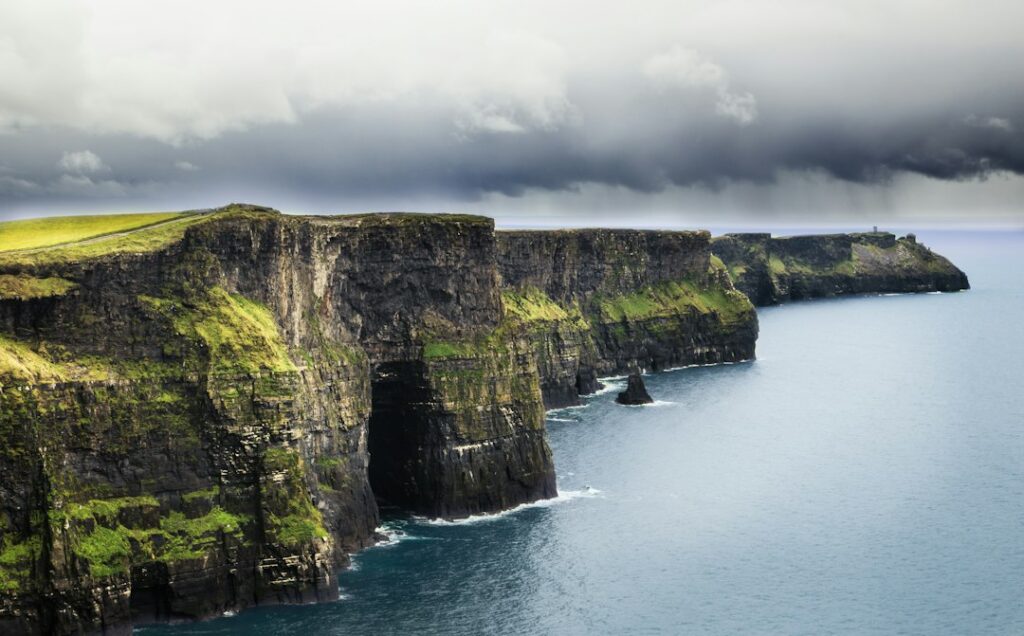
There are cliffs all along Ireland’s coast, but none command the Atlantic quite like the Cliffs of Moher. Rising 702 feet at their highest point near O’Brien’s Tower, these sheer walls of layered sandstone and shale stretch for five miles along the County Clare coastline, forming one of the most recognizable and awe-inspiring landscapes on the island.
On a clear day, the views reach the Aran Islands to the north, the Twelve Bens of Connemara beyond, and Loop Head to the south. On a stormy day, waves explode against the base with a force that shakes the ground beneath your feet. Either way, standing at the edge feels like standing at the end of the world.
A Cliff Built by Time and the Sea
The Cliffs of Moher were formed over 300 million years ago, during the Carboniferous period, when rivers deposited layers of sediment that eventually became rock. What you see today is the result of millennia of erosion — wind, rain, and relentless Atlantic swells carving out one of nature’s finest amphitheaters.
The stone itself tells a story. Dark layers of shale alternate with paler bands of sandstone and siltstone, creating striations that run horizontally across the cliff face. These bands mark ancient river deltas, tidal flats, and shallow seas — a geological record written in stone and read by the ocean.
The cliffs are still changing. Every winter storm claims a little more rock. Every century reshapes the edge. It’s a landscape that refuses to stand still.
O’Brien’s Tower and the Best Vantage Points
Built in 1835 by local landlord Cornelius O’Brien as a viewing point for Victorian tourists, O’Brien’s Tower remains the most popular spot along the clifftop path. The round stone tower sits at the cliffs’ highest point and offers 360-degree views on clear days — though the unobstructed clifftop itself is just as spectacular.
For those willing to walk, the coastal path south toward Hag’s Head is quieter and wilder. This trail takes you away from the visitor center crowds and closer to the raw power of the cliffs. Hag’s Head itself — named for a rock formation said to resemble a woman’s profile — marks the southern end of the cliffs and offers solitude, seabirds, and uninterrupted horizon.
To the north, the path toward Doolin provides equally stunning perspectives, with views back toward the main cliffs and out to the Aran Islands. The walk is gentle, grassy, and unforgettable.
Seabirds, Puffins, and Wild Residents
The Cliffs of Moher are home to one of Ireland’s most important seabird colonies. Over 30,000 birds nest on the ledges and crevices each year, including razorbills, guillemots, kittiwakes, fulmars, and peregrine falcons.
But the stars of the show are the Atlantic puffins. From late April through early August, these charismatic birds return to burrow in the grassy slopes at the cliff edge, particularly around the southern sections near Goat Island. Watching a puffin waddle along the turf, wings too small and body too round, before launching itself into the wind is one of Ireland’s great wildlife moments.
Bring binoculars if you have them. The cliffs reward close attention — a falcon hovering on an updraft, a gannet diving into the waves far below, the constant chatter of gulls echoing off stone.
Visiting the Cliffs: What You Need to Know
The Cliffs of Moher Visitor Experience, built into the hillside to preserve the landscape, offers exhibitions on the cliffs’ geology, wildlife, and history. Admission is around $9 per adult and includes parking, access to the clifftop paths, and the Atlantic Edge exhibition. It’s well done and family-friendly, though the cliffs themselves are the real attraction.
The site can get crowded, especially in summer and on cruise ship days. Arrive early — before 9 a.m. — or late in the afternoon for softer light, fewer visitors, and the kind of quiet that lets you hear the wind and the waves.
Respect the barriers and warning signs. The edge is unstable, wind gusts can be sudden and powerful, and the drop is unforgiving. Every year, people are injured or worse by underestimating the cliffs. Stay behind the stone walls where they exist, and use common sense where they don’t.
Layers are essential. Even on a calm day inland, the clifftop can be windy and cool. Waterproof jackets, sturdy shoes, and a bit of preparation make all the difference between misery and magic.
Why the Cliffs Still Matter
The Cliffs of Moher attract over a million visitors a year, and it’s easy to see why. They’re dramatic, accessible, and undeniably beautiful. But beyond the postcards and the Instagram frames, there’s something deeper at work here — a sense of scale, of geological time, of nature’s indifference and grandeur.
Standing at the edge, you’re confronted with forces far older and far more powerful than yourself. The Atlantic has been hammering these cliffs since long before humans walked Ireland, and it will continue long after we’re gone. There’s humility in that. And beauty.
The Cliffs of Moher aren’t just a sight to see. They’re a place to feel small, and in the best way — reminded that some things are bigger than us, and worth protecting.
Want more stories from Ireland’s most stunning landscapes, hidden gems, and timeless traditions? Subscribe to the Ireland Moments newsletter — a daily celebration of the island we love, delivered straight to your inbox.