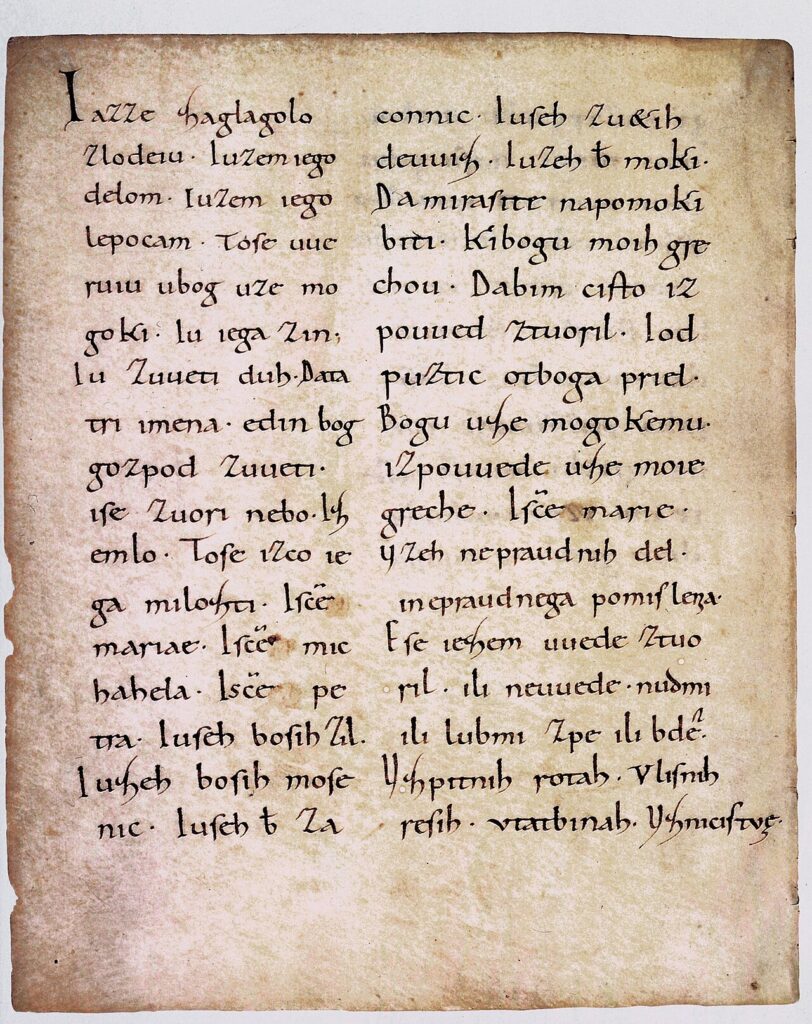
In the Long Room of Trinity College Dublin’s Old Library, behind protective glass and opened to a different page every few months, sits one of Ireland‘s greatest treasures. The Book of Kells—a Latin manuscript of the four Gospels created around 800 AD—is more than a religious text. It’s a masterwork of art, devotion, and imagination that has survived Viking raids, religious upheaval, and over twelve centuries of history.
Every page reveals a level of detail that seems impossible for its time. Spirals intertwine with animal forms, letters bloom into elaborate designs, and colors—made from minerals and plants—still glow with surprising vibrancy. It’s a testament to the skill and patience of the Columban monks who created it, likely on the island of Iona off the coast of Scotland before being brought to the Abbey of Kells in County Meath for safekeeping during Viking invasions.
A Page Takes Months to Complete
The Book of Kells contains 680 pages of vellum—calfskin prepared for writing—though scholars believe some pages were lost over the centuries. What remains is extraordinary. The manuscript includes the four Gospels of Matthew, Mark, Luke, and John, along with prefatory texts and tables.
But it’s the illuminations that make the Book of Kells legendary. Full-page illustrations depict Christ, the Virgin Mary, and the Evangelists in intricate detail. Capital letters at the beginning of chapters explode into ornate designs filled with interlacing patterns, fantastical creatures, and hidden details that reward close inspection. Some letters contain entire scenes—tiny cats and mice, angels and serpents, all woven into the Celtic knotwork.
Experts estimate that a single ornate page could have taken months to complete. The monks used pigments including lapis lazuli imported from Afghanistan, creating rich blues alongside earthy reds, yellows, and greens. They worked with quills cut from goose feathers, using rulers and compasses to achieve geometric precision that still impresses modern mathematicians.
Saved from Vikings and Thieves
The Book of Kells has survived remarkable trials. In 1007, the Annals of Ulster record that “the great Gospel of Columkille” was stolen from the stone church at Kells. It was recovered months later, buried under sods of earth, its gold shrine gone but the manuscript intact.
During the Reformation and Cromwellian period, when many Irish monastic treasures were destroyed, the Book of Kells somehow endured. In 1661, it was presented to Trinity College Dublin by Henry Jones, Bishop of Meath, where it has remained ever since. Today, it’s displayed in the specially designed Treasury exhibition, where climate control and careful conservation ensure its preservation for future generations.
The exhibition displays two volumes of the manuscript—the book was rebound in four volumes in 1953 for conservation purposes—with pages turned regularly to prevent light damage. One volume shows an illuminated page, the other displays text, giving visitors a sense of both the artistry and the purpose of the work.
Details That Reward a Second Look
What makes the Book of Kells so captivating is the layered complexity of its decoration. The famous Chi Rho page—marking the beginning of Matthew’s account of Christ’s birth with the Greek letters XPI—contains an estimated 10,600 decorative elements in a space roughly ten inches by thirteen inches. Viewers have discovered hidden cats clutching mice, otters catching fish, and angels emerging from the elaborate lettering.
The carpet pages—full-page decorations that precede each Gospel—feature geometric and organic patterns so intricate they seem to shift as you look at them. No two pages are alike. Some scholars see Celtic, Pictish, Anglo-Saxon, and Mediterranean influences blended together, evidence of Ireland’s connections across medieval Europe.
Even the text itself contains quirks and personality. Scribes occasionally added marginal notes, made corrections, or allowed decorative elements to playfully interrupt the Latin script. It’s a reminder that real people—with individual styles, preferences, and perhaps moments of humor—created this sacred work.
Experiencing the Book of Kells Today
More than 500,000 people visit the Book of Kells exhibition at Trinity College each year, making it one of Ireland’s most popular attractions. General admission is around $18, with discounts for students and families. The ticket includes access to the Long Room, Trinity’s historic library filled with 200,000 of the college’s oldest books and dominated by a towering barrel-vaulted ceiling.
The Treasury exhibition provides historical context before you reach the manuscript itself, explaining the materials, techniques, and symbolism used by the monks. Interactive displays let you explore details that would be invisible to the naked eye. Then you enter the darkened room where the Book of Kells rests, crowds gathering quietly around the display cases.
It’s worth timing your visit for early morning or late afternoon to avoid peak crowds. The Trinity College campus itself, with its cobbled squares and Georgian buildings, is beautiful to explore. Nearby, the Chester Beatty Library offers another chance to see illuminated manuscripts from various cultures, providing context for the Book of Kells within the broader tradition of sacred art.
The Book of Kells represents something essential about Ireland—a capacity for beauty in difficult times, a dedication to craft and learning, and a tradition of creativity that bridges the earthly and the sacred. Standing before its pages, you’re connected to the monks who mixed pigments by candlelight, to the scribes who spent lifetimes in devotion, and to centuries of people who recognized something worth protecting in this remarkable book.
Want more stories celebrating Ireland’s heritage, culture, and unforgettable places? Subscribe to the Ireland Moments newsletter—a daily celebration of the Emerald Isle delivered to your inbox.