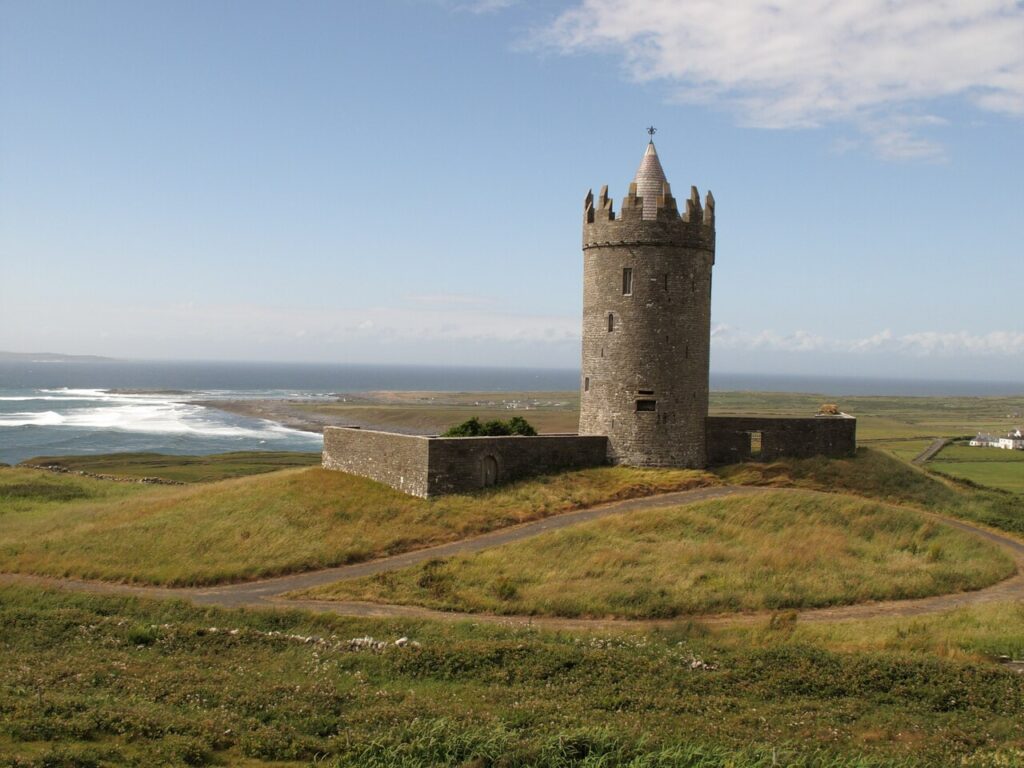
There are castles that sprawl across valleys, and castles that command entire towns. Then there’s Doonagore Castle—a single, perfectly proportioned tower that rises from a green headland above Doolin Bay like a chess piece on Ireland’s western edge.
Built around 1480 by the O’Connor clan of Corcomroe, this circular tower house stands just 52 feet tall, but its position—on a rocky outcrop with the Atlantic crashing below and the Aran Islands visible across the water—gives it an outsized presence. It’s one of the most photographed structures in County Clare, and for good reason: Doonagore looks exactly like what a castle should be.
A Tower Built for Watching
Doonagore wasn’t designed for grandeur. It was built for survival. The O’Connors controlled this stretch of coast during a turbulent century, and the tower served as both a lookout and a last line of defense. Its thick stone walls, narrow windows, and elevated doorway—once accessed by a retractable ladder—made it nearly impossible to storm.
The name itself comes from the Irish Dún Gabhair, meaning “fort of the rounded hill,” a description that still fits perfectly. From the top, you can see for miles: the Cliffs of Moher to the south, the stone-ribbed Burren to the east, and on clear days, the three Aran Islands stretching across Galway Bay.
In 1588, the castle played a grim role in history. After the Spanish Armada was shattered by storms off the Irish coast, survivors swam ashore near Doolin. According to local accounts, dozens of Spanish sailors were captured and executed at Doonagore, their bodies buried nearby. It’s a dark footnote to a structure that now radiates postcard charm.
Restoration and Romance
By the 19th century, Doonagore had fallen into ruin—roofless, crumbling, open to the wind. But in 1970, Irish-American architect John P. McMahon bought the castle and began a meticulous restoration. He rebuilt the conical roof, reinforced the walls, and turned the interior into a private residence.
Today, Doonagore remains privately owned and is not open to the public, but that hasn’t dimmed its appeal. If anything, the fact that you can’t go inside makes it more magnetic. Visitors pull over along the coastal road, walk up the grassy slope, and stand at the base of the tower, feeling the salt wind and imagining centuries of watchers doing the same.
The castle has become a symbol of the Wild Atlantic Way, appearing on postcards, calendars, and Instagram feeds from every angle. At sunrise, it glows gold against the deep blue sea. At sunset, it turns to silhouette. In between, it simply stands—elegant, solitary, and utterly Irish.
Visiting Doonagore
The castle is located about a mile north of Doolin village, just off the R479 coastal road. There’s a small pull-off where you can park and walk up to the tower. The surrounding headland is open, grassy, and windswept, with views that stretch from the Cliffs of Moher to Black Head.
While you can’t enter the castle, the exterior and setting are more than worth the stop. Bring a camera, a windbreaker, and a sense of wonder. The best light is early morning or late afternoon, when the sun rakes across the stone and the Atlantic glows.
Doolin itself is just down the road—a village famous for traditional music, seafood, and ferry access to the Aran Islands and the Cliffs of Moher. After visiting Doonagore, you can grab lunch at a local pub, catch a session, or continue north along the coast to the limestone wilderness of the Burren.
Why It Matters
Doonagore Castle isn’t the biggest or the oldest in Ireland, but it might be the most perfectly placed. It reminds us that Irish castles weren’t always about power or wealth—they were about position, vigilance, and endurance. For nearly five centuries, this little tower has weathered storms, sieges, ruin, and resurrection. It’s still here, still watching, still beautiful.
And in a country crowded with castles, that’s saying something.
If you love stories like this—celebrating Ireland’s castles, coasts, culture, and everything in between—subscribe to the Ireland Moments newsletter. Every day, we bring you a new reason to fall in love with the Emerald Isle all over again.