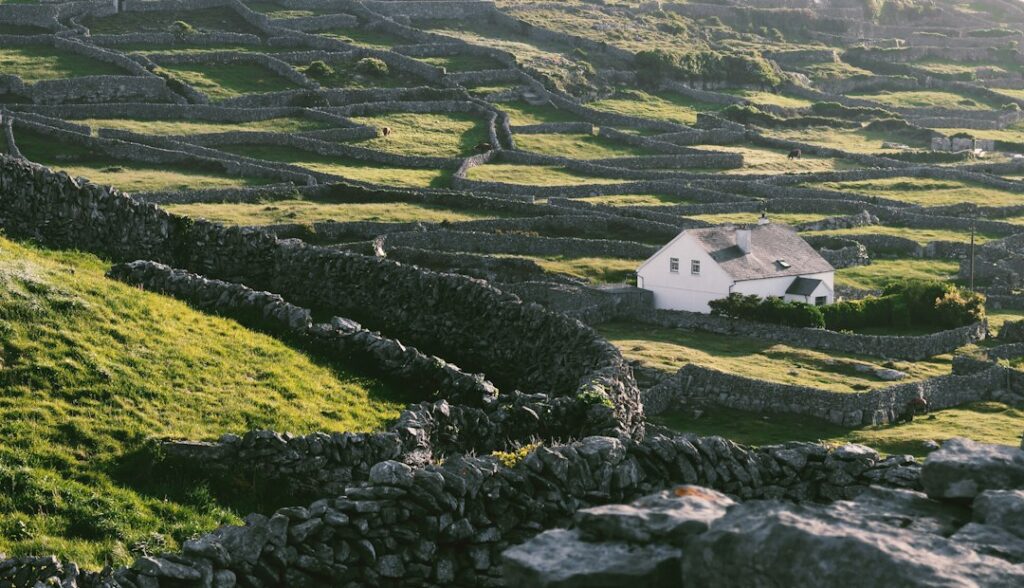
The Burren doesn’t look like it should exist. Stretching across 250 square kilometers of north Clare, this vast plateau of pale limestone looks more like the surface of another planet than the green heart of Ireland. Oliver Cromwell’s men famously complained there wasn’t enough wood to hang a man, nor water to drown him, nor soil to bury him. They were wrong on all counts — but they’d never looked closely enough.
Because the Burren is one of the most botanically rich landscapes in Europe, a geological wonder that draws botanists, archaeologists, and wanderers who understand that barren and beautiful are not opposites.
A Landscape Carved by Ice and Time
The Burren’s limestone formed over 350 million years ago on a tropical seabed. Then came the ice. Glaciers scraped the land clean, leaving behind a karst landscape of horizontal slabs called clints, separated by deep fissures called grikes. Rain did the rest, dissolving the limestone into one of the finest examples of karst topography anywhere.
What looks empty from a distance reveals itself up close as a cracked, layered world. Walk carefully across the pavement and you’ll peer into grikes where ferns, mosses, and wildflowers thrive in microclimates sheltered from wind and grazing. The stone holds heat. The grikes hold moisture. And the result is botanical chaos — in the best possible way.
Where Arctic Meets Alpine
This is where the Burren earns its reputation. Mountain avens, normally found in Arctic tundra, grow alongside Mediterranean orchids. Bloody cranesbill blooms next to spring gentian, a vivid blue flower so rare it’s become the Burren’s signature. In late May and June, the limestone comes alive with color — over 70% of Ireland’s native flora appears here, including 23 of the country’s 27 native orchid species.
It shouldn’t work. Arctic-alpine plants and heat-loving Mediterranean species don’t share space anywhere else in the world. But the Burren’s quirks — the warmth of the stone, the shelter of the grikes, the mild Gulf Stream climate — create conditions for an ecological miracle. Botanists call it “the Fertile Rock.”
Ancient Monuments in Stone
Humans have lived in the Burren for over 6,000 years, and they left their mark. The landscape is dense with history: over 70 megalithic tombs, 500 ring forts, and countless ancient field walls that still divide the stone. Poulnabrone Dolmen, the Burren’s most photographed monument, stands stark against the sky — a portal tomb built around 3,800 BC, older than the pyramids, older than Stonehenge.
The bodies of at least 33 people were placed inside Poulnabrone over a thousand years. Standing beneath its capstone today, you feel the weight of time. The stone is cool. The wind is constant. And the Burren, indifferent to centuries, simply endures.
There are also over 60 wedge tombs scattered across the plateau, including the well-preserved examples at Gleninsheen. Walk the green roads — ancient pathways that thread through the rock — and you’ll stumble on cairns, stone forts, and the remains of settlements whose inhabitants farmed this supposedly barren ground.
Walking the Burren
The best way to understand the Burren is on foot. The Burren Way is a 123-kilometer waymarked trail that loops from Lahinch to Corofin, but you don’t need to walk the whole route to get a feel for the landscape. Shorter loops around Mullaghmore Mountain or the trails near the Burren Perfumery offer stunning views and close encounters with the stone.
For wildflowers, visit between May and August. For solitude, come in autumn or winter when the light is low and the plateau feels infinite. And for guidance, consider a walking tour with a local guide — people like Tony Kirby of Heart of Burren Walks or Shane Connolly, who know every plant, tomb, and story hidden in the rock.
Don’t miss Aillwee Cave, one of the oldest caves in Ireland, where underground rivers carved passages through the limestone. Or the Burren Centre in Kilfenora, where you can get your bearings before heading out into the stone. And if you’re driving, take the Corkscrew Hill road from Ballyvaughan — the views over Galway Bay are worth the hairpin turns.
Why It Matters
The Burren is a reminder that emptiness can be deceptive. What looks barren holds rare beauty. What seems lifeless shelters ecosystems found nowhere else. It’s a landscape that demands attention, patience, and a willingness to look closely.
It’s also fragile. Visitors are asked to walk only on marked paths and existing stone, to leave no trace, and to respect the rare plants that make the Burren what it is. This is not a place to rush through. It’s a place to sit with, to walk slowly, and to let surprise you.
Want more stories from Ireland’s wildest corners, delivered to your inbox daily? Subscribe to the Ireland Moments newsletter — a daily celebration of Ireland’s places, culture, history, and the details that make the Emerald Isle unforgettable.