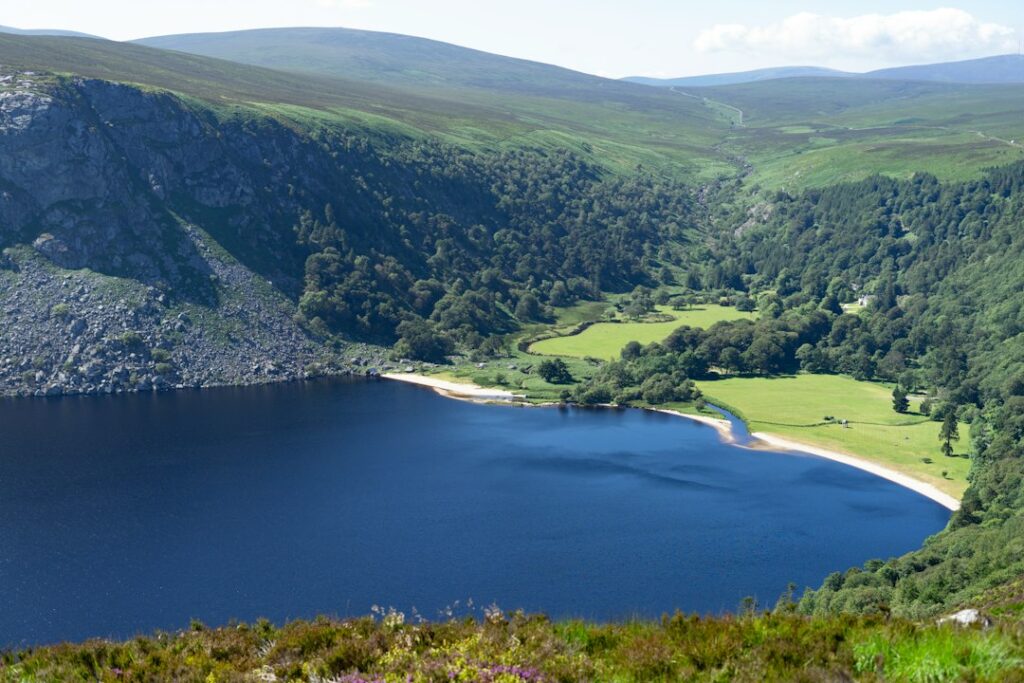
There are places in Ireland where history, nature, and something harder to name come together so perfectly that you feel it the moment you arrive. Glendalough is one of them. The name means “valley of the two lakes” in Irish, and while that’s accurate, it barely scratches the surface of what makes this glacial valley in the Wicklow Mountains so magnetic.
Founded by Saint Kevin in the 6th century, Glendalough became one of Ireland’s most important monastic cities, a center of learning and spirituality that drew pilgrims from across Europe. Today, it still draws people by the thousands—not for religious pilgrimage necessarily, but for something just as powerful: a chance to walk among ruins that have stood for more than a millennium, to hike trails that climb into the clouds, and to stand beside dark, still water surrounded by mountains.
The Monastic City That Time Preserved
The monastic settlement at Glendalough is one of the best-preserved in Ireland. The round tower, standing 30 meters tall and more than 1,000 years old, is the site’s unmistakable landmark. Built as a bell tower and refuge during Viking raids, it’s a masterpiece of medieval engineering—perfectly tapered, doorway raised high off the ground, and still standing straight after centuries of wind and weather.
Walk through the stone gateway, one of the only surviving monastic gateways in Ireland, and you enter what was once a thriving city. The roofless cathedral, built in the 10th and 11th centuries, dominates the lower site. Nearby, St. Kevin’s Church—nicknamed “St. Kevin’s Kitchen” because of its stone roof and miniature round tower—is smaller but perfectly intact, a gem of Romanesque architecture.
Scattered across the valley are other churches, Celtic crosses, and gravestones so old their inscriptions have faded into whispers. The Priest’s House, a 12th-century building that once sheltered relics, still holds carved stones that hint at the artistry and devotion of the monks who lived here.
The Twin Lakes and the Hermit’s Bed
Beyond the monastic city, the valley opens up to reveal the two glacial lakes that give Glendalough its name. The Lower Lake sits close to the ruins, calm and accessible, framed by oak and birch woods. But it’s the Upper Lake, a short walk further into the valley, that stops people in their tracks.
Surrounded by steep forested slopes and sheer rock faces, the Upper Lake feels remote and timeless. On a still morning, the water mirrors the sky and mountains so perfectly it’s hard to tell where one ends and the other begins. This is where Saint Kevin is said to have lived as a hermit in a cave high on the cliff face—a spot now known as St. Kevin’s Bed, accessible only by boat or a very brave climb.
Legend says Kevin lived there in solitude, praying and fasting, until his reputation for holiness drew followers who refused to leave him alone. Whether or not you believe the stories, standing beside the Upper Lake, looking up at that impossible perch, makes the legend feel entirely plausible.
Trails That Climb Into the Wicklow Mountains
Glendalough isn’t just a place to look at—it’s a place to walk. The valley is the gateway to some of the best hiking in the Wicklow Mountains, with trails ranging from easy lakeside strolls to full-day climbs.
The Wicklow Way, Ireland’s oldest long-distance trail, runs right through Glendalough. You can pick it up for a few hours or a few days. The Spink Trail is a local favorite: a steep loop that climbs the cliffs above the Upper Lake, offering views so dramatic they’ve graced a thousand postcards. In spring, the woodland paths are carpeted with bluebells. In autumn, the valley glows amber and gold.
For something easier, the Green Road is a gentle old miners’ path that follows the valley west toward the abandoned lead and zinc mines at Glendasan. It’s quiet, shaded, and perfect for families or anyone who wants to walk without the climb.
A Place That Stays With You
Glendalough is less than an hour’s drive from Dublin, which makes it one of the most visited sites in Ireland. But even with the crowds, especially in summer, the valley holds its quiet power. Arrive early or late in the day, and you’ll have the ruins and trails mostly to yourself. The light slants differently then—golden on the stones, silver on the water—and the valley feels like it must have felt to Kevin all those centuries ago.
Whether you come for the history, the hiking, or simply to stand beside an ancient lake in the mountains, Glendalough has a way of staying with you long after you leave.
Want more stories from Ireland’s most beautiful and storied places? Subscribe to the Ireland Moments newsletter—a daily celebration of the Emerald Isle, delivered to your inbox.