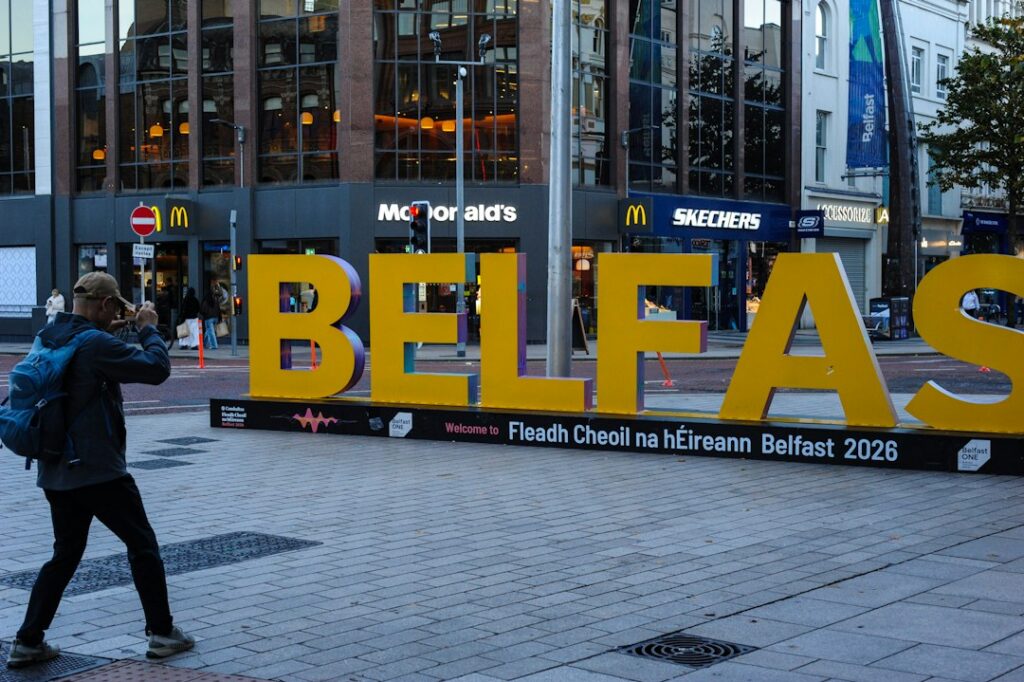
Belfast doesn’t ask for your approval. It earns it. This is a city that built the world’s most famous ship, survived decades of hardship, and emerged as one of Ireland‘s most compelling destinations—a place where industrial heritage meets creative energy, where Victorian elegance frames modern ambition, and where every corner tells a story of transformation.
Sitting at the head of Belfast Lough, framed by Cave Hill and the surrounding drumlins, Belfast combines the grit of a working port with the grace of a cultural capital. It’s a city that rewards curiosity, serves exceptional food, and never pretends to be anything other than itself.
The Cranes That Built a Legend
Samson and Goliath—the twin yellow cranes that dominate Belfast’s skyline—are more than industrial relics. They’re symbols of a city that built ocean liners, commercial vessels, and the most famous ship in history. The Titanic Quarter, where the ill-fated liner was constructed and launched in 1912, has been reimagined as a waterfront district anchored by the Titanic Belfast museum.
The museum itself—a glittering angular building clad in aluminum shards—sits on the exact spot where the ship was designed. Inside, nine galleries take you from the drawing board to the ocean floor, using interactive exhibits, reconstructed cabins, and the original shipyard slipways. Standing on the very dock where Titanic left dry land is a moment that connects you directly to Belfast’s swagger and ambition at the height of the industrial age.
But the Titanic Quarter isn’t stuck in the past. The surrounding streets are now home to film studios (where Game of Thrones was partly shot), tech companies, apartments, and the SS Nomadic—Titanic’s tender ship and the last White Star Line vessel still afloat.
A City Built in Victorian Confidence
Central Belfast is a masterclass in Victorian architecture. City Hall, opened in 1906, dominates Donegall Square with its green copper dome and Portland stone façade. Inside, marble staircases, stained glass windows, and whispering gallery arches make it one of Ireland’s finest civic buildings. Free tours reveal the Council Chamber, the Great Hall, and stories of the linen barons and shipbuilders who funded it all.
Walk north along Donegall Place and you’ll find more evidence of Belfast’s 19th-century wealth: the ornate Crown Liquor Saloon with its gas lamps and snugs, the Grand Opera House with its gilt and red velvet, and St. George’s Market—a brick-and-iron Victorian market hall that still thrives every Friday, Saturday, and Sunday with local produce, street food, crafts, and live music.
The Cathedral Quarter, once the heart of the newspaper trade, is now Belfast’s bohemian center. Cobbled streets, street art, independent bars, and the MAC (Metropolitan Arts Centre) make it the place to catch live music, theater, comedy, and exhibitions. It’s where the city’s creative pulse is loudest.
Murals, History, and the Black Taxi Tour
Belfast’s political murals are part of the city’s DNA. Concentrated in neighborhoods like the Falls Road and Shankill Road, these large-scale paintings document decades of conflict, identity, and hope. A Black Taxi tour—led by local drivers who lived through the Troubles—offers context, nuance, and personal stories that no guidebook can match.
You’ll see the Peace Wall (still standing, covered in messages from visitors worldwide), memorials to those lost, and newer murals celebrating figures like Frederick Douglass, who visited Belfast in 1845. These tours don’t shy away from difficult history, but they also show a city that has chosen dialogue, creativity, and forward movement.
Food, Drink, and the Best of Both Traditions
Belfast’s food scene has exploded in recent years. St. George’s Market is the place to start—grab a breakfast bap, sample local cheeses, or try Irish stew from one of the hot food stalls. For sit-down meals, OX on Oxford Street serves Michelin-starred modern Irish cuisine, while Mourne Seafood Bar on Bank Street specializes in oysters, mussels, and whatever came off the boat that morning.
The city’s pub culture is strong. The Crown Liquor Saloon is a National Trust property and a working pub—order a pint of Guinness and settle into one of the carved wooden snugs. Kelly’s Cellars, dating to 1720, is Belfast’s oldest pub and still pulls a perfect pint. For whiskey lovers, the Titanic Distillers tasting room offers spirits made in Belfast for the first time in nearly a century.
Cave Hill and the Giant’s Ring
Just outside the city center, Cave Hill rises 1,200 feet above Belfast, offering panoramic views of the lough, the city, and the Scottish coast on clear days. The hill’s profile—known as Napoleon’s Nose—inspired Jonathan Swift’s Gulliver’s Travels. The walk to the summit takes about an hour and passes McArt’s Fort, an ancient hill fort where the United Irishmen swore their oath in 1795.
South of the city, near Shaw’s Bridge, the Giant’s Ring is a massive Neolithic henge—a circular earthwork 600 feet across with a dolmen at its center. It’s one of Ireland’s most atmospheric ancient sites and rarely crowded, even on weekends.
A City That Keeps Moving Forward
Belfast doesn’t trade on charm or quaintness. It offers something rarer: authenticity, energy, and a story still being written. Whether you’re tracing Titanic’s legacy, exploring political history, eating your way through St. George’s Market, or hiking Cave Hill at sunrise, you’re engaging with a city that has earned every bit of its confidence.
Want more stories celebrating Ireland’s cities, culture, and hidden corners? Subscribe to the Ireland Moments newsletter—a daily celebration of the island we love, delivered to your inbox every morning.