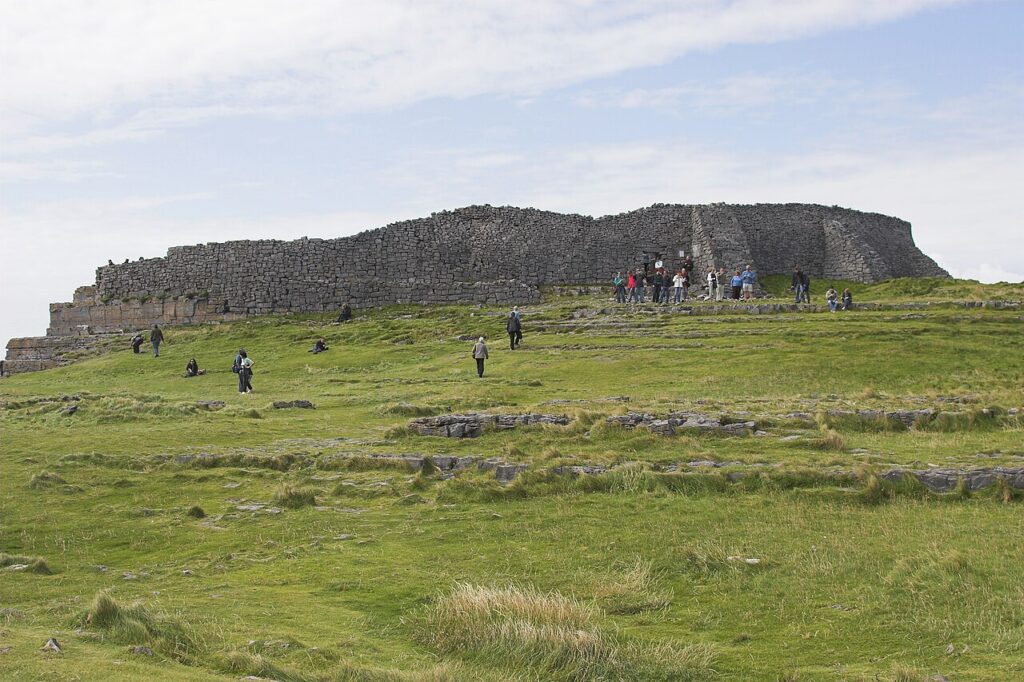
Three thousand years ago, someone decided the best place to build a fort was on the edge of a 300-foot cliff, with nothing between the stone walls and America but cold Atlantic air. That fort is Dún Aonghasa, and it still commands the western edge of Inishmore, the largest of the Aran Islands, like it’s been waiting for you all along.
This isn’t a castle with turrets and tapestries. It’s a semicircular stone fort—three concentric rings of drystone walls, built without mortar, fitted so tightly that wind and time haven’t brought them down. The inner enclosure opens to the cliff edge, where the land just stops. Stand there on a clear day and you’ll understand why this place has pulled people to its edge for millennia.
What Makes Dún Aonghasa So Extraordinary
Dún Aonghasa is one of the finest prehistoric stone forts in Europe. It dates to the late Bronze Age or early Iron Age—somewhere around 1100 BC—though some believe parts of it are even older. No one knows exactly who built it or why. Some say it was a ceremonial site. Others argue it was a defensive stronghold. Either way, it’s a feat of engineering and endurance.
The outermost wall is mostly rubble now, but the middle and inner walls still stand strong, some sections reaching 13 feet high and 13 feet thick. Between the middle and outer walls, you’ll find a chevaux de frise—a field of jagged limestone slabs, standing upright like teeth, designed to slow down attackers or livestock. It’s one of the best-preserved examples in Ireland.
The fort covers about 14 acres, but the real drama is at the inner wall. Walk through the narrow stone entrance, cross the grassy enclosure, and you’ll reach the cliff edge. There’s no barrier, no railing—just rock, sky, and a sheer drop to the waves below. The view is staggering: the Cliffs of Moher to the southeast, the hills of Connemara to the north, and the endless Atlantic stretching west.
Getting There and What to Expect
Inishmore is accessible by ferry from Rossaveal or Doolin, or by a short flight from Connemara Airport. The island itself is small—about nine miles long—and most visitors rent a bike, hire a minibus, or walk. Dún Aonghasa is about four miles west of Kilronan, the island’s main village.
The walk from the visitor center to the fort takes about 20 minutes uphill along a stone path. It’s steep in places, but manageable for most fitness levels. Wear good shoes—the stone can be slippery, especially after rain—and bring layers. The wind at the cliff edge is no joke.
The site is managed by the Office of Public Works, and there’s a small admission fee (around $5 USD). The visitor center offers context on the fort’s history, the archaeology of the Aran Islands, and the people who’ve lived here for thousands of years. It’s worth a stop before you climb.
Why It Still Matters
Dún Aonghasa isn’t just old. It’s a living link to a time when Ireland’s people built with stone, lived close to the land, and chose the most dramatic, unforgiving places to make their mark. The fort has survived storms, erosion, and the slow work of time because it was built with care and intention.
Standing at the edge, you feel the scale of it—the sky, the sea, the stone underfoot. It’s humbling and exhilarating at once. Photographers come for the light. Historians come for the walls. Everyone else comes for the view and leaves with something they didn’t expect: a sense of connection to the people who stood here long before roads or ferries or visitor centers.
The fort has appeared in documentaries, travel features, and countless Instagram feeds, but it’s never crowded in a way that diminishes the experience. Even on busy summer days, the cliff edge offers enough space for solitude.
What Else to See on Inishmore
If you’re making the trip to Inishmore, don’t stop at Dún Aonghasa. The island is dotted with ancient sites: Dún Eochla and Dún Eoghanachta are smaller ring forts with sweeping views. The Worm Hole—Poll na bPéist—is a natural rectangular pool cut into the limestone shore, and it’s hosted Red Bull Cliff Diving events. The Seven Churches, despite the name, is a collection of ruined monastic buildings, not seven actual churches, but it’s atmospheric and worth the walk.
Kilronan has a handful of pubs where you can hear traditional music, eat fresh seafood, and talk to locals who’ll tell you stories about the island that no guidebook includes. Tigh Nan Phaidi and Joe Watty’s are good bets for music and craic.
The island’s roads are lined with stone walls—thousands of miles of them, built by hand over centuries to mark fields and shelter crops from the wind. The landscape is stark, beautiful, and unlike anywhere else in Ireland.
Dún Aonghasa is one of those places that earns its reputation. It’s remote, ancient, and spectacular—a fort on the edge of everything, still standing after three thousand years. If you love Ireland’s wild places and deep history, this is one you don’t miss.
Want more stories from the edge of Ireland? Subscribe to the Ireland Moments newsletter—your daily celebration of the places, music, food, and history that make the Emerald Isle unforgettable.