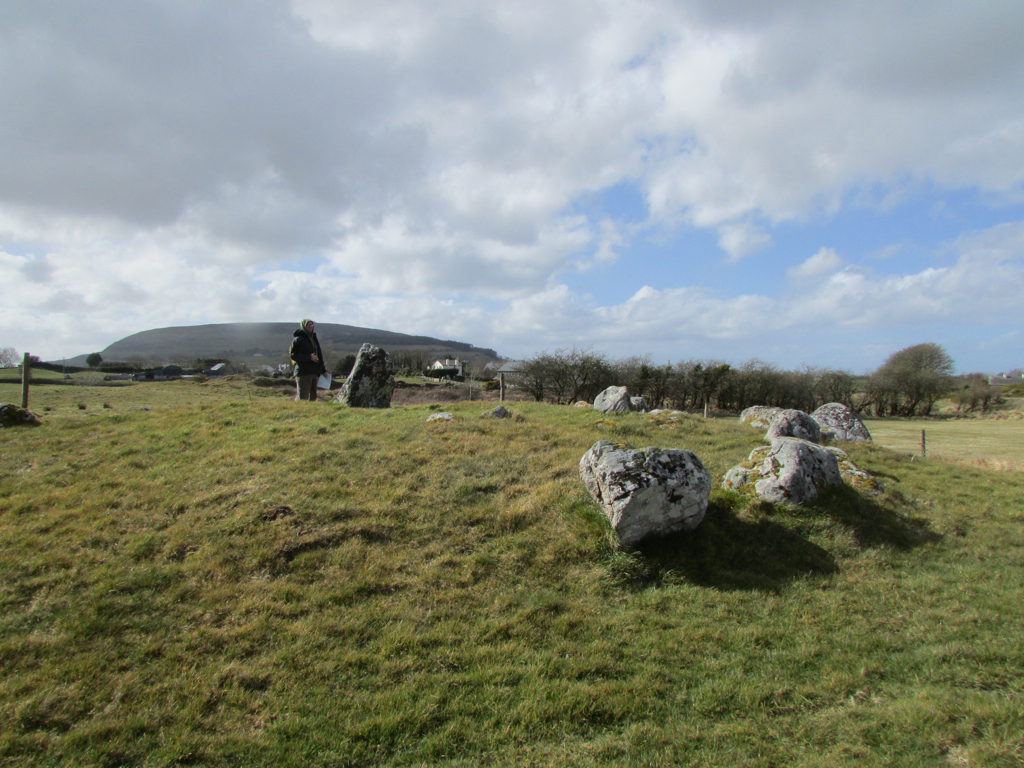
In a green valley beneath the flat summit of Knocknarea, more than 60 ancient tombs lie scattered across the pastures of Carrowmore. This is Ireland’s largest megalithic cemetery, and one of the oldest in Europe. Radiocarbon dating places some of the tombs at over 5,700 years old—older than Newgrange, older than Stonehenge, and roughly contemporary with the earliest Egyptian pyramids.
Yet Carrowmore remains quieter than its more famous neighbors, a place where you can walk among Stone Age monuments with nothing but birdsong and the wind off Sligo Bay for company.
A Neolithic Landscape
Carrowmore sits at the heart of a larger prehistoric landscape. To the west, the cairn of Queen Maeve crowns Knocknarea’s summit. To the east, the great passage tomb of Carrowkeel overlooks from the Bricklieve Mountains. And all around, the tombs of Carrowmore form a constellation of stone circles, dolmens, and passage graves—each one a portal into Ireland’s deepest past.
The tombs themselves are modest compared to the grandeur of Newgrange. Most are simple passage tombs surrounded by low stone circles, their capstones balanced on uprights like ancient furniture left out in the fields. The largest and most intact is Tomb 51, known as Listoghil, which stands at the center of the complex. Inside, a short passage leads to a cruciform chamber lit by a modern skylight—an echo of the solar alignment that once marked the winter solstice here, just as it does at Newgrange.
What Carrowmore lacks in scale, it makes up for in intimacy. You can walk right up to most of the monuments, run your hand along the glacial boulders, and peer into the chambers where Ireland’s first farmers laid their dead to rest. The stones are pocked with lichen and weathered by millennia, but they still hold their ground.
Who Built Carrowmore?
The people who built Carrowmore were farmers, arriving in Ireland around 4000 BCE as part of the great Neolithic expansion that swept across Europe. They brought wheat, barley, cattle, and sheep—and a tradition of building monuments to honor their ancestors. Carrowmore was their cathedral, their family plot, and their claim to the land.
Excavations have uncovered cremated human remains, stone tools, pottery, and offerings of quartz and chalk. The dead were placed in the tombs, often with grave goods, and the chambers were sealed. Over generations, the cemetery grew, each family adding its own stone circle to the landscape. By the time the Bronze Age arrived, Carrowmore was already ancient—a sacred ground layered with memory.
The site was rediscovered in the 17th century, and by the 19th century, antiquarians were digging into the tombs with more enthusiasm than care. Many stones were removed for building material, and several tombs were destroyed. What survives today is a fraction of what once stood here—but it’s enough to feel the weight of deep time.
Visiting Carrowmore
Carrowmore Megalithic Cemetery is located about three miles southwest of Sligo town, clearly signposted off the N4. The visitor center is small but excellent, with displays on Neolithic life, the construction of the tombs, and the wider archaeological landscape of County Sligo. Admission is around $5, and guided tours are available in summer.
The site is mostly open pasture, so wear good shoes and be ready for wind. A marked trail loops through the main cluster of tombs, with interpretive signs at each one. Plan to spend at least an hour—longer if you want to sit quietly and let the place settle around you.
If you’re making a day of it, climb Knocknarea to visit Queen Maeve’s Cairn (a steep but rewarding hike), or drive east to Carrowkeel for more tombs and one of the finest views in Ireland. Sligo town itself is worth exploring, with its Yeats connections, lively music scene, and excellent pubs.
Why It Matters
Carrowmore is a reminder that Ireland’s story begins long before Celts, monks, or castles. It begins with people who cleared forests, planted crops, and built in stone—people who looked at death and decided it demanded architecture. These tombs are Ireland’s oldest surviving structures, and they still command respect.
Standing among the stones at Carrowmore, you’re not looking at history. You’re standing in it. The same hills rise in the distance. The same rain falls. And beneath your feet, the bones of Ireland’s first farmers lie in the dark, waiting for no one.
Love stories like this? Subscribe to the Ireland Moments newsletter for a daily celebration of Ireland—its places, culture, music, and the moments that make the Emerald Isle unforgettable.