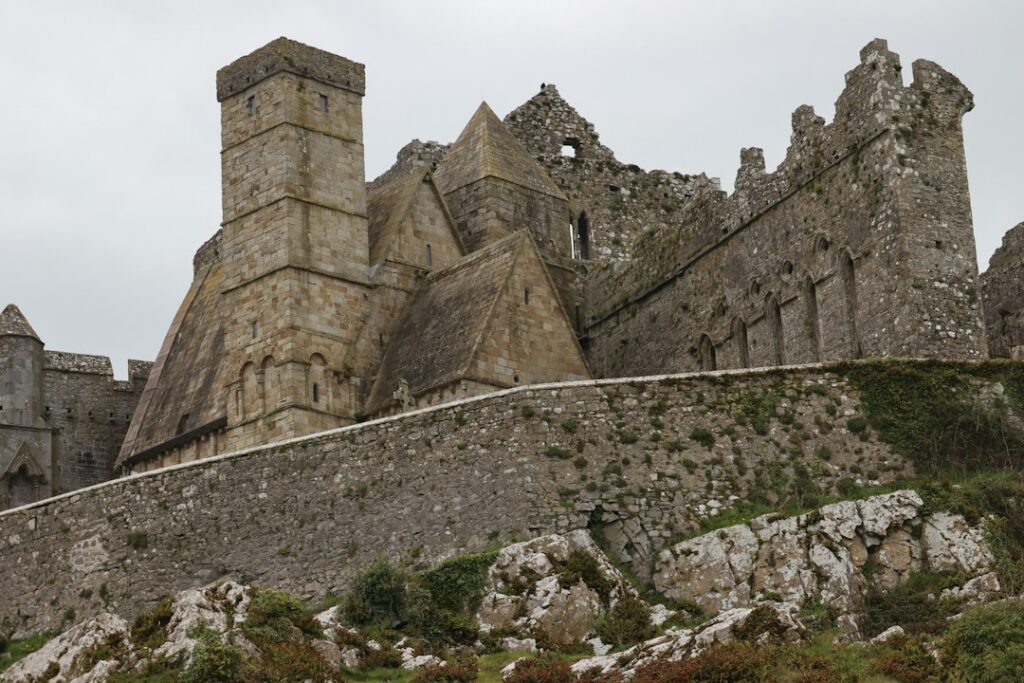
The Rock of Cashel announces itself from miles away. Rising abruptly from the flat plains of County Tipperary, this limestone outcrop crowned with cathedral ruins, round tower, and Celtic cross commands the skyline like no other Irish monument. For over a thousand years, it served as the seat of Munster’s high kings, a powerhouse of early Christianity, and a symbol of Ireland’s layered past.
Today, it stands as one of Ireland’s most visited heritage sites—and for good reason. The Rock is not a single building but a complex of structures spanning centuries, each telling its own story. Walk through the gates, and you’re stepping into the heart of medieval Ireland.
The Seat of Kings and Saints
Cashel’s history begins in the 4th century, when the Eóghanachta dynasty claimed the rock as their royal seat. Legend says St. Patrick himself baptized King Aengus here in 450 AD, accidentally piercing the king’s foot with his crozier—a wound Aengus bore in silence, believing it part of the Christian rite.
By the 12th century, Cashel had become a major ecclesiastical center. In 1101, King Muirchertach Ua Briain handed the Rock over to the Church, and construction began on the grand structures that survive today. Cormac’s Chapel, consecrated in 1134, is the jewel of the complex—a Romanesque masterpiece with intricate carvings, blind arcades, and a steeply pitched stone roof. Its twin towers and preserved frescoes make it one of Ireland’s finest medieval buildings.
The 13th-century Gothic cathedral dominates the site, its roofless nave open to the sky. Stand inside and look up—the soaring arches and lancet windows frame clouds and blue, turning ruin into art. The round tower, dating to around 1100, is one of the best-preserved in Ireland, its conical cap still intact.
What to See and Experience
Start at the base and walk the path up to the Rock. The approach alone is half the experience—views stretch across the Golden Vale to the Galtee Mountains, and the scale of the fortifications becomes clear. The outer walls, added in the 15th century, enclose the entire plateau.
Inside, explore Cormac’s Chapel first. Its weathered sandstone carvings depict biblical scenes and mythical beasts, while traces of original frescoes survive in the chancel. The sarcophagus said to hold King Cormac Mac Cárthaigh rests near the entrance.
The cathedral’s crossing tower offers the best vantage point—though now off-limits for safety, you can still appreciate its commanding height from below. The Hall of the Vicars Choral, a restored 15th-century building at the entrance, houses original High Crosses, including the intricately carved Cross of St. Patrick.
Don’t miss the round tower. Though you can’t climb it, its positioning and preservation make it a photographer’s dream. The graveyard surrounding the complex holds centuries of local history, with Celtic crosses and weathered headstones leaning at dramatic angles.
Visiting the Rock
The Rock of Cashel is open year-round, with extended hours in summer. Admission is around $10 for adults, with discounts for seniors and students. Guided tours are included and highly recommended—the guides bring the stones to life with stories of kings, bishops, and sieges.
Visit early in the morning or late afternoon to avoid crowds and catch the best light. The golden hour turns the limestone gold, and the shadows deepen every carved detail. Cashel town, a five-minute walk from the base, offers cafés, pubs, and shops. Stop at the Cashel Folk Village for a dose of local history, or grab lunch at Mikey Ryan’s Bar, where traditional music sessions run most evenings.
The Rock is an easy day trip from Cork, Limerick, or Kilkenny—each about an hour away. It pairs beautifully with nearby attractions like the Rock of Dunamase, Hore Abbey (a ruined Cistercian monastery visible from the Rock itself), and the Glen of Aherlow.
Why It Matters
The Rock of Cashel is more than a ruin—it’s a symbol of Irish identity. It witnessed the transition from pagan kingship to Christian authority, survived Viking raids and English sieges, and endured Cromwell’s assault in 1647. Its stones have absorbed centuries of prayer, power, and poetry.
To stand on the Rock is to stand where kings knelt and bishops preached, where monks illuminated manuscripts and soldiers defended walls. It’s Ireland’s past made visible, a skyline that hasn’t changed in a thousand years.
Whether you’re tracing your heritage, chasing medieval history, or simply drawn to dramatic landscapes, Cashel delivers. It’s the kind of place that stays with you long after you leave—a limestone throne above the Golden Vale, still commanding attention, still telling its story.
Want more stories from Ireland’s ancient heart? Subscribe to the Ireland Moments newsletter—a daily celebration of the people, places, and traditions that make the Emerald Isle unforgettable.