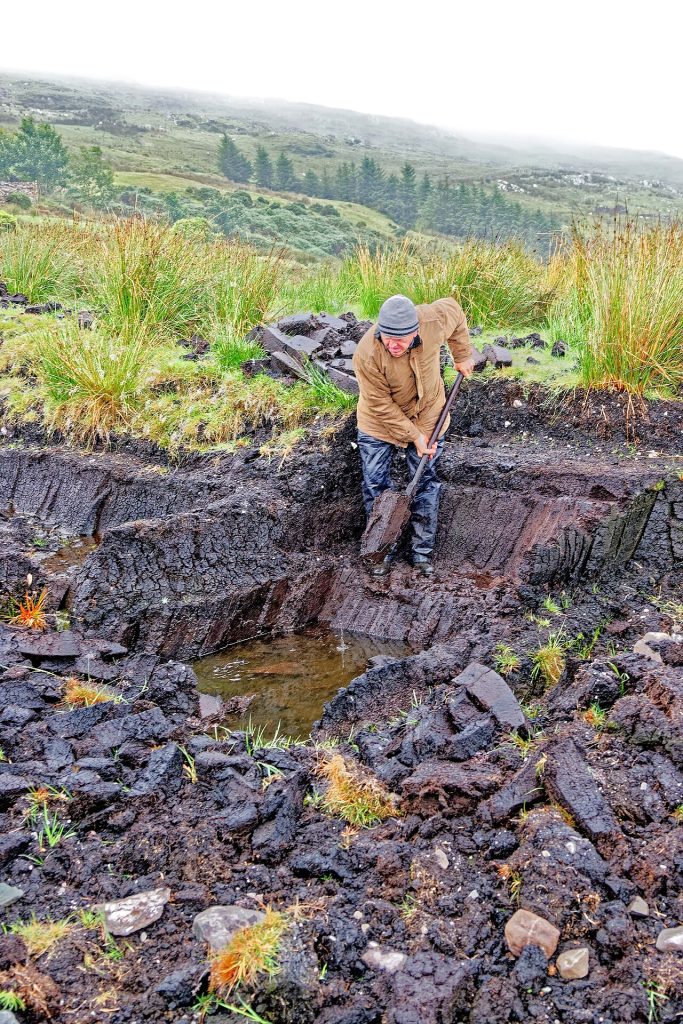
There’s a particular smell that defines rural Ireland in late spring and early summer—the earthy, almost sweet scent of turf smoke curling from cottage chimneys. It’s the smell of peat, cut from the bogs that blanket much of the Irish countryside, dried under uncertain skies, and burned through long winter evenings. For generations, turf cutting wasn’t just a tradition. It was survival.
Today, while fewer families depend entirely on turf for heat, the practice endures as both practical necessity and cultural touchstone. Understanding how turf is cut, dried, and burned offers a window into Ireland’s relationship with its landscape—one shaped by necessity, community, and a deep respect for what the land provides.
What Is Turf and Why Does It Matter?
Turf, or peat, forms over thousands of years in Ireland’s waterlogged bogs. Layers of decomposed plant material—primarily sphagnum moss—compress into dense, dark blocks that burn slowly and steadily. Before coal became widely available, and long before oil or gas, turf was Ireland’s primary fuel source.
The boglands themselves cover roughly 17% of Ireland’s surface, concentrated in counties like Mayo, Galway, Kerry, Offaly, and Donegal. These bogs are ancient ecosystems, some dating back 10,000 years. They’re also cultural archives—preserved butter, ancient roadways, and even Iron Age bodies have been found perfectly preserved in their acidic, oxygen-poor depths.
Cutting turf from these bogs connects modern Ireland to its agrarian past. It’s physical work, weather-dependent, and requires knowledge passed down through families. The tradition also fosters community—turf cutting is rarely a solo endeavor.
How Turf Is Cut: The Work of May and June
Turf cutting begins in late April or May, when the ground firms up enough to work but before summer growth makes access difficult. The tool of choice is the sleán, a narrow, wing-shaped spade designed specifically for slicing cleanly through peat.
A skilled cutter works methodically. The sleán is driven vertically into the bog, then leveraged to lift out a brick-shaped sod. Each cut turf, called a sod or a brick, measures roughly 12 inches long, 4 inches wide, and 4 inches deep. The sods are tossed up onto the bank, where they’ll begin the slow process of drying.
In County Mayo and parts of Connemara, you’ll still see families working their traditional turf banks—narrow trenches carved into the bog over generations. It’s backbreaking work, but there’s a rhythm to it. Conversations unfold between cuts. Flasks of tea appear mid-morning. Children learn by watching, then by trying.
Once cut, the turf must dry. This takes weeks, sometimes months, depending on the weather. The sods are first spread flat to air-dry, then stacked in small pyramids called footings or rickles to allow air circulation. By late summer, if the weather cooperates, the turf is dry enough to be brought home and stacked in a turf shed or rick beside the house.
Where to See Turf Cutting and Bogland Heritage
If you want to experience turf cutting firsthand or learn more about Ireland’s boglands, a few places offer exceptional insight.
The Céide Fields in north County Mayo combine one of the world’s oldest field systems with a landscape still actively worked for turf. The visitor center explains both the ancient Neolithic farms buried beneath the bog and the modern relationship communities maintain with these lands.
In County Offaly, the Lough Boora Discovery Park sits on cutaway bogland—former industrial peat harvesting sites now rewilded and transformed into trails, art installations, and wetland habitats. Nearby, the Irish Peatland Conservation Council offers guided walks that explain bog ecology and the cultural history of turf use.
For a more hands-on experience, several rural heritage centers and working farms in counties Kerry, Galway, and Donegal offer seasonal demonstrations. At places like the Muckross Traditional Farms near Killarney, you can watch turf being cut the old way and hear stories from people who grew up with turf smoke as the scent of home.
The Future of Turf in Ireland
Turf cutting exists today in a complicated space. Environmental concerns about bog preservation and carbon release have led to restrictions on cutting in protected raised bogs. Many families with traditional turbary rights—legal rights to cut turf from specific bogs—have faced difficult choices between heritage and conservation.
Yet in communities across the west and northwest, turf remains part of daily life. For some, it’s still the most affordable way to heat a home. For others, it’s about maintaining a connection to place and family memory. The scent of a turf fire is different from any other—earthy, warm, unmistakably Irish.
Visitors who encounter turf smoke drifting from a pub hearth or a cottage chimney are smelling a practice older than written Irish history. It’s a reminder that Ireland’s landscapes aren’t just scenic backdrops—they’re living, worked, and deeply woven into the rhythms of Irish life.
Want more stories that dig into the heart of Irish tradition? Subscribe to the Ireland Moments newsletter and get a daily celebration of Ireland delivered to your inbox—landscapes, culture, history, and the details that make the Emerald Isle unforgettable.