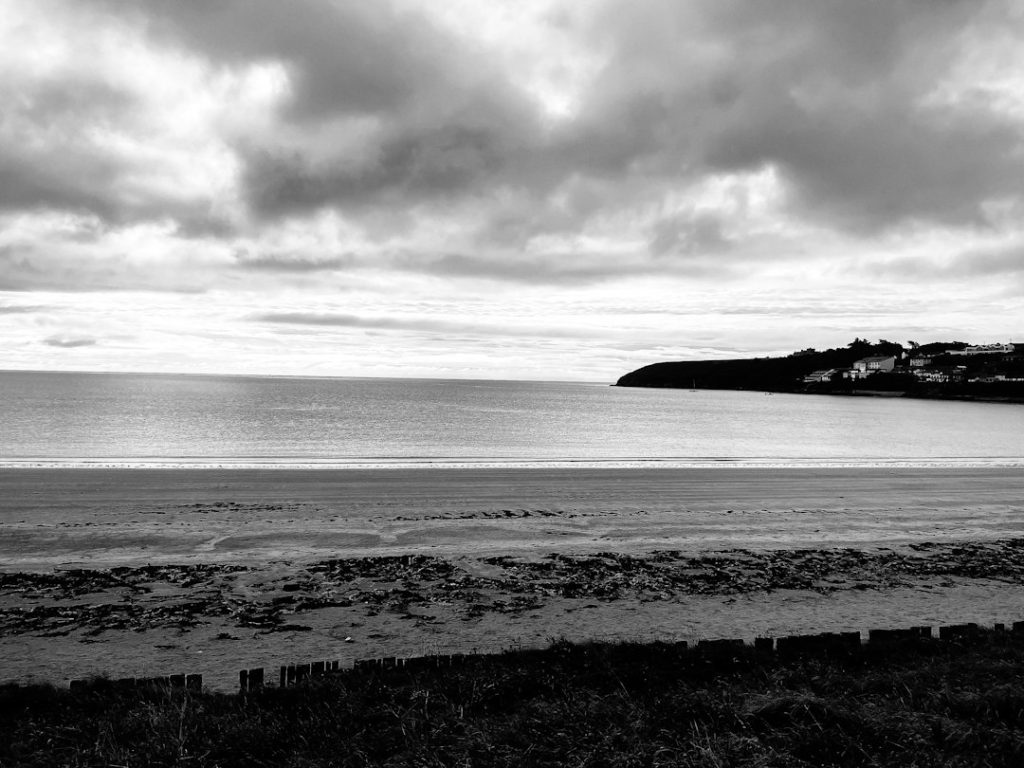
There’s a moment when you round the bend into Ardmore, County Waterford, and everything clicks into place. The Atlantic spreads out in front of you, a 12th-century round tower rises above the village, and the remains of a medieval cathedral sit quietly on the hillside. This isn’t a reconstructed heritage park or a museum behind glass. It’s a living village where Ireland’s oldest Christian settlement still shapes daily life.
Saint Declan arrived here in the early 5th century—possibly before Saint Patrick—and established a monastery that would anchor this coastline for more than 1,500 years. Today, Ardmore remains one of Ireland’s most rewarding stops for anyone who wants history, scenery, and the unhurried rhythm of a working Irish village all in one place.
The Round Tower and Cathedral
Ardmore’s round tower is one of the finest in Ireland. At 95 feet tall, it’s perfectly intact, right down to its conical cap. The tower dates to the 12th century and served as both bell tower and refuge during Viking raids. You can’t climb it, but standing at its base and looking up at the precise stonework is enough to feel the weight of centuries.
Next to the tower sit the ruins of Saint Declan’s Cathedral, built in the 13th century on the site of his original monastery. The western gable is covered in stone carvings—biblical scenes including the Archangel Michael weighing souls, the Fall of Man, and the Adoration of the Magi. These carvings are some of the best-preserved Romanesque sculptures in the country, weathered but still vivid after 800 years.
Inside the graveyard, Saint Declan’s Oratory—a small stone church dating to the 8th century—marks the traditional site of his grave. Pilgrims still visit, especially on his feast day, July 24, when a pattern (a traditional pilgrimage) draws locals and visitors to walk barefoot along the beach and pray at the holy well nearby.
The Cliff Walk
The Ardmore Cliff Walk is a 3-mile loop that hugs the coastline from the village out to Ram Head and back. It’s one of the most accessible and scenic coastal walks in Waterford, with views across to Youghal, the Knockmealdown Mountains inland, and the open Atlantic to the south.
The path is well-maintained and takes about 90 minutes at a steady pace. Along the way, you’ll pass the wreck of the Samson, a crane ship that ran aground in 1987 and still rusts on the rocks below. The headland itself is wild and windswept, with seabirds wheeling overhead and waves crashing against the cliffs. On clear days, the light here is extraordinary—golden in the late afternoon, with the tower and cathedral silhouetted against the sky.
A Village Worth Lingering In
Ardmore isn’t just a heritage site. It’s a village with a Blue Flag beach, a handful of good cafés and restaurants, and a sense of calm that’s hard to find in busier tourist towns. The beach is a wide, sandy crescent that’s popular with families in summer and nearly empty off-season. The water is cold but swimmable, and the views back toward the village and tower are postcard-perfect.
If you’re staying for a meal, the Cliff House Hotel overlooks the bay and offers fine dining with a focus on local seafood, while White Horses serves more casual fare—chowder, fish and chips, brown bread—with outdoor seating in good weather. For a pint, An Tobar is a cozy spot with occasional trad music sessions and a welcoming crowd.
Ardmore also has a working holy well (Tobar Declain), tucked into the hillside near the cathedral. Locals still tie ribbons and leave offerings there, a tradition that stretches back long before Christianity arrived. It’s a quiet, personal place, and visiting it feels like stepping into a continuity that most modern towns have lost.
Why Ardmore Matters
What makes Ardmore special is that it hasn’t been packaged or polished for tourism. The tower stands in an active graveyard. The cliff walk is maintained by locals. The village still functions as a place people live, not just visit. You can walk the same ground Saint Declan walked, see carvings that medieval pilgrims saw, and still grab a coffee and a scone on Main Street.
It’s also refreshingly uncrowded. Even in summer, Ardmore doesn’t see the tour bus traffic of more famous sites. That means you can take your time, sit on the beach, walk the cliffs without jostling for space, and experience the kind of Ireland that feels increasingly rare: beautiful, historical, and still itself.
If you’re planning a trip along Ireland’s southern coast—especially the stretch between Cork and Waterford—Ardmore deserves more than a quick stop. It’s a place to spend a full day, maybe a night, and let the rhythm of the village and the crash of the Atlantic remind you why Ireland’s quiet corners are often the most memorable.
Love stories like this? Subscribe to the Ireland Moments newsletter and get a daily celebration of Ireland—its places, music, history, and heart—delivered straight to your inbox.