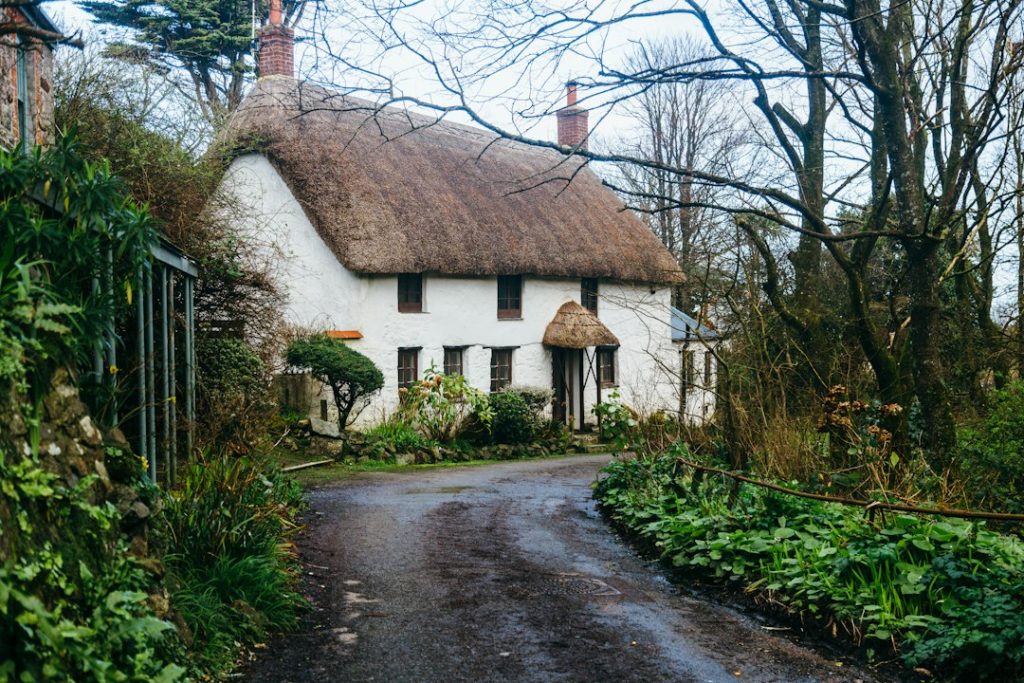
There’s something about a whitewashed cottage with a golden thatched roof that stops you in your tracks. Maybe it’s the soft curve of the ridgeline, the way the thatch seems to grow organically from the walls, or the knowledge that what you’re looking at is both ancient and alive. Ireland’s thatched cottages aren’t museum pieces—they’re working homes, symbols of resilience, and masterpieces of vernacular craft.
Scattered across the countryside from County Kerry to County Donegal, these cottages represent one of Ireland’s most enduring architectural traditions. And while they may look like something out of a fairy tale, there’s serious skill, history, and practicality beneath every golden roof.
The Craft Behind the Thatch
Traditional Irish thatch is made from wheat or oat straw, rye, or water reed—materials that have been used for over a thousand years. The straw is laid in thick bundles, secured with hazel rods called scollops, and stitched into place with tarred twine. A skilled thatcher can work a roof that lasts 15 to 25 years, depending on the material and the weather.
Thatching is a trade passed down through generations. Master thatchers like those still working in County Clare and County Galway learn their craft over decades, understanding not just how to lay straw, but how to read a roof, anticipate wind patterns, and shape a ridge that will shed rain and resist storms. It’s part engineering, part artistry, and entirely tactile.
The thickness of a thatched roof—often two feet or more—provides remarkable insulation. In winter, it keeps cottages warm. In summer, it stays cool. The thatch breathes, allowing moisture to escape, which is one reason these roofs have survived Ireland’s famously damp climate for centuries.
Where to See Ireland’s Best Thatched Cottages
Adare, in County Limerick, is often called Ireland’s prettiest village, and its Main Street is lined with immaculate thatched cottages that date back to the 19th century. Many now house cafés, craft shops, and galleries, but the structures themselves remain true to form.
In County Kerry, the village of Sneem on the Ring of Kerry has several well-preserved examples, as does the nearby Muckross Traditional Farms in Killarney National Park, where working thatched farmhouses show what rural life was like in the 1930s and ’40s.
On Achill Island in County Mayo, you’ll find more rugged versions—low-slung cottages built to withstand Atlantic gales, their thatch weighted with ropes and stones. These homes weren’t built for charm—they were built to survive.
The Ulster American Folk Park in County Tyrone also features reconstructed thatched cottages that tell the story of emigration and rural life in the 18th and 19th centuries.
Why Thatched Roofs Nearly Disappeared
By the mid-20th century, thatched cottages were vanishing. Slate and tin were cheaper, longer-lasting, and required less maintenance. Insurance companies often charged higher premiums for thatched homes due to fire risk. Thatchers themselves were aging out of the trade, and fewer young people were learning the craft.
But in recent decades, there’s been a resurgence. Heritage grants, cultural pride, and a renewed appreciation for traditional skills have brought thatching back. Organizations like the Irish Thatchers Association work to preserve techniques and train new craftspeople. Today, owning a thatched cottage is seen not as a burden, but as a privilege—a way to maintain a connection to Ireland’s rural past.
Living With Thatch Today
Modern thatched cottages aren’t frozen in time. Many have been updated with contemporary interiors, central heating, and Wi-Fi, all while keeping the traditional roof intact. Owners take pride in maintaining their thatch, hiring skilled craftspeople for repairs and re-thatching every couple of decades.
Fire safety has improved dramatically with the use of fire-retardant sprays and updated building codes. Chimneys are lined, spark arrestors are standard, and many homeowners install discreet sprinkler systems beneath the thatch.
The cost of maintaining a thatched roof can run between $8,000 and $15,000 for a full re-thatch, depending on size and materials. It’s not cheap—but for those who live in these homes, the reward is a roof that connects them to centuries of Irish life, a structure that breathes with the seasons, and a home that feels like nowhere else on earth.
If you love Ireland’s landscapes, traditions, and the stories behind them, subscribe to the Ireland Moments newsletter—a daily celebration of the Emerald Isle, delivered straight to your inbox.