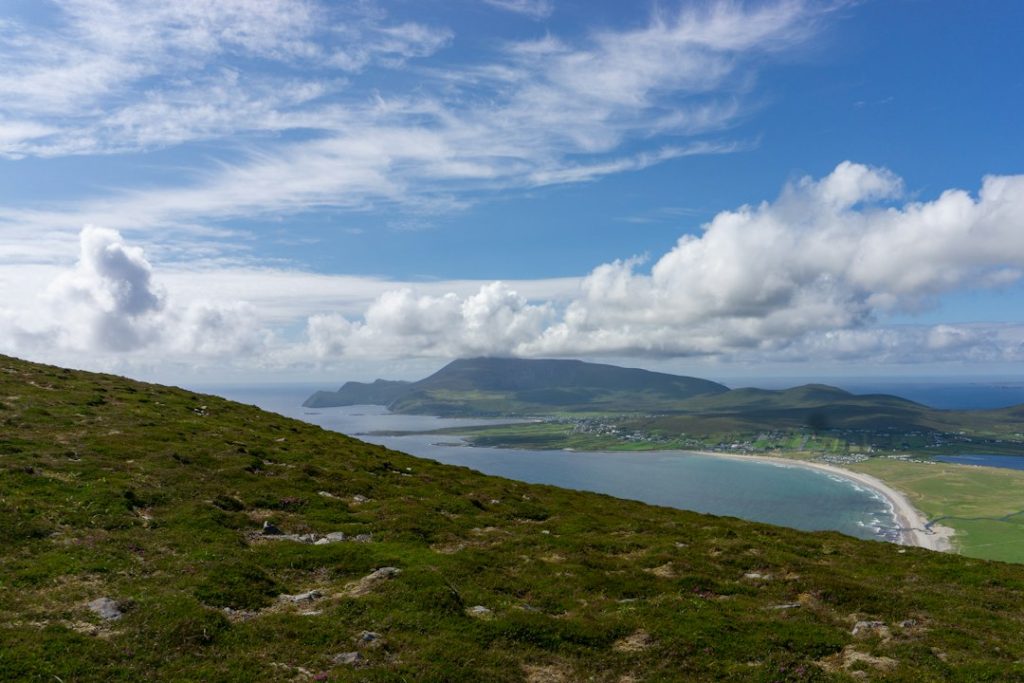
Off the coast of County Mayo, where the Atlantic crashes against Ireland’s western edge, Achill Island rises from the sea like a place forgotten by time. Connected to the mainland by a bridge but feeling utterly remote, this is Ireland’s largest island—and one of its most dramatically beautiful.
Achill stretches across 57 square miles of mountains, moorland, cliffs, and beaches that shift from golden sand to black pebbles within a single coastline. The island’s landscape is severe and stunning, shaped by wind and wave into something that feels both ancient and alive.
Cliffs That Challenge the Atlantic
The Minaun Cliffs on Achill’s southern coast rise 800 feet straight from the ocean, their layered rock faces striped with color—red sandstone, black shale, and grey limestone stacked like geological history. From the cliff-top viewpoint at Ashleam Bay, you can see the Croaghaun cliffs to the west, which tower nearly 2,200 feet above the water, making them among the highest sea cliffs in Europe.
These aren’t manicured attractions with visitor centers and guardrails. They’re raw, windswept edges where you stand alone with the ocean roaring below and nothing between you and North America but three thousand miles of water. On clear days, the views stretch to Clare Island, Inishturk, and the peaks of Connemara across Clew Bay.
Croaghaun is best reached via a steep hiking trail from Keem Bay, and the walk itself—across bogland thick with heather and past abandoned famine villages—tells the story of Achill as powerfully as any guidebook.
Beaches That Belong in Dreams
Achill’s beaches are among Ireland’s finest, and the most stunning is Keem Bay, a horseshoe cove wrapped in cliffs and filled with turquoise water that looks impossibly tropical until you touch it. The sand is soft and pale, the water clear enough to see stones on the bottom, and the setting so cinematic it’s been used in films and postcards for decades.
Keel Beach stretches for two miles along the island’s western edge, a vast expanse of golden sand backed by dunes and the sharp profile of Slievemore mountain. It’s a Blue Flag beach, safe for swimming in summer, and popular with surfers year-round. At low tide, the exposed sandbar creates tidal pools perfect for exploring.
Then there’s Dooagh Beach, quieter and more sheltered, and the extraordinary story of its disappearance and return. In the 1980s, storms stripped the beach of its sand entirely, leaving only rock. Thirty years later, in 2017, a freak storm brought it all back overnight—thousands of tons of golden sand that reappeared as if by magic.
Villages, Ruins, and the Weight of History
Achill’s history is written in stone across the island. The Deserted Village at Slievemore, just above Dooagh, is a haunting collection of over 100 stone cottages abandoned during and after the Great Famine. The roofless homes stretch in a line along the mountainside, their walls still standing, their stories mostly lost. Walking among them—silent except for wind and the occasional bleat of sheep—is to feel the weight of what was endured here.
In the village of Dooagh itself, you’ll find the Achill Experience, an interpretive center housed in a restored cottage that tells the island’s story: from the Neolithic tombs on Slievemore to the seasonal migration of Achill workers—known as “tatie hokers”—who traveled to Scotland each year to harvest potatoes.
The Atlantic Drive, a narrow loop road along the island’s southern coast, winds past tiny settlements, holy wells, and viewpoints where you can pull over and simply stare at the vastness of it all.
A Living Island, Not a Museum
Achill isn’t preserved in amber. It’s a working island with farmers, fishermen, artists, and a small but resilient year-round population. The town of Keel has pubs where you’ll hear traditional music sessions on weekends, cafes serving chowder made from fish caught that morning, and shops stocking woolens knit by local hands.
The island attracts painters, writers, and musicians drawn by the quality of light and the sense of space. Heinrich Böll, the German Nobel laureate, spent summers here and wrote about Achill with deep affection. Graham Greene visited. So did the painter Paul Henry, whose moody, evocative landscapes of Achill helped define how the world sees the west of Ireland.
There’s hiking on Croaghaun, Slievemore, and Achill Head. Sea kayaking from Keem Bay. Surfing at Keel. Dolphin and whale watching off the coast. And in quieter moments, simply walking the boreens—narrow country lanes—where fuchsia blooms wild and stone walls run to the horizon.
Getting There and Staying Awhile
Achill is about two hours from Galway and three from Dublin, accessible via the N59 and then the R319, which crosses the Michael Davitt Bridge onto the island. There’s no need for a ferry—just drive straight on.
Accommodation ranges from guesthouses and B&Bs in Keel and Kildavnet to self-catering cottages with sea views. Prices vary, but expect to pay around $80–$150 per night depending on season and location. Wild camping is tolerated in some areas, though always ask permission and leave no trace.
The best time to visit is May through September, when the weather is mildest and the days longest. But Achill in winter—stormy, dramatic, nearly empty—has its own fierce beauty.
If you love Ireland for its wildness, its history, and its ability to make you feel small in the best possible way, Achill Island will not disappoint. It’s not polished or easy, but it’s real—and unforgettable.
Want more stories from Ireland’s most beautiful corners? Subscribe to the Ireland Moments newsletter and get a daily celebration of the Emerald Isle delivered to your inbox—stories, places, culture, and the magic that makes Ireland unforgettable.