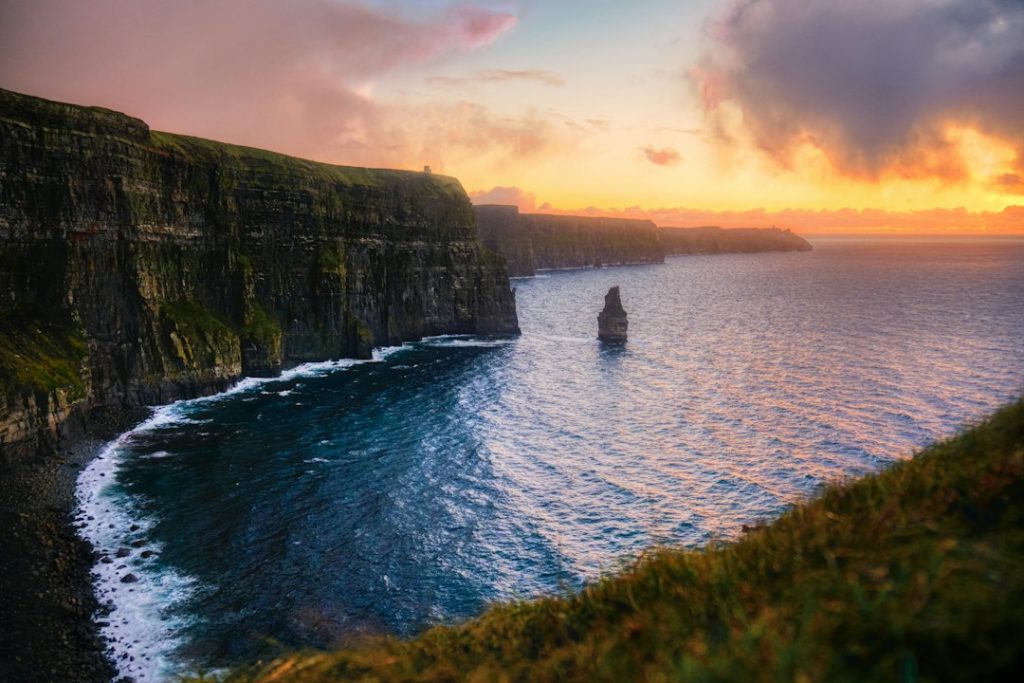
There’s a moment at the Cliffs of Moher when the wind pushes you back from the edge, the Atlantic crashes white against black rock far below, and you realize why five continents’ worth of visitors make the pilgrimage to County Clare every year. These aren’t just cliffs. They’re Ireland’s western rampart, a five-mile wall of layered shale and sandstone that has faced down the ocean for 320 million years.
The Cliffs of Moher rise 702 feet at their highest point near O’Brien’s Tower, stretching from Hag’s Head in the south to just past O’Brien’s Tower in the north. On a clear day—and Clare gives you those more often than you’d expect—you can see the Aran Islands lying low on the horizon, the Twelve Bens mountain range in Connemara, and Loop Head far to the south. On a stormy day, you see something even better: the raw power of the Atlantic doing what it’s done since long before there were people here to watch.
The View That Stops Conversation
Most visitors start at the official visitor center near Liscannor, where a grass-roofed building built into the hillside houses exhibitions, a café, and possibly the most scenic restrooms in Ireland. The paved coastal path leads north and south from here, with viewing platforms and stone walls offering safe vantage points. But it’s when you first round the corner and see the full sweep of the cliffs that conversation stops.
The rock face reveals its age in horizontal bands—dark shale laid down when this was a river delta, sandstone from ancient beaches, all compressed and lifted and carved by ice and sea. Seabirds wheel in the updrafts: puffins in their breeding season from April through July, razorbills, guillemots, and the ever-present gulls. More than 30,000 birds nest here, and their calls mix with the wind and waves into something that sounds like the Earth breathing.
Beyond the Crowds
The main viewing area draws the tour buses, but walk fifteen minutes south toward Hag’s Head or north past O’Brien’s Tower, and you’ll find yourself nearly alone. The coastal path runs for miles in both directions, unfenced and dramatic. This is where you want to be if you’re chasing photographs or solitude—though respect the warning signs. The edge is unstable, the wind unpredictable, and the drop absolute.
O’Brien’s Tower, built in 1835 by local landlord Cornelius O’Brien as a viewing point for Victorian tourists, still serves its purpose. For a few dollars, you can climb the spiral staircase for an even higher perspective. O’Brien had vision: he knew people would come to see this, and he was right.
South of the main site, the trail to Hag’s Head is less traveled and equally spectacular. The sea stack rising from the water is said to resemble the profile of a woman looking out to sea—local legend names her Mal, a witch turned to stone. Real or not, the story fits the landscape.
When to Visit and What to Know
The cliffs are open year-round, and each season offers something different. Summer brings the longest days and the puffins, but also the largest crowds—arrive before 9 a.m. or after 5 p.m. to avoid the rush. Autumn and spring offer dramatic light and fewer people. Winter is wild and moody, with massive swells and the cliffs to yourself, though some coastal paths may close in extreme weather.
Admission to the visitor center and cliff-side paths is around $10 for adults, less for students and seniors, free for children. Parking is included. Dress for wind—always—and bring layers. The temperature at the cliff edge can feel twenty degrees colder than it did in the parking lot.
If you have time, explore the surrounding area. The Burren lies just north, a limestone karst landscape unlike anywhere else in Ireland. The village of Doolin, three miles north, is one of Ireland’s great trad music centers, with nightly sessions at Gus O’Connor’s, McGann’s, and McDermott’s. Liscannor to the south is quieter, with good pubs and the grave of John P. Holland, inventor of the modern submarine, in the local churchyard.
Why They Endure
The Cliffs of Moher could easily feel overrun or commercialized, but they’re too big for that. Stand at the edge, and the human noise falls away. You’re left with stone, sea, sky, and the understanding that this place was magnificent long before the first visitor center and will be magnificent long after the last tour bus leaves.
They’ve appeared in films, on postcards, in a thousand travel dreams. But no image prepares you for the scale, the sound, the way the light changes as clouds race across the Atlantic. The Cliffs of Moher take your breath away every time because they remind you how small you are and how enduring the wild places can be.
Love stories like this? Subscribe to the Ireland Moments newsletter and get a daily celebration of Ireland—its places, culture, music, and magic—delivered to your inbox each morning.