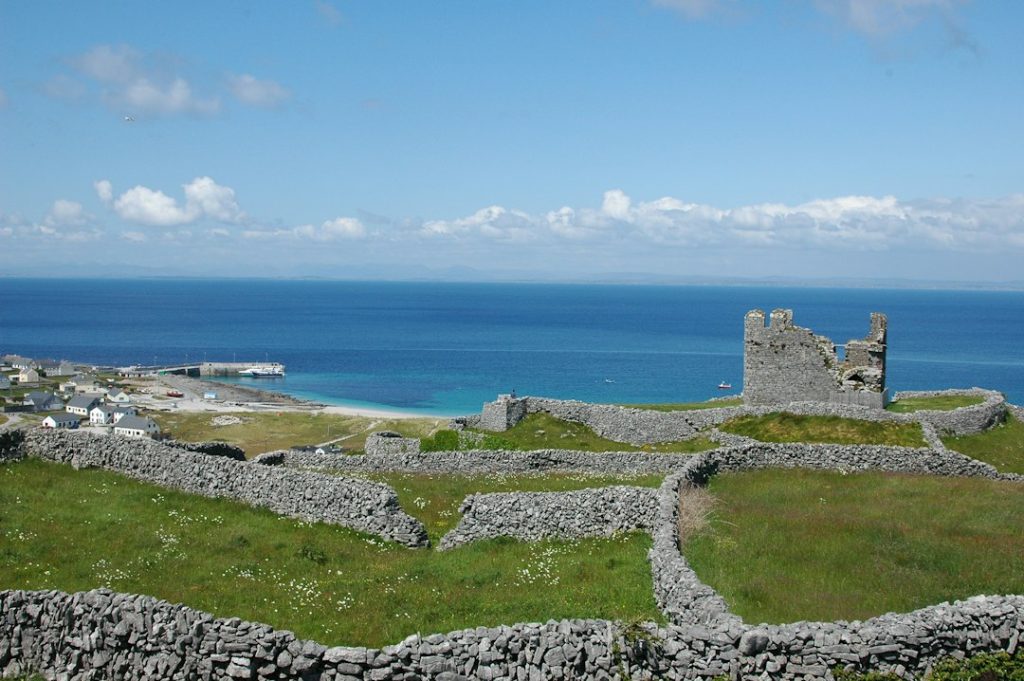
There are places in Ireland where the past doesn’t feel distant—it feels present. The Aran Islands, three limestone outcrops in the mouth of Galway Bay, are among them. Step off the ferry at Kilronan on Inishmore, the largest island, and you’ve crossed more than nine miles of Atlantic. You’ve crossed centuries.
The islands—Inishmore, Inishmaan, and Inisheer—are where Irish is still the first language, where farmers still tend small plots between stone walls, and where ancient forts cling to clifftops as they have for more than 2,000 years. It’s not a theme park. It’s a living, breathing remnant of an older Ireland.
Dún Aonghasa: Europe’s Most Dramatic Iron Age Fort
Perched on the edge of a 300-foot cliff on Inishmore, Dún Aonghasa is one of the finest prehistoric stone forts in Europe. Its semicircular walls—some 13 feet thick—wrap around the cliff edge, opening to nothing but sky and ocean. No one knows exactly why it was built here, or why it faces the sea with such theatrical defiance.
The walk up from the visitor center takes about 20 minutes, winding through fields crosshatched with stone walls. When you reach the fort, you can walk right to the edge—there are no guardrails, just limestone, wind, and vertigo. On a clear day, the Cliffs of Moher are visible to the south. On a stormy one, the waves below sound like thunder.
Archaeologists date the fort to around 1100 BC, though it may be older. It’s part of a network of stone forts across the islands, including Dún Dúchathair (the Black Fort) and Dún Eochla, but Dún Aonghasa is the one that stops your breath.
Stone Walls That Map a Way of Life
The Aran Islands are famous for their stone walls—more than 1,500 miles of them, built without mortar, threading across all three islands. They’re not decorative. They’re essential. The islands have almost no natural soil; what exists was created by islanders over generations, layering seaweed and sand into the cracks between limestone.
The walls divide tiny fields, shelter crops from the Atlantic wind, and mark centuries of backbreaking work. Walking or cycling the narrow roads of Inishmore, you’re never more than a few feet from one. They give the landscape its signature texture—a patchwork of gray stone and green grass that looks, from above, like a giant jigsaw puzzle.
These walls also represent resilience. For centuries, islanders survived on little—fishing, kelp harvesting, subsistence farming—and the walls are a testament to what people can do with stone, determination, and time.
The Aran Sweater: Knit Into Identity
The Aran sweater is one of Ireland’s most recognized exports, and it was born here. Traditionally knit with unscoured wool that retained its natural lanolin, these cream-colored sweaters were warm, water-resistant, and built to last. Each family had its own stitch patterns—cables, diamonds, blackberry stitches—that could, according to island lore, identify a fisherman lost at sea.
Today, you can still buy hand-knit Aran sweaters on the islands, especially in the small shops of Kilronan and Killeany. They’re not cheap—a genuine hand-knit sweater can cost $200 or more—but they’re heirlooms, not souvenirs. Many island women still knit, often to order, keeping a craft alive that’s both practical and cultural.
Getting There and Getting Around
Ferries to the Aran Islands leave year-round from Rossaveel (about 25 miles west of Galway city) and seasonally from Doolin in County Clare. The crossing to Inishmore takes about 40 minutes. Inisheer, the smallest island, is closest to Doolin and takes about 30 minutes. Inishmaan, the middle island and least visited, is the quietest—home to fewer than 200 people and where playwright J.M. Synge spent his summers more than a century ago.
Once on Inishmore, you can walk, rent a bike (about $15 for the day), or take a minibus tour. Bikes are ideal—the island is mostly flat, and the roads are quiet. Inisheer is small enough to explore entirely on foot. Inishmaan rewards the slow traveler; there’s little infrastructure, and that’s the point.
Pack layers. The weather changes fast, and the wind off the Atlantic is constant. Bring cash—not all shops and cafés take cards, especially on the smaller islands.
Why the Islands Still Matter
The Aran Islands aren’t frozen in time, but they move at their own pace. Irish is spoken in homes, pubs, and schools. Traditions aren’t performed—they’re lived. And while tourism is vital to the island economy, it hasn’t erased what makes the islands singular.
There’s something clarifying about a place where the land was made by hand, where the language predates English, and where the forts and walls and sweaters all tell the same story: survival, continuity, and pride.
A day trip to the Aran Islands is enough to see Dún Aonghasa, cycle the coast, and catch the last ferry back. But it’s also enough to make you want to return—and stay longer.
Want more stories that celebrate the places, traditions, and magic of Ireland? Subscribe to the Ireland Moments newsletter—a daily dose of the Emerald Isle, delivered to your inbox.