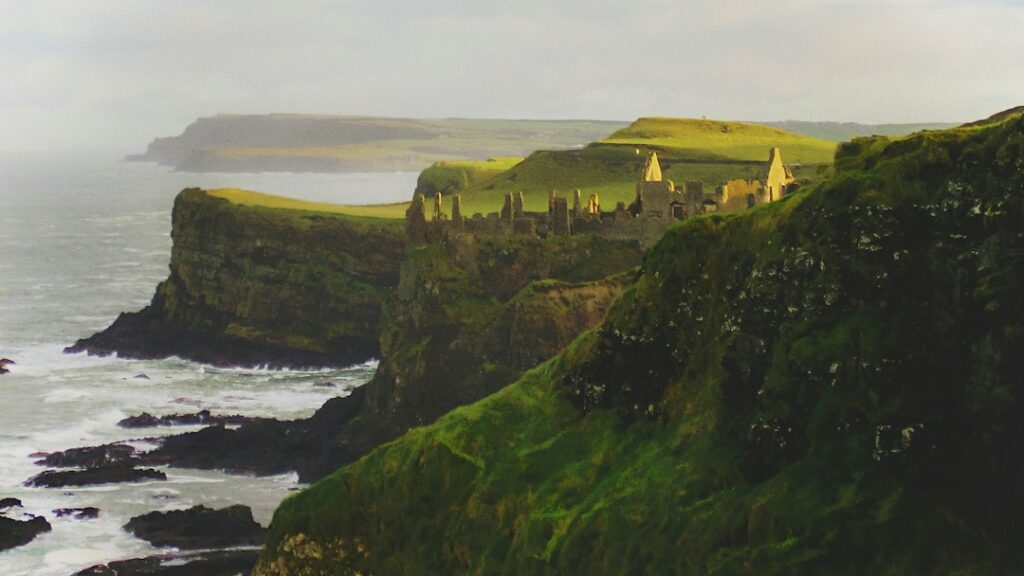
There are castles, and then there’s Dunluce. Clinging to the edge of a basalt headland on the north Antrim coast, this 13th-century ruin doesn’t just command a view—it defies gravity, logic, and the relentless fury of the Atlantic below. Half fortress, half shipwreck, Dunluce Castle is the most theatrical ruin in Ireland, a place where history and drama are written in stone, salt spray, and sheer nerve.
If you’ve ever wondered what happens when ambition meets erosion, this is your answer.
A Fortress Built on the Edge
Dunluce Castle sits on a narrow outcrop separated from the mainland by a chasm that once required a bridge to cross. The site was first fortified by the MacQuillans in the 13th century, but it was the ambitious MacDonnells—Scottish lords who claimed the Glens of Antrim—who turned it into the seat of power it became in the 16th and 17th centuries.
Sorley Boy MacDonnell, one of the clan’s most formidable chiefs, expanded Dunluce into a Renaissance stronghold. He added turrets, residential quarters, and even luxuries unusual for the wild north coast—imported glass, fine tapestries, and a kitchen equipped to feed a noble household. The MacDonnells weren’t just defending a castle. They were making a statement: we rule the edge of the world.
But the edge, as it turned out, had other plans.
The Night the Kitchen Fell Into the Sea
Dunluce’s most famous moment is also its most catastrophic. On a stormy night in 1639, part of the castle’s kitchen tumbled into the ocean, taking several servants with it. Some say it was the final straw for the MacDonnell family, who abandoned the castle shortly afterward. Others whisper that the collapse was a warning—that the Atlantic would reclaim what ambition had built too close to its reach.
Today, you can still see the jagged cliff edge where the kitchen once stood. The gap is haunting, a physical reminder that even the mightiest fortresses are temporary guests on Ireland’s coastline. Stand at the ruins and look down, and you’ll understand why this place inspires as much awe as unease.
What You’ll Find at Dunluce Today
Dunluce Castle is now managed by the Department for Communities and open to visitors year-round. The ruins are accessible via a modern bridge, and interpretive panels guide you through the layout—great hall, gatehouse, residential quarters, and the remnants of defensive walls that once bristled with cannons salvaged from the Spanish Armada ship La Girona, wrecked nearby in 1588.
Entrance costs around $7 USD for adults, with discounts for families and seniors. The site includes a small visitor center with artifacts recovered from the MacDonnell era, including coins, pottery, and pieces of weaponry that tell the story of a castle caught between Irish clans, Scottish ambition, and English conquest.
But the real experience is simply standing among the stones. The wind here never stops. The waves crash hundreds of feet below. And the castle, stubborn and skeletal, refuses to let go of its perch.
Why Dunluce Still Matters
Dunluce isn’t just a ruin—it’s a portrait of ambition, resilience, and the limits of both. It’s a place that reminds you Ireland’s history wasn’t written in drawing rooms or on battlefields alone, but on wild coastlines where survival itself was a form of defiance.
The MacDonnells are long gone, but their castle remains—battered, beautiful, and utterly unforgettable. It’s been featured in everything from paintings to fantasy epics (yes, those battlements inspired parts of Game of Thrones), but no screen or canvas does justice to the real thing. You have to feel the wind, smell the salt, and hear the waves to understand what made this place worth fighting for.
Dunluce is located just a few miles west of the Giant’s Causeway and Bushmills Distillery, making it an essential stop on any north coast itinerary. Visit at sunset if you can, when the light turns the ruins gold and the Atlantic stretches endlessly toward Scotland.
Want more stories from Ireland’s castles, coastlines, and wild places? Subscribe to the Ireland Moments newsletter—a daily celebration of Ireland delivered to your inbox.