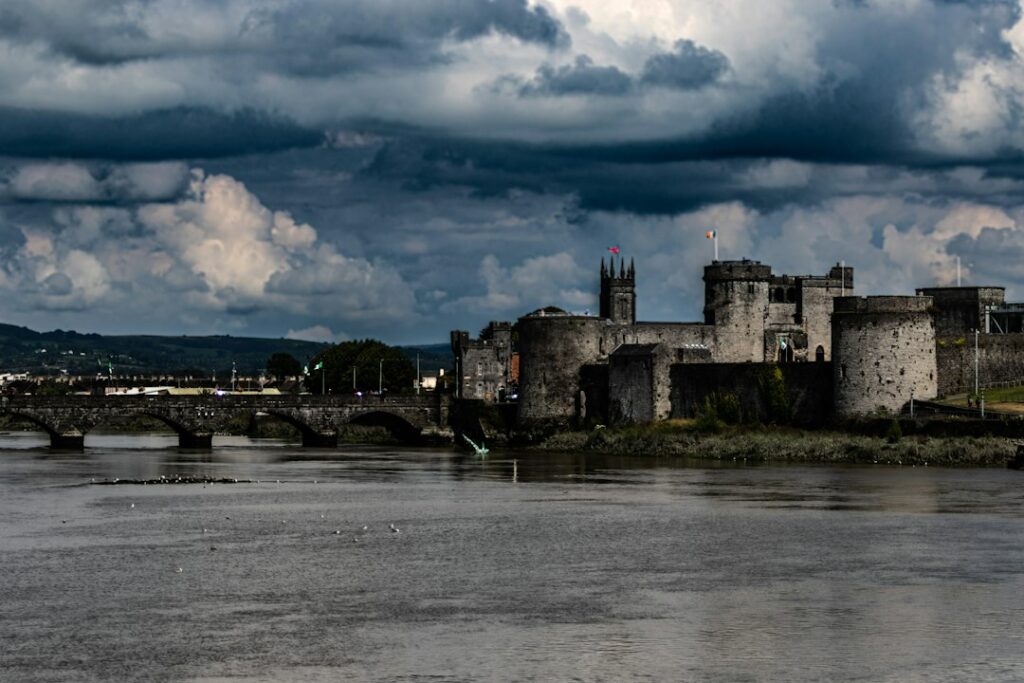
On King‘s Island in the heart of Limerick City, where the Abbey River meets the Shannon, King John’s Castle rises from the same ground Vikings fortified more than a thousand years ago. Built in 1200 on the orders of King John of England, this five-towered fortress has witnessed every chapter of Limerick’s turbulent history—from Norman conquest to Williamite siege—and today stands as one of Ireland’s most intact and engaging medieval castles.
Unlike many Irish castles reduced to romantic ruins, King John’s Castle still commands the river crossing with its original curtain walls, corner towers, and twin-towered gatehouse. Walk its ramparts and you’re standing where archers once watched for approaching armies, where cannons fired during the Siege of Limerick in 1691, and where the city’s defenders held out against centuries of assault.
Built on Viking Foundations
The Normans didn’t build on empty ground. When they arrived in Limerick in 1175, they found a thriving Viking settlement established two centuries earlier by Norse traders who recognized the Shannon’s strategic importance. King John’s Castle was deliberately constructed over the earlier Viking fortifications, and today’s visitors can descend beneath the castle courtyard to see excavated Viking houses, their wooden foundations preserved in the clay.
These underground exhibits reveal everyday Viking life: gaming pieces, combs carved from bone, and the remnants of workshops where craftsmen worked silver and iron. It’s a rare glimpse of Ireland’s Norse heritage, made more powerful by its location directly beneath the Norman fortress that replaced it.
A Castle Built for War
King John’s Castle was designed for one purpose: control. Its massive D-shaped towers anchored curtain walls that enclosed more than half an acre. The gatehouse, with its twin towers flanking a fortified entrance, could be sealed with heavy wooden doors and an iron portcullis. Arrow loops were positioned to create killing zones where attackers would face fire from multiple angles.
The castle’s military architecture is unusually well preserved, thanks in part to later modifications. During the Williamite sieges of 1690 and 1691, the castle was adapted for artillery warfare. Bastions were added to mount cannons, and these additions—rather than destroying the medieval structure—helped protect it. Today you can trace the evolution of military technology from medieval arrow slits to early modern gun emplacements, all within the same walls.
Interactive History Done Right
King John’s Castle achieves something many heritage sites struggle with: it makes 800 years of history accessible without dumbing it down. The visitor experience balances authenticity with engagement. You can handle replica weapons in the Battlement Experience, feeling the weight of a Norman sword or the draw of a medieval bow. Touchscreen displays in the excavated Viking settlement bring archaeological finds to life without overwhelming the actual artifacts.
The courtyard hosts demonstrations of medieval crafts and combat techniques, while the audiovisual theater presents Limerick’s sieges with the drama they deserve. Climb to the top of the towers for views across the Shannon that explain exactly why this spot mattered so much for so long. On a clear day, you can see upriver toward Lough Derg and downriver toward the estuary—the water highway that made Limerick wealthy and made its castle essential.
A Living Part of Limerick
What sets King John’s Castle apart from many Irish heritage sites is its integration with modern Limerick. It’s not isolated on a hilltop or tucked away in countryside—it’s right in the city center, next to the Thomond Bridge, within walking distance of cafes, shops, and the Hunt Museum. You can tour the castle in the morning and be sitting in a riverside pub by lunch.
The castle grounds also host events throughout the year, from medieval fairs to outdoor theater. In summer, the courtyard comes alive with reenactors, musicians, and storytellers. It’s heritage that remains part of the city’s daily rhythm rather than a monument sealed off from everyday life.
Admission runs around $15 for adults, with family tickets offering better value. The castle is open year-round, though hours vary seasonally. Plan at least two hours to do the site justice—more if you want to explore the Viking excavations thoroughly or take your time on the ramparts.
King John’s Castle proves that Irish history doesn’t need to choose between authenticity and accessibility. The stones are real, the history is complex, and the experience is genuinely memorable. It’s a castle that still does what it was built to do: command attention and guard the Shannon crossing, now welcoming visitors instead of repelling them.
Want more stories from the heart of Ireland delivered to your inbox? Subscribe to the Ireland Moments newsletter—a daily celebration of the people, places, and traditions that make the Emerald Isle unforgettable.