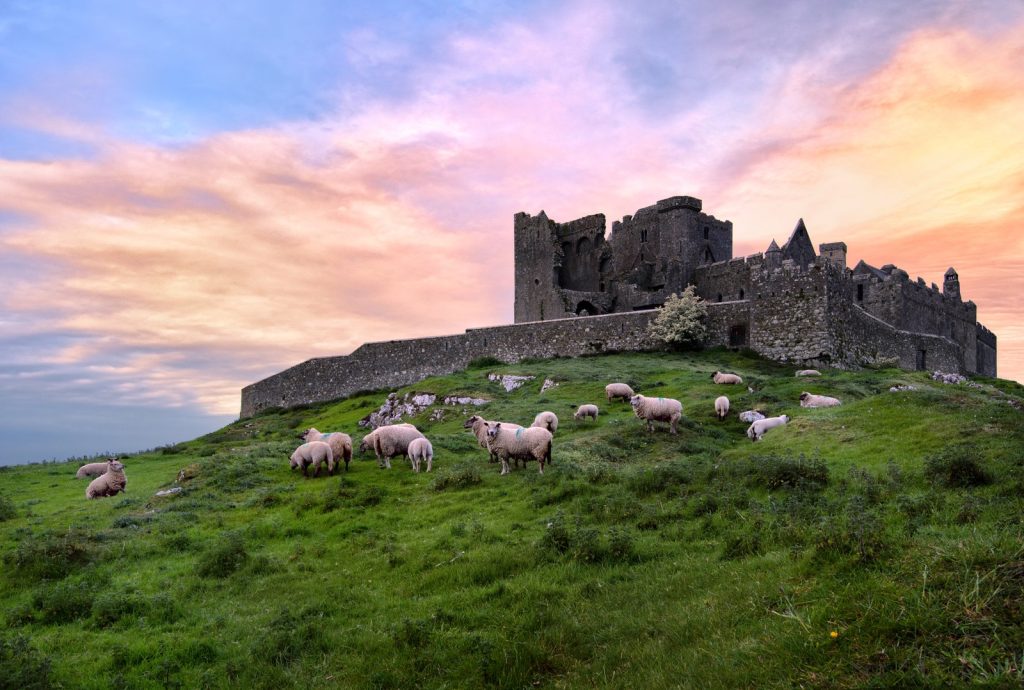
There are dramatic ruins scattered across Ireland, but none command the landscape quite like the Rock of Cashel. Rising 200 feet above the Golden Vale of County Tipperary, this limestone outcrop crowned with medieval buildings stops traffic on the N8. It’s been a seat of kings, a center of Christian power, and one of the most photographed sites in Ireland—and once you see it, you’ll understand why.
The Rock has been a place of power for more than 1,500 years, and walking its grounds feels like flipping through the pages of Ireland’s most pivotal chapters.
From Pagan Fortress to Royal Seat
Long before Christianity took root, the Rock of Cashel was a stronghold of the Eóghanachta dynasty, the kings of Munster. Legend says St. Patrick himself baptized King Aengus here in the 5th century—accidentally driving his crosier through the king’s foot in the process. Aengus, believing it was part of the ritual, never flinched.
By the 12th century, the kings of Munster gifted the Rock to the Church, transforming it into one of Ireland’s most important ecclesiastical centers. What you see today is the result of centuries of ambition, faith, and craftsmanship: a complex of stone buildings that includes a round tower, a roofless cathedral, a 12th-century chapel, and a 15th-century castle.
Each structure tells its own story, but together they form one of the most complete medieval sites in the country.
Cormac’s Chapel: A Romanesque Jewel
The crown jewel of the Rock is Cormac’s Chapel, built in 1127 by Cormac Mac Cárthaigh, King of Munster. This tiny stone church is a masterpiece of Irish Romanesque architecture, with intricately carved arches, a vaulted ceiling, and faded frescoes that hint at its former glory.
The chapel’s twin towers and detailed stonework set it apart from anything else in Ireland at the time. It was continental in style, a statement of power and sophistication. Stand inside and look up—the ribbed barrel vault overhead was cutting-edge engineering in the 12th century, and it’s still standing strong nearly 900 years later.
The chapel is small, intimate, and surprisingly moving. It’s easy to imagine monks chanting in the half-light, their voices echoing off ancient stone.
The Cathedral and Round Tower
The Gothic cathedral, built in the 13th century, dominates the site. Its soaring walls, now open to the sky, frame views of the Tipperary countryside that stretch for miles. The lancet windows, though empty, still catch the light in ways that make you pause. Walk through the nave and you’re walking where archbishops once presided over the spiritual life of Munster.
At the site’s highest point stands a round tower, one of the best-preserved in Ireland. Built in the early 12th century, it rises 92 feet and served as both a bell tower and a lookout. The doorway is elevated above ground level—a defensive feature common to Irish round towers—and climbing it (when access is permitted) offers sweeping views over the plains below.
On a clear day, you can see the Galtee Mountains to the south and the Devil’s Bit to the north, a gap in the hills that folklore says was bitten out by the devil himself before he spat the Rock of Cashel into place.
Visiting the Rock of Cashel
The Rock is located just outside the town of Cashel, about 90 minutes from both Cork and Limerick, and two hours from Dublin. It’s open year-round, with admission around $10 USD for adults. Guided tours are included and highly recommended—the guides bring the stone to life with stories of kings, bishops, and battles.
Give yourself at least 90 minutes to explore. Walk the grounds slowly, let the scale sink in, and don’t miss the replica High Cross in the hall—the original, carved in the 12th century, is one of Ireland’s finest.
The site is mostly outdoors and exposed, so dress for the weather. The wind on top of the Rock can be fierce, even in summer, but it only adds to the drama.
Plan your visit for early morning or late afternoon if you can. The light at those times turns the limestone gold, and you’ll have space to take it all in without the crowds. Sunset from the Rock, with the plains stretching into purple distance, is unforgettable.
Why the Rock Matters
The Rock of Cashel isn’t just a ruin. It’s a place where myth and history collide, where you can trace the arc of Irish civilization from pagan kings to medieval bishops. It’s proof that Ireland’s greatest monuments aren’t always hidden in remote valleys—sometimes they rise in plain sight, daring you not to stop.
If you love Ireland’s castles, abbeys, and ancient places, the Rock of Cashel deserves a place at the top of your list. It’s grand without being overdone, ruined but still proud, and more beautiful in person than any photograph can capture.
Want more stories from Ireland’s most inspiring places? Subscribe to the Ireland Moments newsletter—a daily celebration of the Emerald Isle, delivered to your inbox each morning.