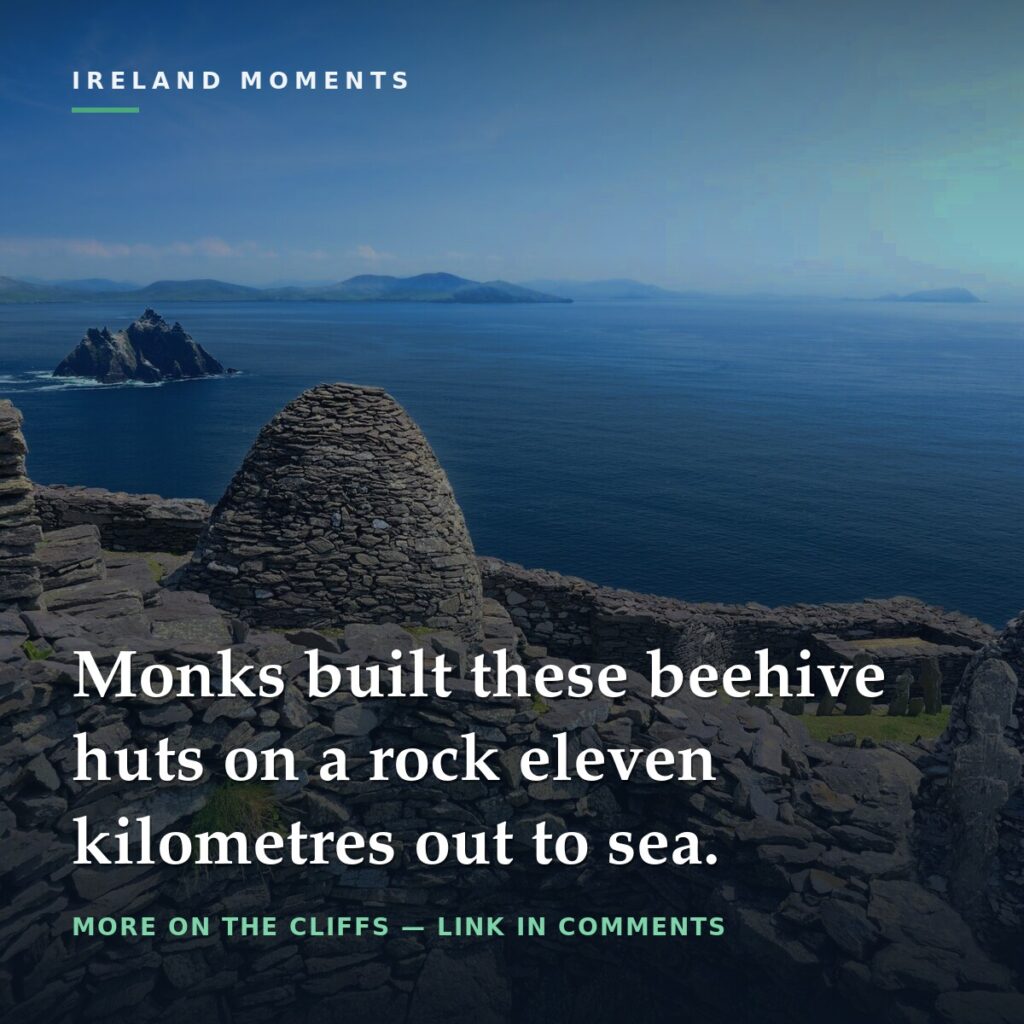
Eight miles off the Kerry coast, rising 714 feet from the wild Atlantic, Skellig Michael holds one of Ireland’s most extraordinary architectural achievements: a collection of beehive huts so perfectly crafted they’ve survived storm, salt, and fourteen centuries without mortar.
These clochán—circular stone cells built by early Christian monks around the sixth century—weren’t simply shelters. They were statements of faith, engineering genius, and a determination to live as close to God as stone and skill would allow.
Built Without Mortar, Designed for Eternity
The beehive huts on Skellig Michael were constructed using corbelling, an ancient dry-stone technique where each layer of flat stone slightly overhangs the one below, spiraling inward until the structure closes at the top. No cement. No wooden supports. Just stone on stone, fitted with such precision that rain runs off the exterior while the interior stays dry.
The monks quarried flat slabs of Old Red Sandstone from the island itself, shaping each piece to lock into place. The result is a dome strong enough to withstand Atlantic gales that can gust over 100 miles per hour. Some huts are large enough to stand in; others are small, solitary cells for prayer and sleep.
Walk inside one today and the silence is immediate. The thick stone walls muffle the wind. Light filters through a low doorway. The air smells of ancient rock and sea. It feels less like a ruin and more like a pause—an architectural whisper that hasn’t faded.
A Monastery Between Sea and Sky
The monks who built these huts didn’t choose Skellig Michael for comfort. They chose it for isolation. In the early Christian tradition, remote places brought you closer to the divine, and few places in Europe were more remote than this jagged pinnacle in the Atlantic.
The monastic settlement includes six beehive huts, two oratories, stone crosses, and a terraced garden where the monks grew what little they could. Everything was carried up 600 stone steps carved into the cliff face. Water was collected in cisterns. Food came from fishing, foraging, and the occasional supply boat from the mainland.
Life here was harsh, disciplined, and profoundly intentional. The monks prayed, copied manuscripts, and lived according to a rhythm dictated by the sea, the sky, and the liturgy. The beehive huts were their world: sleeping quarters, scriptoriums, sanctuaries.
Why They Still Matter
The beehive huts of Skellig Michael are more than historical curiosities. They’re proof of what’s possible when human ingenuity meets absolute commitment. These structures have outlasted empires, weathered storms that sank ships, and remained standing while castles crumbled on the mainland.
UNESCO named Skellig Michael a World Heritage Site in 1996, recognizing both its architectural significance and its role in preserving early Christian monasticism during Europe’s Dark Ages. The monks who lived here helped keep learning, literacy, and faith alive when much of the continent had descended into chaos.
But beyond the history, there’s something deeply moving about standing beside a beehive hut and realizing it was built by hand, stone by stone, by people who believed their work mattered not just for years, but for eternity. They were right.
Visiting the Beehive Huts Today
Skellig Michael is accessible by boat from Portmagee or Ballinskelligs between late spring and early autumn, weather permitting. The crossing takes about an hour, and seas can be rough. Boats land at a stone pier, and from there it’s a steep climb up 600-plus steps to the monastery.
Only a limited number of visitors are allowed each day to protect the site, and tours must be booked weeks in advance. Expect to pay around $100 per person for the boat trip. The island has no facilities—no restrooms, no shelter, no food—so come prepared.
Once you reach the summit, you’ll have roughly two hours to explore before the boat departs. Walk carefully. The stones are ancient, the edges sheer, and the wind unforgiving. But if you sit quietly beside one of the beehive huts and listen, you might hear what the monks heard: the cry of gulls, the crash of waves, and the steady whisper of stone holding its ground against the sea.
These huts weren’t built to impress. They were built to endure. And fourteen centuries later, they still do.
Want more stories that celebrate Ireland’s landscapes, heritage, and soul? Subscribe to the Ireland Moments newsletter—a daily dose of the Ireland you love, delivered straight to your inbox.