Three miles off the tip of the Dingle Peninsula, the Blasket Islands rise from the Atlantic like the final full stop at the edge of Europe. Great Blasket, the largest of the six islands, hasn’t been permanently inhabited since 1953, but its story — of resilience, literature, and a way of life shaped entirely by the sea — echoes across the water still.
These aren’t ruins you walk through with a guidebook. This is a landscape where every stone wall, abandoned cottage, and sheep path tells the story of people who lived closer to the ocean than almost anywhere else in Ireland.
A Community Shaped by the Atlantic
Life on Great Blasket was never easy. The islanders survived on fishing, subsistence farming, and an intimacy with the sea that most of us will never know. There was no priest, no doctor, no shop. Supplies came by currach — the traditional canvas-covered boat — when the weather allowed, which it often didn’t.
Winters were brutal. Summers brought tourists and scholars, drawn by the Irish spoken here in its purest, most archaic form. By the mid-20th century, the population had dwindled. The young left for the mainland or America. In 1953, the last 22 islanders were evacuated, and the village fell silent.
Today, you can walk among those cottages. The main village street is still visible, roofless homes open to the sky. Nettles grow where hearths once burned. It’s haunting, yes, but also strangely peaceful — a place where nature has taken back what was always borrowed.
The Island That Wrote Itself Into History
What makes the Blaskets extraordinary isn’t just their isolation — it’s what that isolation produced. In the early 20th century, three islanders wrote memoirs that became classics of Irish literature, despite having little formal education.
Tomás Ó Criomhthain’s An tOileánach (The Islandman), Peig Sayers’ Peig, and Muiris Ó Súilleabháin’s Fiche Blian ag Fás (Twenty Years A-Growing) captured a vanishing world in vivid, unsentimental prose. They wrote in Irish, at the urging of visiting scholars who recognized the linguistic and cultural treasure slipping away.
These weren’t romantic pastorals. They were clear-eyed accounts of hardship, joy, death, and the rhythms of island life. Peig’s voice, in particular — earthy, funny, devastating — became so iconic that generations of Irish students encountered her memoir in school. The Blaskets became legendary not because they were remote, but because their people found the words to make remoteness universal.
Visiting the Blaskets Today
You reach Great Blasket by ferry from Dunquin Pier, a dramatic slip of concrete clinging to the cliffs below the village. Boats run from April through September, weather permitting. Weather permitting is the key phrase — the crossing can be rough, and departures are often canceled. The Atlantic doesn’t negotiate.
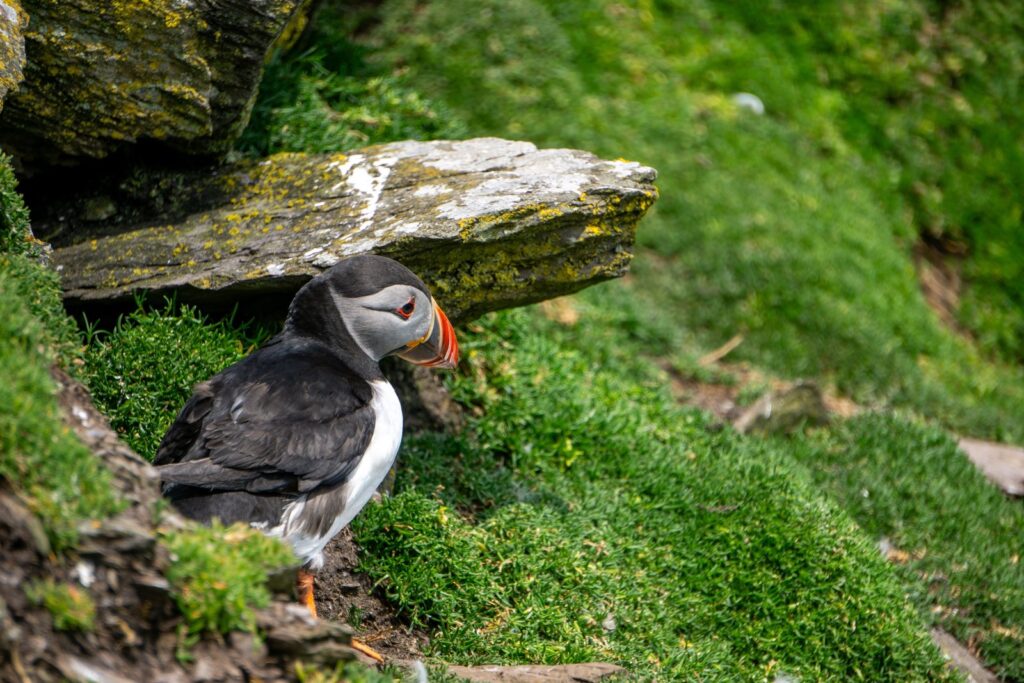
The ferry ride takes about 20 minutes. As you approach, seabirds wheel overhead — puffins, razorbills, gulls. Seals lounge on rocks. The island itself is treeless, all grass and stone and sky, with the abandoned village tucked into a sheltered cove on the northeast side.
Most visitors spend three to four hours on the island. There’s a small café near the pier (summer only) and nothing else — no facilities, no shelter if the weather turns. Wear sturdy boots. The paths are rough, and the island’s spine rises to over 900 feet. The views from the top stretch across the Dingle Peninsula, out to the smaller Blaskets, and west to nothing but ocean.
If you don’t want to make the crossing, the Blasket Centre in Dunquin offers an excellent introduction. The interpretive exhibits cover island life, the literature, the language, and the emigration that eventually emptied the place. The building itself is worth the visit — a modern structure of glass and stone perched on the clifftop, with floor-to-ceiling windows framing the islands across the sound.
Why the Blaskets Still Matter
The Blasket Islands are more than a scenic day trip. They’re a reminder of how recently Ireland’s most isolated communities lived lives that would be unrecognizable today — and how much was lost when that world disappeared.
But they’re also a reminder of what endures. The stories written here are still read. The Irish spoken here influenced the standard taught in schools. The landscape — raw, unforgiving, breathtaking — hasn’t changed. And every summer, visitors make the crossing to walk where the islanders walked, to stand at the edge of the world and look back toward the life they left behind.
The Blaskets don’t need to be inhabited to be alive. They just need to be remembered.
Love stories like this? Subscribe to the Ireland Moments newsletter — a daily celebration of Ireland’s places, culture, music, and heritage, delivered to your inbox every morning.