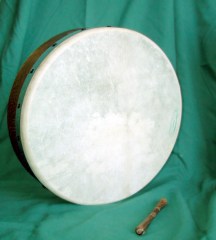
Walk into any proper trad session across Ireland and you’ll hear it before you see it: that deep, rhythmic thump that anchors the reels and jigs, the heartbeat beneath the fiddles and flutes. The bodhrán—Ireland’s frame drum—is as essential to traditional music as the whiskey behind the bar.
Pronounced “bow-rawn,” this deceptively simple instrument consists of goatskin stretched tight over a wooden frame, typically made from ash or beech. Yet in the hands of a skilled player, it becomes something far more complex: a conversation partner to the melody instruments, adding texture, drive, and soul to every tune.
From Ancient Roots to Modern Sessions
The bodhrán’s origins remain debated among historians. Some trace it back to pre-Christian Ireland, where frame drums appeared in battle and ritual. Others point to more practical beginnings—farmers using grain sieves or tools that doubled as instruments during céilís and house dances.
What’s certain is that the bodhrán experienced a renaissance in the 1960s, thanks to pioneering players like Seán Ó Riada and later Johnny “Ringo” McDonagh of De Dannan. They elevated the drum from a background rhythm keeper to a lead voice in its own right. Today, players like John Joe Kelly and Colm Murphy continue pushing the instrument’s boundaries while honoring its traditional role.
The drum typically measures 14 to 18 inches in diameter, though you’ll find variations. The skin—almost always goat—responds to humidity and temperature, meaning players often warm their bodhrán near a fire or heater before playing. It’s an instrument that breathes with the weather, very Irish in that way.
The Technique That Makes It Sing
Playing bodhrán looks simple until you try it. The player holds the drum vertically in one hand, using the other hand to strike the skin with a double-headed stick called a tipper or cipín. But the magic happens with the hand behind the skin, pressing and releasing to change pitch and tone mid-strike.
Good bodhrán playing is about restraint as much as rhythm. In a session, the drum should support, not dominate. It accents the melody’s natural rhythm—the roll of a reel, the lilt of a jig, the swing of a hornpipe—without overpowering the tune. There’s an old joke that the best thing to keep your bodhrán in is a locked car with the windows up, but that speaks more to poor playing than the instrument itself.
The Kerry style, the top-end style, the West Limerick style—regional variations exist, each with distinct patterns and emphases. In County Clare, you’ll hear tighter, more minimal playing that leaves space for the melody instruments. In Donegal, the rhythm often mirrors the harder, driving style of the local fiddling.
Where to Hear Bodhrán Played Right
The best education in bodhrán comes from listening to masters in their element. Head to Hughes’ Bar in Drumshanbo, County Leitrim, on a Thursday night and you might catch some of Ireland’s finest traditional players, bodhrán included. The drum fits seamlessly into the session’s flow there, never demanding attention but impossible not to feel.
In Doolin, County Clare—arguably Ireland’s trad music capital—sessions at Gus O’Connor’s Pub and McGann’s feature bodhrán players who understand the Clare aesthetic: crisp, clean, and musical. You’ll hear how the drum can drive a set of reels without a single unnecessary strike.
For those interested in learning, the Craiceann International Bodhrán Summer School takes place each July in Inis Oírr, the smallest of the Aran Islands. Players from beginner to advanced gather for workshops, sessions, and concerts, all centered on this singular instrument.
Choosing and Caring for Your Bodhrán
If you’re thinking of buying a bodhrán, expect to spend anywhere from $150 for a decent student model to over $500 for a professional instrument. Malachy Kearns in County Meath and Paraic McNeela in County Clare both craft exceptional drums, each with their own approach to skin selection, frame construction, and tuning systems.
A good bodhrán should feel balanced in your hand, with even tension across the skin. Many modern drums include tuning systems—small screws that let you adjust the skin’s tightness to compensate for weather changes. Traditionalists might scoff, but they’re undeniably practical, especially if you’re playing in varying conditions.
Care is simple but essential: keep your drum away from direct heat and extreme cold, don’t leave it in a hot car, and occasionally treat the skin with a light application of mineral oil if it dries out. The drum will age and mellow over time, developing its own voice the more you play it.
The bodhrán isn’t for everyone, and not every session welcomes them—some traditional music purists still resist their presence. But when played with skill, sensitivity, and respect for the music, few instruments capture the pulse of Ireland quite like this simple frame drum.
Want more stories celebrating Ireland’s music, traditions, and culture? Subscribe to the Ireland Moments newsletter—a daily celebration of the Emerald Isle delivered to your inbox each morning.