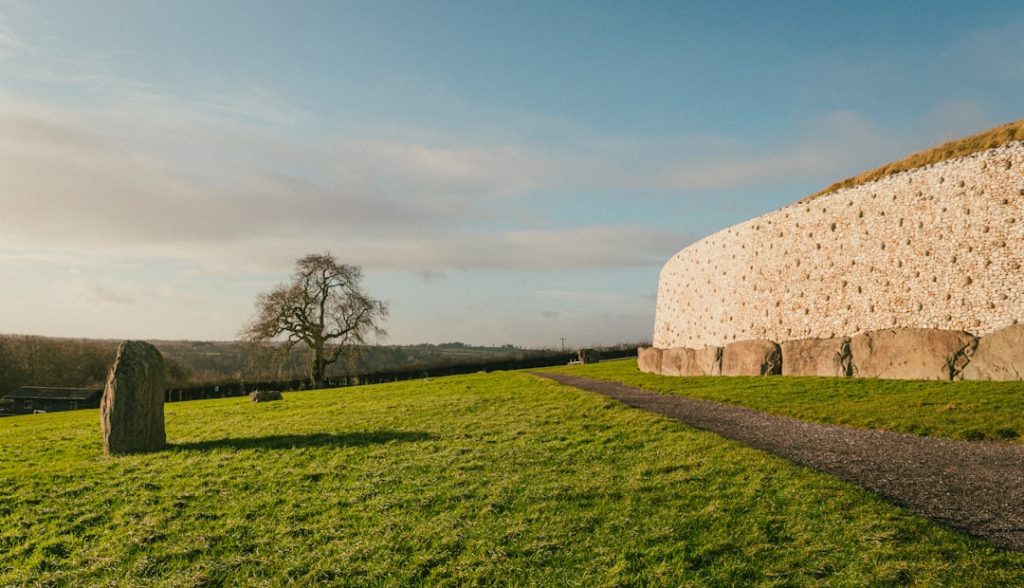
In the Boyne Valley of County Meath, about an hour north of Dublin, sits a structure that predates Stonehenge by 500 years and the Great Pyramid of Giza by more than 600. Newgrange, a passage tomb built around 3200 BCE, is not just ancient—it’s a testament to the sophistication, ambition, and astronomical knowledge of Neolithic Ireland.
Standing before its massive white quartz facade, restored to echo its original appearance, you’re looking at one of the most important archaeological sites in Europe. And once you step inside, you’ll understand why it continues to captivate archaeologists, historians, and visitors from around the world.
A Monument Built to Capture the Sun
Newgrange wasn’t just a tomb—it was an astronomical clock and a sacred space. The entire structure was designed with a single, breathtaking purpose: to capture the light of the winter solstice sunrise.
Every year on December 21st, for about 17 minutes, a beam of sunlight enters through a specially designed roof box above the entrance and travels down the 60-foot passage, illuminating the inner chamber. The precision required to achieve this—over five millennia ago, without modern tools—is staggering.
The annual solstice lottery draws thousands of applicants for just 50 spots to witness the phenomenon in person. But even if you visit at any other time of year, guides recreate the effect with artificial light during tours, and the experience is no less profound.
What You’ll See Inside
The passage tomb is covered by a massive circular mound, 250 feet in diameter and 40 feet high at its center, constructed from layers of earth and stone. The entrance is flanked by the famous kerbstones, 97 in total, many carved with spirals, lozenges, and concentric circles—symbols whose meanings are still debated.
The most famous is Kerbstone 1, directly at the entrance, covered in elaborate triple spirals and diamond patterns. Some believe these carvings represent maps, celestial bodies, or the journey between worlds. Others see them as purely decorative. No one knows for certain.
Inside, the passage is lined with massive standing stones, some weighing several tons. The corbelled roof of the inner chamber—built without mortar—has remained watertight for over 5,000 years, an engineering feat that still impresses modern architects. Three recesses branch off the central chamber, each containing a large stone basin that likely held cremated remains or offerings.
Visiting Newgrange Today
You can’t simply walk up to Newgrange. All visits begin at the Brú na Bóinne Visitor Centre, located on the south side of the River Boyne. From there, shuttle buses take small groups to the monument itself. Tours are guided only, and they book out quickly, especially in summer and around the solstice.
Admission is approximately $15 for adults, with discounts for seniors and children. Combination tickets that include nearby Knowth—another spectacular passage tomb with its own unique features—are available for around $20. Knowth is equally impressive and less crowded, with two passage tombs and incredible Neolithic art.
Plan to spend at least two to three hours at the visitor centre and monuments. The centre itself offers excellent exhibits on Neolithic Ireland, the construction techniques used, and the people who built these structures. Interactive displays help you understand the scale and sophistication of the Boyne Valley complex, which includes over 90 monuments.
Why Newgrange Matters
Newgrange isn’t just old—it’s a window into a highly organized, spiritually complex society that thrived in Ireland thousands of years before writing, metal tools, or the wheel reached these shores. The people who built it understood geometry, astronomy, and engineering at a level that challenges our assumptions about prehistoric life.
It’s also a reminder that Ireland’s story stretches back far beyond the Celts, the Vikings, or the Normans. This land has been home to human creativity, ritual, and wonder for over 10,000 years. Standing in that inner chamber, whether in the beam of winter solstice light or its recreation, you feel that continuity—the unbroken thread connecting ancient hands to yours.
If you’re planning a trip to Ireland and have any interest in history, archaeology, or simply experiencing something truly awe-inspiring, Newgrange belongs at the top of your list. Book ahead, arrive early, and give yourself time to take it all in.
Want more stories like this delivered to your inbox every day? Subscribe to the Ireland Moments newsletter—your daily celebration of Ireland’s places, culture, history, and the moments that make the Emerald Isle unforgettable.