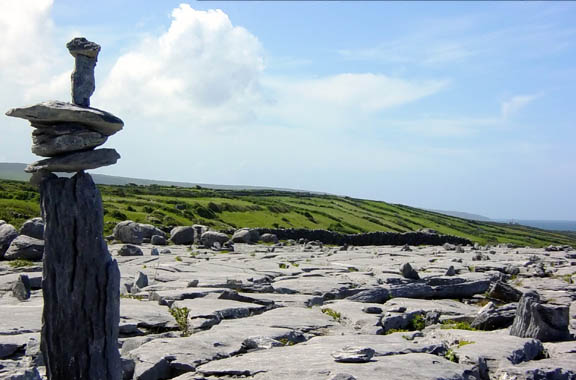
The first time you see the Burren, it stops you cold. Stretching across northern County Clare, this vast expanse of cracked gray limestone looks more like the surface of the moon than the Irish countryside. No trees. No hedgerows. Just stone, layered and fractured, rippling toward the Atlantic in silvery waves.
But call it barren and you’ll miss the point entirely. The Burren—from the Irish Boíreann, meaning “great rock”—is one of the most biodiverse landscapes in Europe, a geological marvel where Arctic, Alpine, and Mediterranean plants grow side by side, where underground rivers carve hidden caves, and where humans have left their mark for over 6,000 years.
A Landscape Forged by Ice and Time
The Burren’s limestone pavement was laid down 350 million years ago, when this part of Ireland sat beneath a warm tropical sea. Glaciers sculpted it during the last Ice Age, scraping away soil and leaving behind a plateau of bare rock crosshatched with deep fissures called grikes. These cracks create thousands of micro-climates, sheltering plants that have no business growing together.
Walk carefully in late spring or early summer, and you’ll spot gentians from the Alps blooming alongside saxifrages from the Arctic, with Mediterranean maidenhair fern tucked in the shade. Twenty-three of Ireland’s twenty-seven native orchid species grow here. It’s a botanical puzzle that has fascinated naturalists for centuries.
The Burren National Park, covering about 3,700 acres in the southeast corner near Corofin, offers some of the best access to this landscape. The terrain is rough—wear sturdy boots—but the trails are manageable, and the views are unforgettable.
Tombs Older Than Writing
The Burren holds one of the densest concentrations of ancient monuments in Ireland. Poulnabrone Dolmen, a portal tomb standing stark against the sky, dates to around 3,800 BC. The capstone, weighing roughly five tons, balances on slim uprights in a feat of Neolithic engineering that still impresses today.
Excavations in the 1980s found the remains of at least 33 people buried beneath it, along with tools and ornaments. Standing there now, wind whipping across the open stone, you feel the weight of all those centuries.
More than seventy other tombs dot the region—wedge tombs, cairns, ring forts. The Caherconnell Stone Fort, a circular cashel dating to around 950 AD, has been restored and offers guided tours. Nearby, you can watch sheepdog demonstrations that show how farmers still work this unforgiving land.
What Lives Beneath the Stone
The Burren’s real drama happens underground. Because limestone is porous and soluble, rainwater has carved vast cave systems beneath the surface. Rivers disappear into swallow holes and emerge miles away. The entire plateau is honeycombed with passages.
Aillwee Cave, near Ballyvaughan, is open to visitors year-round. The guided tour takes you through chambers formed over millions of years, past a frozen waterfall and the remains of hibernation pits once used by brown bears—extinct in Ireland for over 1,000 years, but their bones still rest in the darkness.
The region is also home to Ireland’s only native pine marten population in the west, along with stoats, badgers, and the elusive Irish hare. Peregrine falcons nest on the cliffs near the coast. For such a seemingly empty place, the Burren teems with life if you know where to look.
How to Experience the Burren
Start in the village of Kilfenora, home to the Burren Centre, where exhibits explain the geology, flora, and archaeology in clear, engaging detail. It’s worth an hour before you head out onto the stone itself.
For walking, the Burren Way is a 70-mile waymarked trail, but you don’t need to tackle the whole route. A few hours hiking from Ballyvaughan toward Fanore gives you a taste of the landscape, with the Atlantic glittering to the west.
If you’re driving the coast road from Doolin to Ballyvaughan, pull over often. The stone terraces descending to the sea at places like Black Head are mesmerizing, especially in late afternoon light when the limestone glows gold.
Spring and early summer offer the best wildflower displays, but the Burren rewards visits in every season. Even in winter, when mist clings to the grikes and rain darkens the stone, it holds a stark, ancient beauty.
Want more stories about Ireland’s hidden corners, traditions, and the places that make the island unforgettable? Subscribe to the Ireland Moments newsletter—a daily celebration of Ireland, delivered to your inbox each morning.