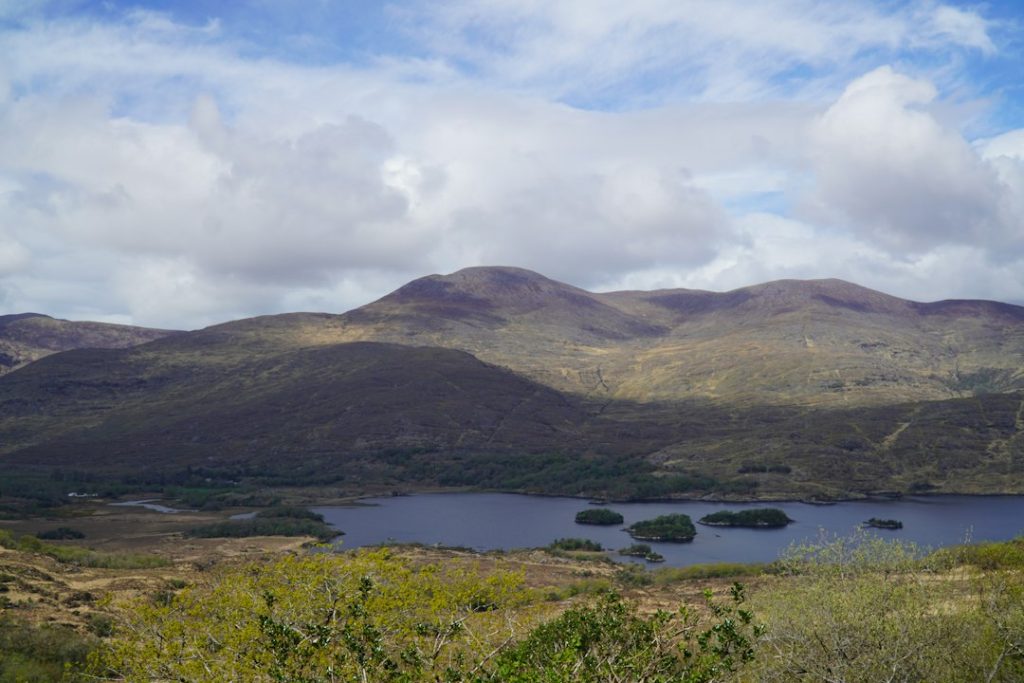
Killarney National Park sprawls across 25,000 acres of County Kerry wilderness, but most visitors never venture past the postcard stops. They see Muckross House, snap a photo at Ladies View, and move on. What they miss are the hidden valleys, silent lakeshores, and oak forests that make this UNESCO Biosphere Reserve one of Ireland’s most remarkable landscapes.
Established in 1932 as Ireland’s first national park, Killarney protects ecosystems found nowhere else in the country. The ancient oakwoods here are remnants of forests that covered Ireland after the last ice age. Walk quietly through them and you might spot red deer, Ireland’s only native deer species, or catch the flash of a white-tailed sea eagle overhead—a species reintroduced after being extinct in Ireland for a century.
The Three Lakes That Define Killarney
Lough Leane, Muckross Lake, and Upper Lake form the liquid heart of the park, connected by the Long Range River and the Meeting of the Waters. Lough Leane—the name means “lake of learning”—is the largest, stretching across 5,000 acres and dotted with islands. On Innisfallen Island, monks founded a monastery in the 7th century and wrote the Annals of Innisfallen, one of Ireland’s most important medieval chronicles.
You can reach Innisfallen by boat from Ross Castle, a short row across waters that change color with the light—gray-green under clouds, brilliant blue when the sun breaks through. The island ruins sit among holly trees and silence, a world apart from the Ring of Kerry traffic just miles away.
Muckross Lake is darker, deeper, and hemmed in by mountains. Its shores support one of Europe’s last remaining native yew woodlands, twisted trees that can live for centuries. Upper Lake, the smallest and most remote, lies in the shadow of Purple Mountain and feels almost alpine.
The Gap of Dunloe: Glacial Drama
This narrow mountain pass cuts between Purple Mountain and Macgillycuddy’s Reeks, Ireland’s highest mountain range. Carved by glaciers, the Gap runs for seven miles through a landscape of rock and water—five small lakes, waterfalls, and boulder-strewn slopes where nothing grows but heather and tough mountain grass.
Most people experience the Gap by jaunting car—traditional horse-drawn carriages driven by locals whose families have worked this route for generations. The horses know every stone, every turn, every spot where the echo bounces back when you shout into the valley. If you walk it instead, start early. The morning light catches the Black Lake perfectly, and you’ll have the upper stretches to yourself.
At the southern end, the Gap opens to the Meeting of the Waters, where the three lakes connect. From here, you can take an open boat back through the lakes to Ross Castle, gliding past Dinis Island and the Old Weir Bridge while your boatman points out the mountains: Torc, Mangerton, the Reeks rising to 3,400 feet.
Torc Waterfall and the Old Kenmare Road
Torc Waterfall drops 60 feet down a series of rock steps in the middle of ancient oak forest. It’s a five-minute walk from the parking area, which means it’s often crowded. But take the path that continues up behind the falls—the Old Kenmare Road, a 19th-century route that winds through the hills above Muckross Lake.
This trail delivers what guidebooks promise but rarely provide: solitude and views that justify the climb. After about a mile, you’ll reach a viewpoint overlooking the lake, Muckross House, and the mountains beyond. On clear days, you can see all the way to Carrauntoohil, Ireland’s highest peak.
The oak trees here are survivors. Many are over 200 years old, their trunks thick with moss and ferns. In spring, the forest floor blooms with wood sorrel and wild garlic. In autumn, the canopy turns gold and the smell of leaf mold rises from the path.
Red Deer and Rare Ecosystems
Ireland’s largest wild herd of red deer—around 1,000 animals—lives in Killarney National Park. You’re most likely to see them in early morning or evening, grazing in the open areas around Muckross or on the lower slopes of Mangerton Mountain. During the autumn rut, the stags bellow challenges that echo across the valleys, a sound that’s been part of this landscape for millennia.
The park also protects Ireland’s only remaining native oakwoods and the country’s most extensive stand of yew forest. These ecosystems support species found nowhere else: the Killarney fern, once thought extinct and rediscovered here in 2005, and the Kerry slug, a spotted creature that’s been here since before Ireland separated from mainland Europe.
Planning Your Visit
Killarney town makes a convenient base, with accommodation ranging from hostels to historic hotels like the Great Southern, which has been welcoming guests since 1854. The national park itself is free to enter. Muckross House and Gardens charge admission (around $10 USD), but the grounds, trails, and lakes are open to all.
Rent a bike in town—the 11-mile loop from Killarney to Muckross House and back via the lakeshore path is mostly flat and spectacularly scenic. For a longer adventure, the Kerry Way hiking trail passes through the park, offering multi-day options through some of Ireland’s wildest terrain.
The park is beautiful in any season, but May and June bring the rhododendrons into bloom—non-native but undeniably spectacular—while September offers clear skies and fewer crowds. Winter can be magical, with frost on the mountains and the possibility of snow on the Reeks, though some trails become muddy and challenging.
Killarney National Park rewards those who slow down and look closer. The famous views are worth seeing, but the real magic happens in the hidden valleys, on the quiet trails, and in the moments when you round a bend and find yourself completely alone with ancient trees and wild water.
Love stories like this? Subscribe to the Ireland Moments newsletter for a daily celebration of Ireland—the places, traditions, and moments that make the Emerald Isle unforgettable.