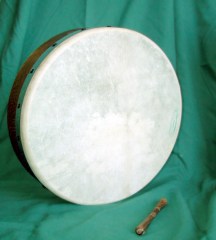
Walk into any traditional music session across Ireland and you’ll hear it before you see it—that deep, resonant pulse that anchors the melody, drives the rhythm, and makes your foot start tapping whether you want it to or not. The bodhrán (pronounced “BOW-rawn”) is Ireland’s frame drum, and its journey from farmyard to concert hall is one of the most compelling stories in Irish music.
What makes this instrument so central to the Irish sound isn’t just its distinctive voice, but the fact that it almost didn’t survive into the modern era. Today, the bodhrán is as synonymous with Irish music as the fiddle or the tin whistle, but that wasn’t always the case.
From Grain Separator to Session Essential
The bodhrán’s origins are practical, even agricultural. For centuries, Irish farmers used shallow wooden frames covered in goatskin to winnow grain—tossing wheat or barley into the air to separate chaff from kernel. These frames, light and durable, doubled as drums during celebrations, weddings, and Wren Day festivities on St. Stephen’s Day.
But the bodhrán wasn’t considered a serious musical instrument until the 1960s folk revival. Pioneering musicians like Seán Ó Riada brought the bodhrán into ensemble settings with Ceoltóirí Chualann, giving it legitimacy and a permanent place in traditional lineups. Suddenly, this humble goatskin drum was sharing the stage with pipes, fiddles, and flutes—and holding its own.
What changed was technique. Early players struck the bodhrán with their hand or a simple stick. Modern players use a double-ended beater called a tipper or cipin, employing wrist rolls, rim shots, and hand pressure on the back of the skin to create an astonishing range of tones and rhythms.
What Makes a Great Bodhrán
Not all bodhráns are created equal. The best are still handmade, using goatskin stretched over a wooden frame—traditionally ash, but sometimes beech or oak. The skin must be thin enough to resonate but thick enough to withstand hours of playing. Tunable bodhráns, which allow players to adjust the tension of the skin with a system of bolts or screws, have become the standard for serious musicians.
Diameter matters. Most bodhráns measure between 14 and 18 inches across. Smaller drums produce higher, sharper tones; larger ones offer deeper bass. The depth of the frame affects resonance—shallow frames (3 to 4 inches) are bright and punchy, while deeper frames (5 to 6 inches) produce a warmer, fuller sound.
Then there’s the tipper. These small double-ended beaters come in countless shapes, weights, and materials—hardwood, bone, carbon fiber. Every player has a preference, and the choice of tipper can completely transform the sound and feel of the drum.
Top makers like Mick O’Connor in County Meath, Seamus O’Kane in Derry, and Christian Hedwitschak in County Clare craft instruments that are both works of art and precision tools. Expect to pay anywhere from $150 for a beginner’s drum to over $600 for a professional-grade, handmade bodhrán with custom inlays and tuning systems.
Masters Who Redefined the Drum
If Seán Ó Riada legitimized the bodhrán, players like Johnny “Ringo” McDonagh, Tommy Hayes, John Joe Kelly, and Colm Murphy elevated it to an art form. They didn’t just keep time—they shaped the music, responding to the melody, adding texture, syncopation, and soul.
Johnny McDonagh, who played with De Dannan, brought a jazz sensibility to the bodhrán, treating it as a full percussion instrument rather than a mere timekeeper. John Joe Kelly of Flook introduced complex polyrhythms and an almost orchestral approach to dynamics. Tommy Hayes pioneered techniques that blur the line between traditional and experimental, using the bodhrán in ways that sound impossibly intricate.
Today, younger players like Colm Phelan and Robbie Walsh continue to push boundaries, blending traditional rhythms with influences from African, Middle Eastern, and Latin percussion traditions. The bodhrán, in their hands, is endlessly adaptable.
Where to Hear It at Its Best
The bodhrán truly comes alive in a session. Head to Matt Molloy’s in Westport, Tigh Coili in Galway, or The Cobblestone in Dublin, and you’ll hear just how essential the bodhrán is to the groove of a good tune. Listen for how the player responds to the lead instruments—accent on the offbeat during a reel, a subtle roll to punctuate a jig, a driving rhythm that pushes a set of polkas forward.
At festivals like the Willie Clancy Summer School in Miltown Malbay or Fleadh Cheoil na hÉireann, you’ll find bodhrán workshops, masterclasses, and late-night sessions where some of the finest players in the world gather to swap techniques, tunes, and stories.
The bodhrán isn’t just the heartbeat of Irish music—it’s the proof that even the simplest tools, in skilled hands, can become transcendent. From goatskin and ash to the center of the session circle, this ancient drum still drives the music forward, one pulse at a time.
Want more stories celebrating Ireland’s music, culture, and soul? Subscribe to the Ireland Moments newsletter—a daily celebration of the Emerald Isle delivered to your inbox.