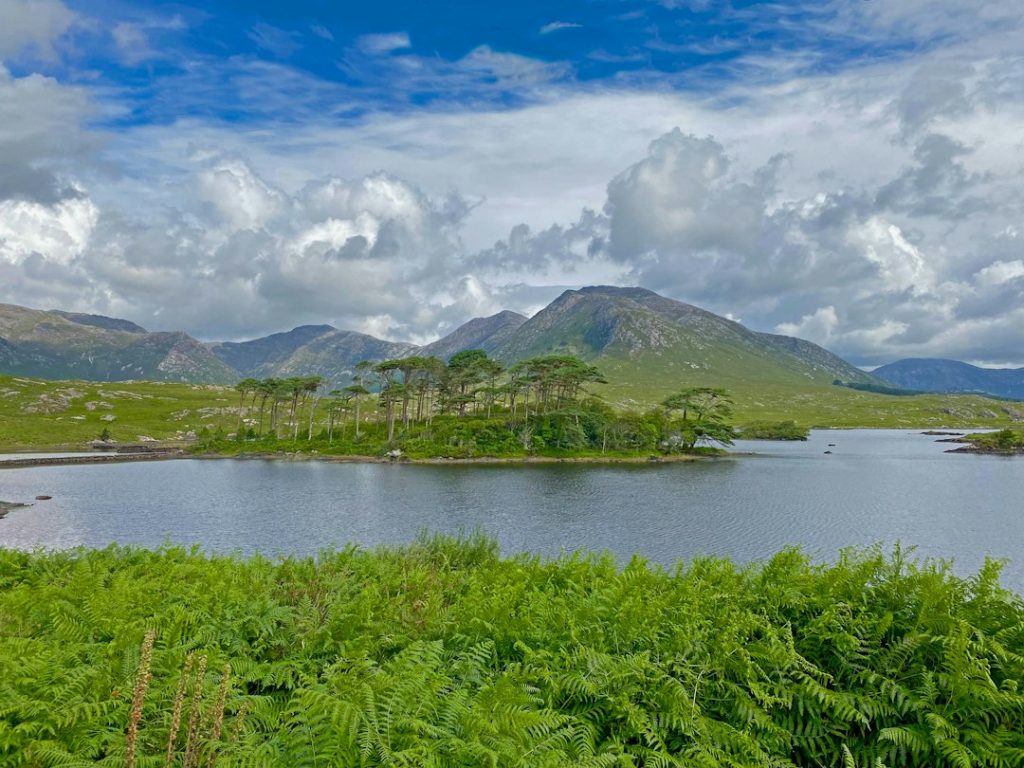
Connemara is what happens when mountains meet the sea and nobody tries to tame what’s in between. Stretching across western County Galway, this wilderness of granite peaks, blanket bog, and storm-battered coastline is Ireland at its wildest and most magnetic. It’s a place where stone walls divide nothing but heather and rock, where Irish is still the first language in many townlands, and where the light changes so fast you’ll swear the landscape is breathing.
If you’ve ever wondered what people mean when they talk about the real Ireland, Connemara is a strong answer.
The Twelve Bens and the Maamturk Mountains
The Twelve Bens—also called the Twelve Pins—form the rugged spine of Connemara. These quartzite peaks rise sharply from the bogland, their bare summits catching cloud and sun in equal measure. The tallest, Benbaun, tops out at 2,395 feet, but the climbs feel tougher than the numbers suggest. The terrain is rough, the weather unpredictable, and the views from the ridges are some of the finest in Ireland.
Across the Inagh Valley, the Maamturks run parallel—a long, serrated ridge that draws serious hikers. The Maamturks Walk, a 16-mile traverse over seven summits, is one of Ireland’s toughest day hikes. It’s not technically difficult, but it’s relentless, and the sense of isolation up there is total.
You don’t have to summit anything to feel Connemara’s mountains. Just driving through the valleys—past Kylemore, through the Inagh, or along the N59 from Recess to Clifden—puts you in their shadow. They anchor the landscape and give Connemara its dramatic backbone.
Bog, Stone, and Sky Roads
Between the mountains and the sea lies Connemara’s blanket bog—thousands of acres of peat, heather, and sedge grass that stretch to the horizon in shades of rust, gold, and green. This is working landscape. Turf is still cut here in late spring, stacked in tiny pyramids to dry through the summer. The bog roads are narrow, winding, and lined with drystone walls that seem to go nowhere in particular.
The Sky Road, a loop west of Clifden, is one of the most scenic drives in Ireland. It climbs above Clifden Bay, offering sweeping views of the Atlantic, the offshore islands, and the mountains behind. On a clear evening, the light here is impossible—golden, slanting, and soft. On a stormy day, it’s equally stunning, just wetter.
Further south, the coast road from Roundstone to Ballyconneely takes you past white-sand beaches like Dog’s Bay and Gurteen Bay, where the sand is made of crushed shells and the water glows turquoise in the right light. These beaches are quiet, even in summer, and feel more Caribbean than Irish—until the wind picks up.
Kylemore Abbey and Connemara’s Hidden Valleys
Kylemore Abbey sits at the foot of Duchruach Mountain, on the shore of Pollacapall Lough. Built in 1868 as a romantic castle and now home to a community of Benedictine nuns, it’s one of Ireland’s most photographed buildings. The neo-Gothic facade, framed by mountains and reflected in the lake, looks like something out of a fairy tale.
The abbey is open to visitors, and the Victorian walled garden—restored and replanted—is worth the walk. The six-acre garden includes glasshouses, herbaceous borders, and a long axis walk that frames the mountains beyond. It’s a rare moment of cultivated beauty in a landscape defined by wildness.
The valleys around Kylemore—Kylemore Glen, the Inagh Valley, and the quieter roads through Letterfrack—are some of Connemara’s best-kept secrets. They’re green, sheltered, and dotted with sheep farms and stone cottages. If you want to slow down and feel the rhythm of the place, these roads are where you do it.
The Heart of the Gaeltacht
Connemara is one of Ireland’s strongest Gaeltacht regions, where Irish is the community language. Villages like Carraroe, Spiddal, and Rosmuc are living centers of Irish culture, not museum pieces. You’ll hear the language in shops, pubs, and schools. Traditional music thrives here, and the sean-nós singing style—unaccompanied, ornamented, and deeply personal—is still passed down through families.
This isn’t heritage for tourists. It’s daily life. And it gives Connemara a cultural weight that’s rare in modern Ireland. If you’re interested in the Irish language or traditional music, spending time in Connemara offers a direct connection to both.
How to Experience Connemara
Connemara rewards slow travel. Rent a car and take the back roads. Stop at viewpoints. Walk a stretch of bog road or climb a hill. Have a bowl of seafood chowder in Roundstone or a pint in a pub where the session starts without announcement.
If you’re hiking, Diamond Hill in Connemara National Park offers a manageable climb with big views. The park’s visitor center in Letterfrack is a good starting point, with trails for all levels and exhibits on the region’s ecology and history.
Stay overnight if you can. Clifden is the main hub, with good accommodation and restaurants. Smaller villages like Roundstone, Cleggan, and Leenaun offer quieter bases. Mornings and evenings in Connemara are magical—when the tour buses are gone and the light does its best work.
Connemara doesn’t shout. It doesn’t need to. It’s a place that reveals itself slowly, in layers—mountain, bog, sea, stone, language, and light. Once you’ve felt it, you’ll understand why people return.
Want more stories like this delivered to your inbox? Subscribe to the Ireland Moments newsletter—a daily celebration of Ireland’s places, culture, music, and the moments that matter.