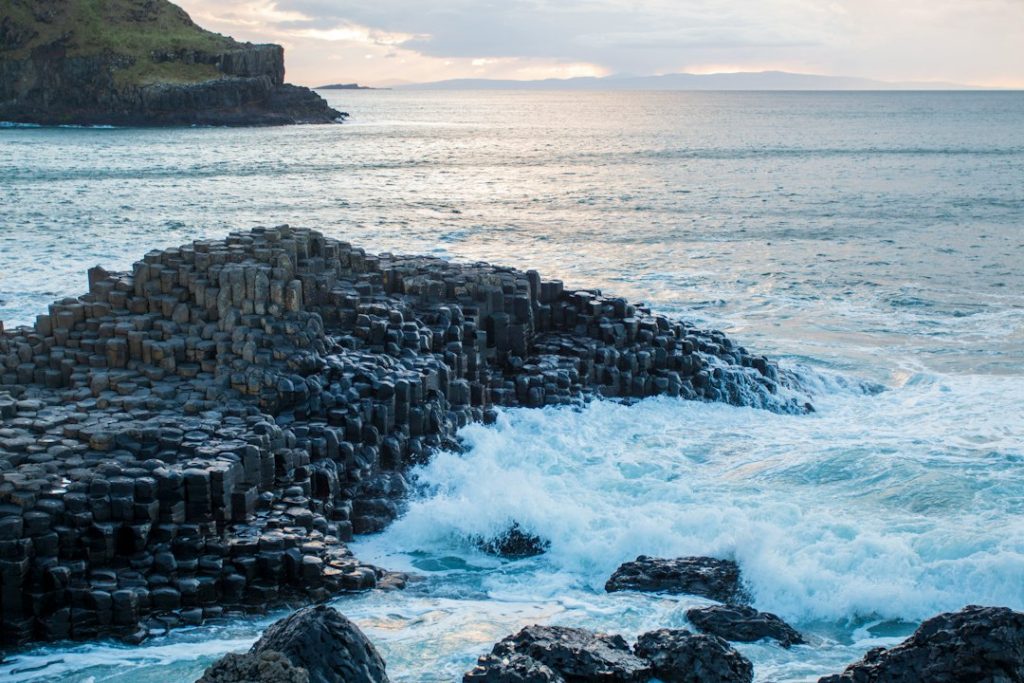
On the edge of County Antrim, where the North Atlantic crashes against Northern Ireland‘s rugged coast, forty thousand basalt columns rise from the sea in perfect hexagonal formations. The Giant‘s Causeway looks like the work of ancient architects, and according to Irish legend, it was—built by the giant Fionn mac Cumhaill to cross the sea to Scotland.
The science is almost as dramatic as the myth. Sixty million years ago, volcanic eruptions sent lava flowing across the landscape. As the molten rock cooled and contracted, it fractured into these precise geometric columns, creating one of the world’s most remarkable geological formations and Ireland’s only UNESCO World Heritage Site.
The Legend of Fionn and Benandonner
Irish folklore tells a better story than geology textbooks. The giant Fionn mac Cumhaill, challenged by his Scottish rival Benandonner, built the causeway as a bridge across the North Channel. When Benandonner crossed to Ireland, Fionn’s clever wife Oonagh disguised her husband as a baby. Seeing the enormous “infant,” Benandonner fled in terror, imagining how massive the father must be, tearing up the causeway behind him.
The legend lives in the landscape. Formations along the causeway bear names like the Giant’s Boot, the Giant’s Harp, and the Wishing Chair. The similar basalt columns at Fingal’s Cave on the Scottish island of Staffa suggest the causeway once stretched all the way across the sea.
Walking Among the Columns
The causeway proper covers about 40,000 interlocking columns, most perfectly hexagonal, though some have four, five, seven, or eight sides. They range from less than a foot to nearly forty feet high, creating natural stepping stones that descend into the sea.
The most iconic view comes from the lower causeway, where you can walk across the columns themselves. They’re worn smooth by centuries of Atlantic weather and millions of footsteps, their tops creating an uneven pavement that does look engineered for giants. The columns extend below the waterline and reappear at Runkerry Head, more than a mile away.
Beyond the main formation, the coastal path reveals the Organ, a section of columns standing vertical against the cliff face like massive pipes. The Grand Causeway, the middle causeway, and the little causeway each have distinct characters, shaped by how the lava cooled and the sea has carved them since.
The Wild Coastal Setting
The Giant’s Causeway sits within a landscape that earned its UNESCO designation not just for geology but for raw beauty. The Causeway Coastal Route stretches 120 miles from Belfast to Derry, with the causeway as its centerpiece. Steep cliffs, hidden bays, and dramatic headlands frame the columns.
Port na Spaniagh, just east of the causeway, marks where the Spanish Armada galleon Girona sank in 1588. The clifftop ruins of Dunseverick Castle stand two miles away, one of Ireland’s oldest fortified sites. Five miles west, the Carrick-a-Rede rope bridge swings above a sixty-foot chasm.
The causeway area supports a unique ecosystem. Fulmars nest on the cliff ledges, while spring brings wildflowers including sea campion, thrift, and the rare frog orchid. Harbor porpoises and basking sharks occasionally appear offshore.
Visiting Wisely
The site draws nearly one million visitors yearly, making timing essential. Arrive before 9 a.m. or after 5 p.m. during summer to avoid crowds. Winter offers solitude and dramatic light, though weather can be fierce.
The walk from the visitor center to the causeway takes fifteen minutes downhill on a paved path. The shuttle bus costs about $2 each way for those who need it, but the walk reveals views the bus bypasses. Allow two to three hours to explore the formations and coastal paths properly.
Admission to the causeway itself is free—it’s a natural site. The visitor center charges around $16 for adults, covering exhibitions, facilities, and site maintenance. The center, built into the hillside and topped with basalt-inspired columns, won architectural awards for blending into the landscape.
The cliff-edge path beyond the main causeway leads to Benbane Head and stunning views back toward the formations. Hamilton’s Seat, a clifftop viewpoint, offers the best overview of the entire causeway stretching into the sea. Wear proper hiking shoes—the stones can be slippery, and the coastal path is exposed.
Beyond the Columns
The Giant’s Causeway anchors a full day of exploring. The village of Bushmills, two miles south, is home to the world’s oldest licensed whiskey distillery, operating since 1608. The Bushmills Original and Black Bush are excellent, but the distillery’s single malts deserve the attention.
Dunluce Castle, perched on a cliff edge four miles west, rivals any castle in Ireland for sheer drama. Part of the kitchen actually fell into the sea during a storm in 1639. The medieval ruins, with the ocean visible through gaps in the walls, could illustrate every Irish legend ever told.
The causeway represents something rare—a place where geology, mythology, and raw Atlantic beauty converge into something that satisfies scientists and dreamers equally. Whether you see the work of cooling lava or a giant’s ambition, forty thousand stone columns rising from the sea demand attention.
Want more stories from Ireland’s most remarkable places, from ancient sites to hidden corners? Subscribe to the Ireland Moments newsletter—a daily celebration of the Emerald Isle, delivered to your inbox each morning.