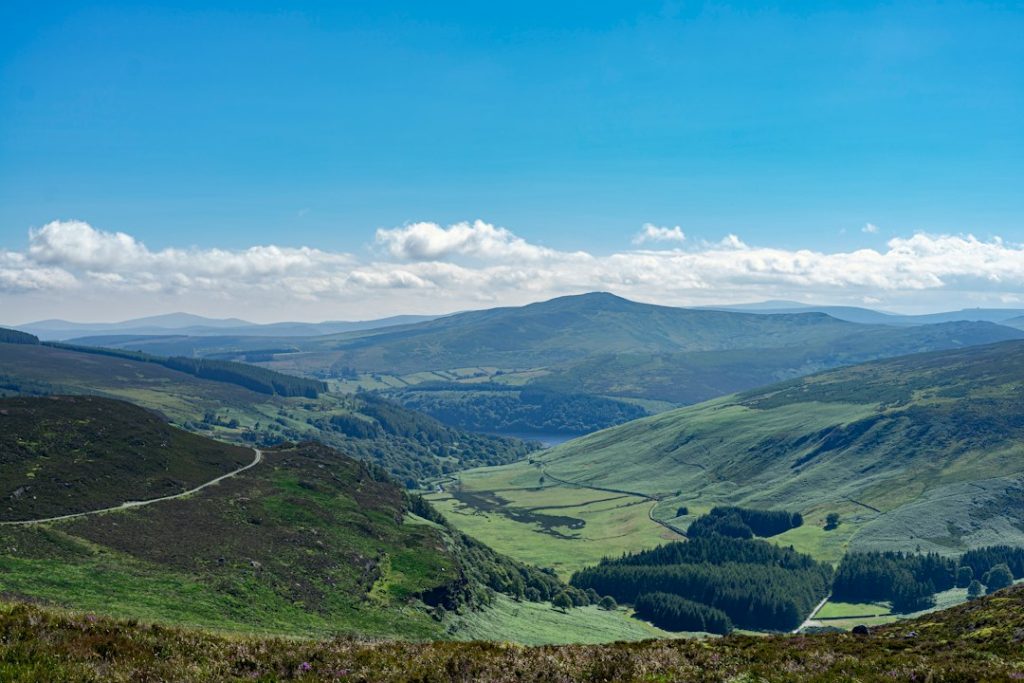
There are beautiful places in Ireland, and then there’s Glendalough. This glacial valley in County Wicklow, whose name means “Valley of the Two Lakes” in Irish, combines natural drama with ancient spirituality in a way that stops you in your tracks. It’s where Ireland’s wild landscape and sacred history meet so completely that even the most hardened skeptic feels something shift.
Founded by St. Kevin in the 6th century, Glendalough became one of Ireland’s most important monastic cities, a center of learning that drew pilgrims from across Europe. Today, the ruins still stand beside two dark lakes, cradled by forested slopes and granite peaks, looking much as they have for over a thousand years.
The Monastic City That Time Preserved
The monastic settlement at Glendalough is remarkably intact. The round tower, rising 100 feet above the valley floor, is one of the finest in Ireland—its conical cap and doorway 10 feet above ground still perfectly preserved. It served as both bell tower and refuge when Viking raiders came up the valley.
St. Kevin’s Church, known locally as St. Kevin’s Kitchen because of its stone roof and chimney-like bell tower, is the site’s most photogenic building. The craftsmanship in its corbelled stone roof, built without mortar, is extraordinary. Walk the grounds and you’ll find the cathedral ruins, several smaller churches, Celtic crosses weathered smooth by centuries of mountain rain, and gravestones so old their inscriptions have become whispers in stone.
The Gateway, with its twin granite arches, is the only surviving example of a monastic gateway in Ireland. Passing through it feels like crossing a threshold between worlds—which, in a sense, you are.
The Two Lakes and St. Kevin’s Bed
The Lower Lake sits right beside the monastic city, reflecting the round tower on still mornings in a way that’s become iconic. But it’s the Upper Lake, a mile’s walk up the valley, that holds Glendalough’s deepest magic. Surrounded by sheer cliffs and accessible only on foot, this darker, quieter lake feels genuinely ancient.
High on the south cliff face, 30 feet above the Upper Lake, is St. Kevin’s Bed—a small cave where the saint is said to have slept and prayed in complete solitude. The story goes that a young woman named Kathleen fell in love with Kevin and followed him to this remote spot. In his determination to remain celibate and devoted to God, Kevin pushed her away, and she fell to her death in the lake below. It’s a harsh story, but it speaks to the extremes of early Irish monasticism.
You can’t access the cave anymore, but you can see it from the lakeside path, a dark opening in the cliff that makes you wonder at the commitment required to live that life.
Walking the Valley
Glendalough is crisscrossed with marked trails that range from easy lakeside strolls to challenging mountain climbs. The Green Road is an easy 2.5-mile loop that takes you from the monastic site to the Upper Lake through oak woodland—it’s the old miners’ road, dating from the 18th and 19th centuries when Glendalough had a thriving lead mining industry.
For something more challenging, the Spink Trail climbs the eastern flank of the valley, offering stunning views down onto the Upper Lake from a wooden boardwalk that traverses the cliff edge. It’s about 7 miles round trip with serious elevation gain, but the perspective it gives you on the valley’s glacial formation is unmatched.
The Poulanass Waterfall, just west of the Upper Lake, is worth the short detour. After rain, it’s a thundering cascade; in dry summer months, a gentle ribbon. Either way, the moss-covered rocks and oak canopy around it feel like something from a fairy tale.
Why It Still Matters
Glendalough gets busy—very busy in summer and on weekends—but it absorbs the crowds better than most Irish heritage sites. There’s enough space, enough trails, enough quiet corners that you can still find solitude if you’re willing to walk a bit further.
What makes Glendalough special isn’t just its beauty or its history taken separately. It’s that this place has been considered sacred for 1,500 years, and you can still feel why. The early monks chose this valley not in spite of its remoteness and dramatic landscape, but because of it. They understood something about thin places—spots where the veil between the everyday and the eternal feels gauzy.
Visit early in the morning before the tour buses arrive, or late in the afternoon when the light goes golden on the round tower. Walk up to the Upper Lake and sit quietly. Listen to the water, the wind in the oaks, maybe the call of a raven echoing off the cliffs. You’ll understand why St. Kevin stayed.
Glendalough is about 30 miles south of Dublin, easily reached by car or bus. Entry to the monastic site and trails is free, though the visitor center charges a small fee (around $5). The site is open year-round from dawn to dusk.
Want more stories from Ireland’s most beautiful and meaningful places? Subscribe to the Ireland Moments newsletter for a daily celebration of the Emerald Isle, delivered to your inbox each morning.