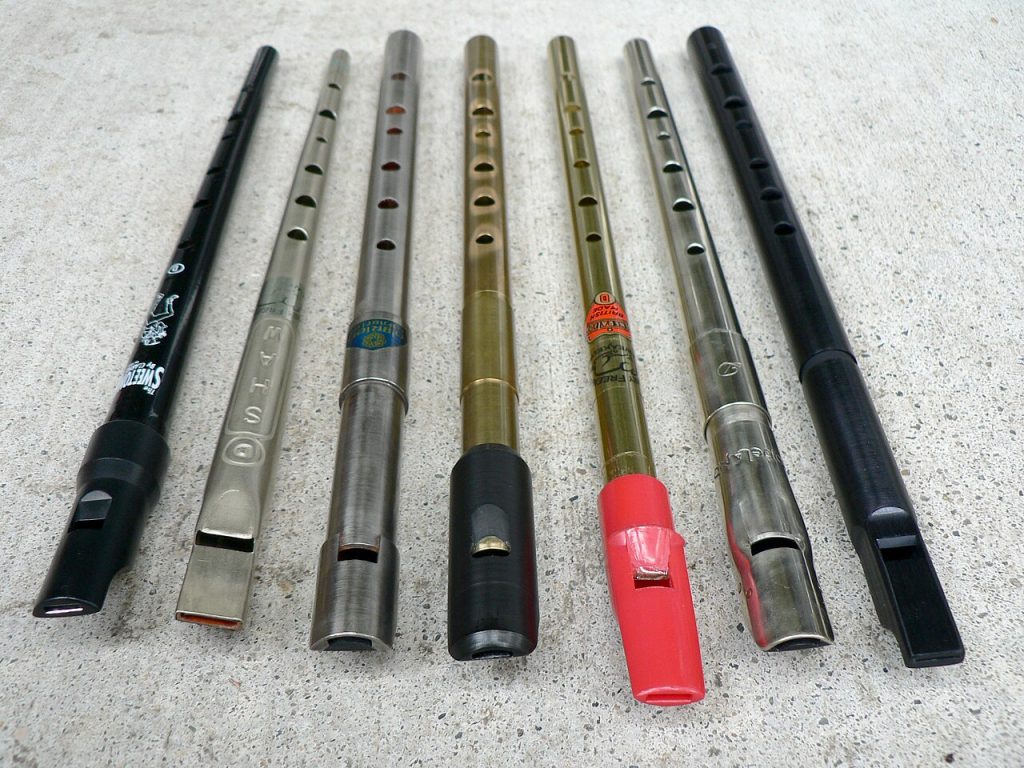
Walk into any music shop in Ireland and you’ll find them hanging by the register: tin whistles in D, sometimes C, gleaming and modest, usually priced around $10 to $20. They look almost too simple to matter. But this unassuming six-holed pipe has launched more musical journeys than perhaps any instrument in Irish tradition.
The tin whistle — or penny whistle, as it’s sometimes called — is where most Irish musicians begin. It’s the instrument schoolchildren learn, the one buskers favor on Grafton Street, and the voice that carries some of the tradition’s most beloved airs and jigs. Its simplicity is deceptive. In skilled hands, a tin whistle can make you weep.
The Whistle That Reached Everyone
The modern tin whistle emerged in the mid-1800s when English instrument maker Robert Clarke began mass-producing affordable whistles from rolled tin with a wooden fipple. Suddenly, music was within reach of every household. In Ireland, where music had always been passed down through families and communities, the tin whistle became a democratic force.
Before recorded music, before radio, the whistle let anyone with a few coins join the session. It required no formal training, no expensive outlay, no years of practice before you could play a simple tune. You learned by listening, by trying, by playing badly until you played well. That’s still how most people start.
The whistle’s accessibility never diminished its artistic potential. Players like Mary Bergin, Micho Russell, and Joanie Madden proved the instrument could hold its own alongside fiddles, pipes, and flutes in the finest company. Bergin’s 1979 album Feadóga Stáin remains a masterclass in ornamentation, breath control, and the whistle’s expressive range.
What Makes a Whistle Sing
The tin whistle is a simple-system flute: six holes, no keys, played by covering and uncovering the holes with your fingers. Most traditional players use a whistle in D, which suits the majority of session tunes. The scale is diatonic, meaning it plays a major scale naturally, though skilled players bend notes, use half-holing, and vary breath pressure to achieve the cuts, rolls, and slides that give Irish music its character.
What matters isn’t the mechanics — it’s the sound. A good whistle has a clear, sweet tone in the lower register and a bright, cutting voice in the higher notes. Brands like Clarke, Generation, Feadóg, and Tony Dixon make excellent beginner instruments. Serious players often graduate to more expensive models from makers like Michael Burke, Copeland, or Goldie, which can run $150 to $400 and offer greater tuning precision and tonal warmth.
But even a $12 Clarke can sound beautiful. The whistle rewards breath control, phrasing, and feeling more than expensive gear. It’s an instrument that meets you where you are.
Learning the Language of Tunes
The tin whistle teaches you to listen. Because it’s so immediate — blow and it makes sound — beginners quickly move from fumbling through scales to attempting actual tunes. “The Kesh Jig,” “Drowsy Maggie,” “The Irish Washerwoman” — these are the tunes every whistle player learns, often by ear, often in the company of others.
That’s the deeper gift of the whistle: it brings you into the tradition. You don’t learn whistle in isolation. You learn it at a session, at a workshop, from a recording, from a friend who shows you how to tap your foot and where to breathe. The whistle is social. It’s meant to be played with others, to add a voice to the conversation of reels and jigs.
In Irish music, the whistle often carries the melody while fiddles, flutes, and accordions weave around it. It’s a lead instrument and a supporting one, depending on the moment. Because it’s so portable, it’s the instrument you bring to the beach, the pub, the session that starts in someone’s kitchen at midnight.
Why It Still Matters
In an age of digital music production and infinite playlists, the tin whistle endures because it insists on presence. You can’t automate it, sample it, or fake it. You have to breathe, to phrase, to feel the tune in your body. It connects you to centuries of players who learned the same way, who played the same tunes, who passed the music forward by simply playing it.
If you’ve ever wanted to learn Irish music, the tin whistle is where to start. Pick up a Clarke or Generation in D, find a slow session or a beginner’s tutorial online, and start with one tune. “The Silver Spear,” maybe, or “Saddle the Pony.” Play it badly at first. That’s the point. The whistle forgives, and the tradition welcomes.
Ireland’s musical voice begins here, in this simple pipe, in your hands, in the breath you give it. The rest is just practice, and joy, and time.
Love stories like this? Subscribe to the Ireland Moments newsletter and get a daily celebration of Ireland — its music, places, culture, and the details that make it unforgettable — delivered to your inbox every morning.