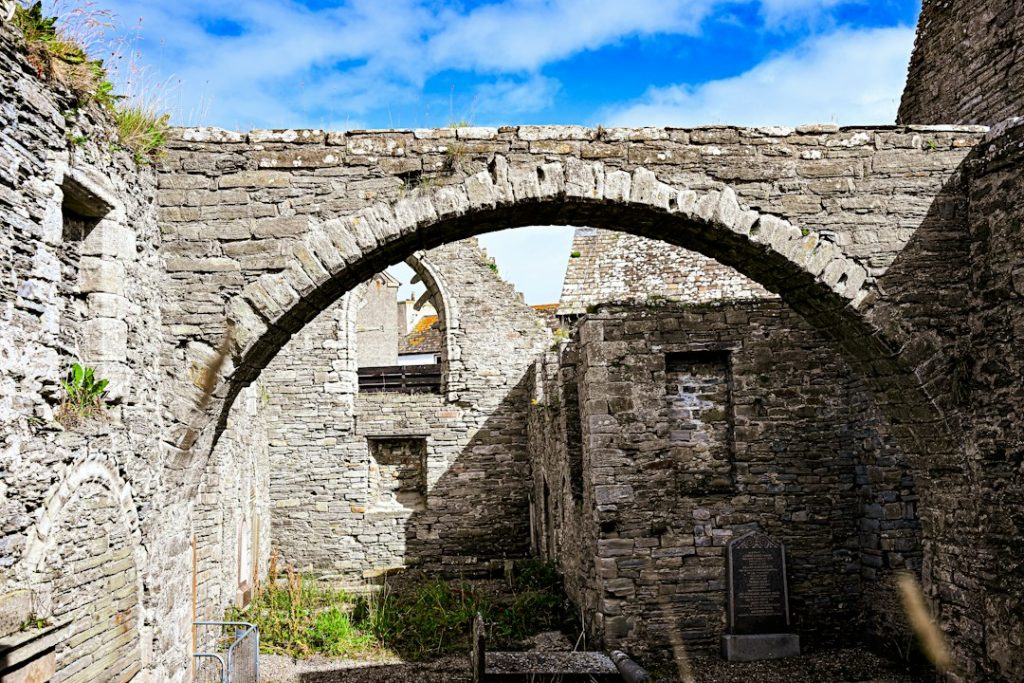
Walk along the edge of the River Corrib where it meets Galway Bay, and you’ll find a modest stone archway that doesn’t shout for attention. The Spanish Arch isn’t grand like Blarney or dramatic like Dunluce. It’s weathered, compact, and easy to miss if you’re rushing toward the Latin Quarter’s pubs and cafés. But this unassuming arch holds the soul of medieval Galway—a city that once traded wine, spices, and stories with half of Europe.
Built in 1584 as an extension to Galway’s city walls, the Spanish Arch was designed to protect the quays where merchant ships unloaded their cargo. Galway in the 16th and 17th centuries was one of Ireland’s busiest ports, controlled by fourteen powerful merchant families known as the Tribes of Galway. Ships from Spain, France, and Portugal brought wine, brandy, silk, and salt, while Galway exported wool, hides, and fish to the Continent.
The Spanish Connection
The arch gets its name from the Spanish traders who were regular visitors to Galway’s docks. Spanish wine was particularly prized, and the relationship between Galway and Spain ran deep. Many of the Tribes had trading ties—and sometimes family connections—to Spanish ports like Cádiz and Seville. The arch itself was part of a protective wall meant to shield these valuable goods from the tides and from pilfering as they were moved from ship to warehouse.
Though the original structure was larger, much of the wall was destroyed in 1755 when a tsunami triggered by the Lisbon earthquake hit Galway’s waterfront. What remains today is a fragment, but it’s enough to imagine the bustle: stevedores hauling barrels, merchants haggling in multiple languages, the smell of salt and tar, the creak of rigging in the wind.
A Gathering Place Today
The Spanish Arch has become one of Galway’s most beloved landmarks, not because it’s monumental, but because it’s woven into daily life. On sunny days, locals and visitors gather on the grassy slope beside the arch, sitting along the riverbank with takeaway coffee or fish and chips from McDonagh’s just up the road. Street musicians set up nearby. Swans glide past. The Long Walk, a picturesque row of colorful buildings, stretches along the waterfront, and the arch frames it all.
Across from the arch is the Galway City Museum, a modern building that tells the fuller story of the city’s history—from its medieval merchant princes to the Claddagh fishing village that once thrived just beyond the walls. Admission is free, and it’s worth an hour to understand the context of what you’re looking at when you stand beneath that old stone.
Why It Still Matters
The Spanish Arch is a reminder that Ireland was never as isolated as it might seem. Galway was cosmopolitan centuries before the term existed, a place where languages mixed, where ideas and goods flowed freely, and where the Atlantic wasn’t a barrier—it was a highway. The arch represents an Ireland confident in its place in the wider world, trading not just goods but culture, music, and influence.
Today, Galway still carries that spirit. It’s a city of festivals, artists, students, and travelers. The Spanish Arch is where history meets the present, where you can sit on old stones and watch the river meet the bay, knowing that others did the same four hundred years ago, waiting for ships that carried the world to their doorstep.
If you find yourself in Galway, don’t just snap a photo and move on. Sit for a while. Let the arch do what it’s always done—mark the threshold between land and sea, between then and now, between Ireland and everywhere else.
Love stories like this? Subscribe to the Ireland Moments newsletter—a daily celebration of Ireland’s places, culture, music, history, and the moments that make the island unforgettable.