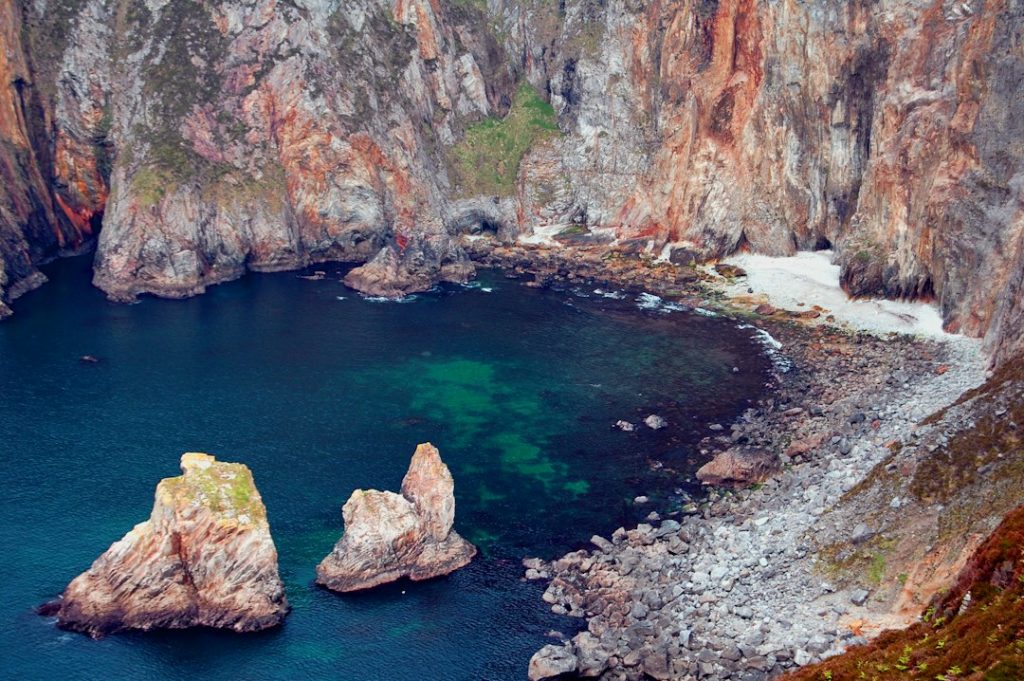
When most people think of Ireland‘s sea cliffs, the Cliffs of Moher come to mind. But tucked away in the remote southwest corner of County Donegal, Slieve League rises nearly 2,000 feet above the Atlantic—almost three times higher than its famous cousin to the south. These are among the highest accessible sea cliffs in Europe, and they remain one of Ireland’s best-kept secrets.
What makes Slieve League extraordinary isn’t just the height. It’s the wildness, the color, and the fact that on most days, you’ll share this magnificent place with only a handful of others.
The Approach That Takes Your Breath Away
The journey to Slieve League begins in the village of Teelin, where a narrow road climbs steeply toward Bunglas, the main viewing point. The drive itself is spectacular—winding past stone walls, grazing sheep, and ever-expanding views of Donegal Bay. Park at the upper car park, and you’re standing at the edge of one of Ireland’s most astonishing landscapes.
From Bunglas, the cliffs drop in near-vertical walls of russet, amber, and charcoal—layered bands of ancient quartzite and shale that glow in the changing light. On clear days, you can see the Sligo mountains to the south, the Bluestack Mountains inland, and even as far as the hills of Mayo across the bay.
For those who want more, the walk continues along One Man’s Pass—a narrow ridge with sheer drops on either side—toward the summit of Slieve League itself at 1,972 feet. It’s not for the faint of heart, but it’s one of the most exhilarating hikes in Ireland.
Color, Light, and the Ever-Changing Atlantic
What sets Slieve League apart from other Irish cliffs is the extraordinary color. The rock here contains iron oxides that paint the cliff face in shades of rust, copper, and deep red—especially vivid after rain or in the low light of morning and evening. When the sun breaks through Atlantic clouds, the whole mountainside seems to ignite.
The ocean below shifts from jade to indigo to slate gray, depending on the weather. Atlantic swells crash against sea stacks and hidden coves, sending up plumes of white spray. Seabirds—fulmars, razorbills, and the occasional peregrine falcon—ride the updrafts along the cliff face.
There’s a rawness here that feels untouched. No visitor center, no guardrails, no admission fee. Just rock, sea, sky, and wind.
The Pilgrim’s Path and Ancient Connections
Slieve League has been a sacred place for centuries. The cliffs were once part of a pilgrimage route that led to a small chapel and holy well near the summit, dedicated to St. Assicus, a follower of St. Patrick. Pilgrims would climb barefoot, seeking blessings and penance in this high, wild place.
You can still see the ruins of the chapel, though they’re weathered almost to invisibility now. The pilgrim’s path is still walked today, not for religious reasons necessarily, but for the sense of connection it offers—to the land, the past, and something larger than yourself.
Local guides in Teelin offer walking tours that include stories of shipwrecks, folklore, and the families who have lived in the shadow of these cliffs for generations. It’s a landscape that’s been shaped as much by human memory as by the relentless Atlantic.
How to Experience Slieve League
The best time to visit is late spring through early autumn, when the weather is more predictable and the days are long. But even in summer, conditions can change quickly—bring layers, waterproofs, and sturdy boots.
If you’re not comfortable with heights or exposed ridges, the view from Bunglas is more than enough. If you’re an experienced hiker and the weather is calm, the full ridge walk to the summit and back takes about three to four hours.
Nearby, the village of Carrick offers pubs, cafés, and accommodations. Ti Linn Café in Carrick serves excellent soup and scones, perfect after a cliff walk. And if you have time, the drive along the coast to Glencolmcille and Malin Beg reveals even more of Donegal’s rugged beauty.
Slieve League doesn’t shout for attention. It simply stands, ancient and towering, at the edge of Europe—waiting for those who seek something quieter, higher, and more profound than the well-trodden path.
If this glimpse of Ireland’s wildest cliffs has stirred something in you, subscribe to the Ireland Moments newsletter—a daily celebration of the places, stories, and spirit of the Emerald Isle, delivered to your inbox each morning.