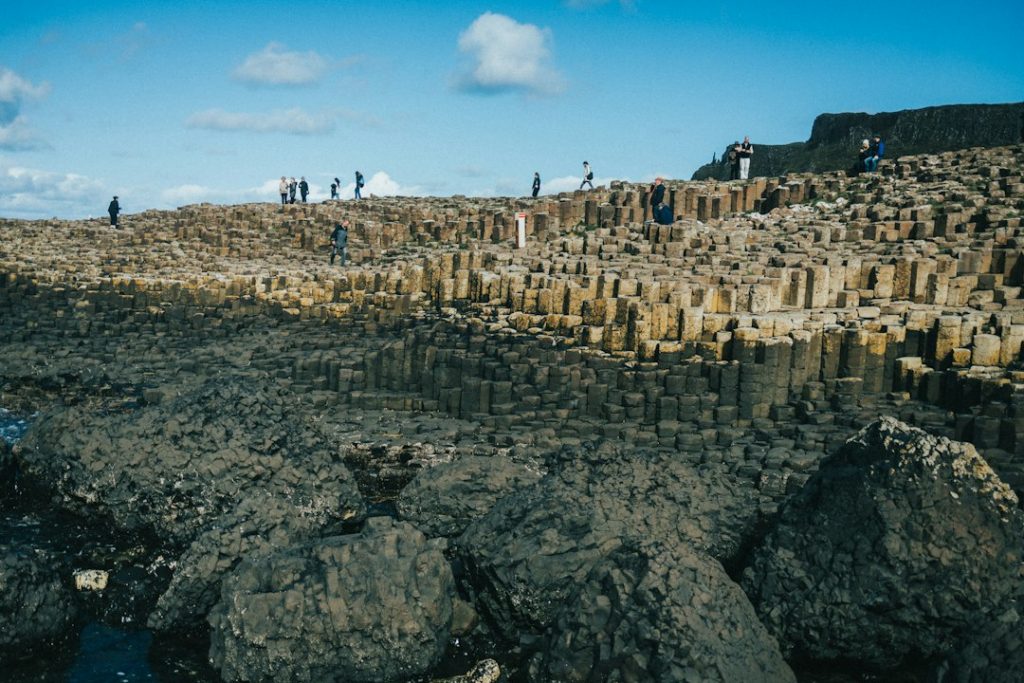
The Giant‘s Causeway doesn’t look real. Standing on Northern Ireland’s Antrim coast, you’re faced with around 40,000 basalt columns, most of them hexagonal, fitted together so precisely that they resemble the tiles of some ancient giant’s floor. The stones step down into the crashing Atlantic, dark and geometric against the foam, and for a moment you understand exactly why people believed a giant built them.
This is Ireland’s only UNESCO World Heritage Site, and it’s not hard to see why. Nowhere else on Earth looks quite like this.
The Legend of Fionn mac Cumhaill
According to Irish mythology, the warrior Fionn mac Cumhaill built the causeway as a bridge to Scotland so he could fight his rival, the giant Benandonner. When Fionn saw how massive Benandonner was, he retreated home, and his clever wife Oonagh disguised him as a baby. Benandonner, seeing the “infant” and imagining how large the father must be, fled back to Scotland, tearing up the causeway behind him.
The story holds up surprisingly well when you visit. Similar basalt formations exist on the Scottish island of Staffa, lending the myth a geological footnote. And the columns themselves—some as tall as 40 feet—do look like the remnants of something monumental and deliberate.
What Really Happened Here
The truth is almost as dramatic as the legend. Around 60 million years ago, intense volcanic activity caused molten basalt to push through chalk beds and spread across the landscape. As the lava cooled rapidly, it contracted and fractured into the columns we see today, with the hexagonal shape being the most efficient way for the rock to crack under tension.
The result is a natural wonder that feels designed. The columns form stepping stones, pillars, and platforms. Some areas, like the Giant’s Boot and the Wishing Chair, have been named for their shapes. The Organ, a cluster of tall columns reaching up the cliff face, looks exactly like its name suggests.
Walk carefully—the stones can be slippery, especially near the water—and take your time. The causeway isn’t large, but it rewards slow exploration. Look closely and you’ll see the variations: some columns are wide and squat, others needle-thin. The tops form a mosaic of geometric perfection.
Planning Your Visit
The Giant’s Causeway is located about two miles north of the town of Bushmills in County Antrim, roughly 60 miles from Belfast. The official visitor center charges around $16 for adults, which includes access to the site, exhibitions, and an audio guide. Parking costs extra if you drive.
You can walk down to the causeway from the center—it’s about a 15-minute downhill walk on a paved path, with a steeper climb back up. A shuttle bus runs regularly if you’d rather save your energy for exploring the stones themselves.
Arrive early or late to avoid the crowds, especially in summer. Early morning light is particularly beautiful, casting long shadows across the columns and catching the spray from the waves. The site is open year-round, but autumn and spring offer the best balance of decent weather and fewer visitors.
Don’t miss the clifftop walk that continues east from the causeway along the Antrim Coast Path. The views are spectacular, and you’ll often have long stretches to yourself. If you’re feeling adventurous, the hike to the nearby ruins of Dunseverick Castle adds an extra layer of history to the day.
Why It Still Amazes
Photographs don’t quite capture the Giant’s Causeway. It’s the scale that surprises—the way the columns extend far out into the water, disappearing beneath the waves. It’s the sound of the sea crashing against 60-million-year-old rock. It’s the realization that this wasn’t carved or constructed, but formed by fire and time and physics.
The causeway sits on one of the most dramatic stretches of coastline in Ireland, where cliffs plunge into the Atlantic and the wind carries salt and stories in equal measure. Whether you come for the geology or the mythology, you’ll leave understanding why both explanations have endured.
This is the kind of place that makes you believe in giants—or at least in the power of the earth to create something that looks like magic.
Want more stories from Ireland’s most remarkable places and traditions? Subscribe to the Ireland Moments newsletter and get a daily celebration of the Emerald Isle delivered to your inbox.