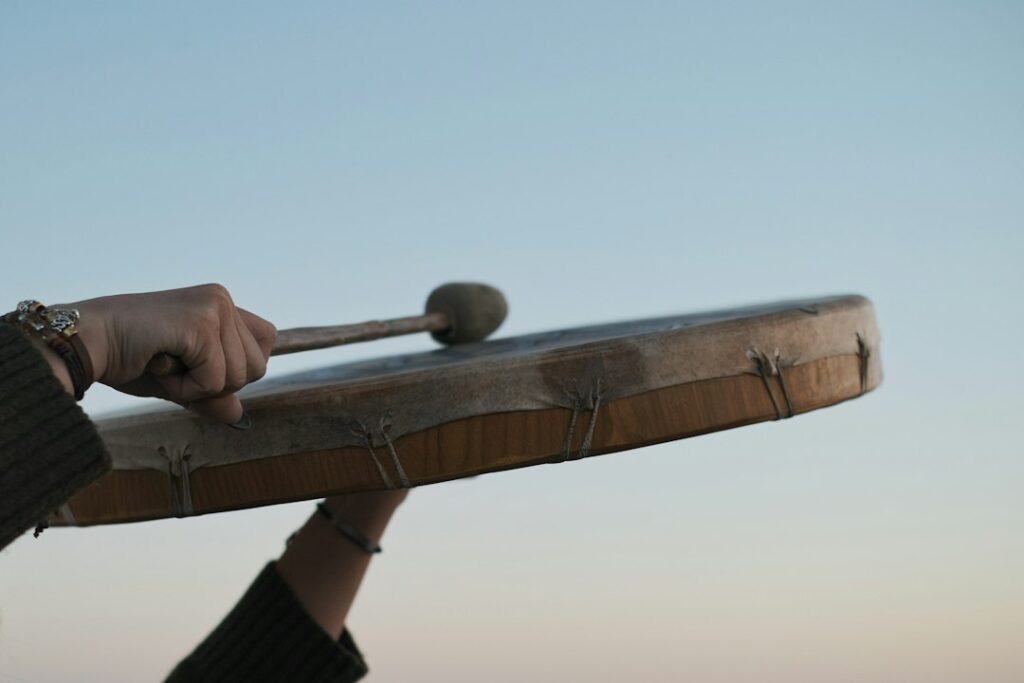
Walk into any trad session across Ireland and you’ll hear it before you see it: a deep, rhythmic thump that anchors the fiddles, flutes, and accordions swirling around it. That’s the bodhrán—Ireland’s frame drum—and it’s the instrument that turns a collection of melodies into a unified, breathing force.
Pronounced “BOW-rawn,” this circular drum looks deceptively simple. But in skilled hands, it becomes the heartbeat of Irish music, driving dancers to their feet and holding sessions together from the first note to the last.
An Ancient Drum with Deep Roots
The bodhrán is one of Ireland’s oldest instruments, with origins that reach back centuries. Historians debate whether it began as a farm tool for winnowing grain, a battle drum, or a ritual instrument tied to Celtic ceremony. What’s certain is that by the mid-20th century, it had found its true calling in traditional music.
The drum itself is made from a wooden frame—usually ash or oak—stretched with a goatskin head. Players strike it with a double-ended stick called a tipper or cipin, using a flicking wrist motion that creates rhythm, texture, and drive. The best players don’t just keep time—they add color, responding to the tune’s mood and the energy in the room.
Séan Ó Riada, the composer and musician who revolutionized Irish traditional music in the 1960s with his ensemble Ceoltóirí Chualann, is credited with bringing the bodhrán from the margins into the session. Before him, it was rarely heard in formal settings. After him, it became essential.
The Technique That Makes It Sing
Playing the bodhrán is about far more than hitting a drum. The left hand (for right-handed players) rests inside the drum against the skin, controlling tone and pitch by varying pressure. The right hand wields the tipper, striking the skin in rapid, controlled patterns that mirror the rhythm of jigs, reels, hornpipes, and polkas.
A good bodhrán player listens as much as they play. They know when to drive a reel forward with a steady pulse, when to drop back and let a slow air breathe, and when to accent the offbeat to give a jig its lift. The best players—like Johnny “Ringo” McDonagh of De Dannan, John Joe Kelly of Flook, or Colm Murphy—are masters of restraint and power, knowing exactly when to do more and when to do less.
Regional styles vary. In County Clare, players favor a crisp, dry sound. In Donegal, the style is more driving and aggressive, matching the high-energy fiddle tradition. In Kerry, there’s often a rolling, syncopated feel that mirrors the landscape—constant motion, but never rushed.
Where to Hear It Done Right
The bodhrán is everywhere in Ireland, but some places showcase it better than others. In Dingle, County Kerry, sessions at Foxy John’s or the Courthouse Pub often feature bodhrán players who’ve grown up with the drum, learning by ear in kitchens and back rooms.
In Miltown Malbay, County Clare, the Willie Clancy Summer School—held every July—draws bodhrán players from around the world for a week of workshops, performances, and late-night sessions. It’s the bodhrán equivalent of a pilgrimage.
Galway’s Crane Bar and An Púcán are reliable spots to hear the drum in action, often played by musicians who understand that the bodhrán’s job is to serve the tune, not dominate it. And in Dublin, venues like The Cobblestone in Smithfield host sessions where the bodhrán takes its rightful place—neither too loud nor too quiet, just right.
Why It Matters
The bodhrán doesn’t play melody. It doesn’t sing. But it does something just as vital—it creates the foundation that lets everything else soar. It’s the pulse beneath the ornament, the earth beneath the sky. Without it, a session can feel untethered. With it, the music has weight, direction, and life.
For learners, the bodhrán is also one of the most accessible traditional instruments. You don’t need years of training to make a sound—though you’ll need years of listening to make the right sound. A decent beginner drum runs around $80 to $150, and handmade professional models from makers like Meinl, Bodhráns.com, or Christian Hedwitschak can range from $250 to $600.
But the real cost is time—time spent in sessions, listening to how rhythm breathes with melody, learning when to hit and when to hold back.
The bodhrán is Ireland in drum form: humble, powerful, and impossible to ignore once you know it’s there. It’s the heartbeat of the session, the backbone of the tune, and the reason your foot starts tapping before your mind catches up.
Want more stories from the heart of Irish music and culture? Subscribe to the Ireland Moments newsletter—your daily celebration of Ireland, delivered straight to your inbox.