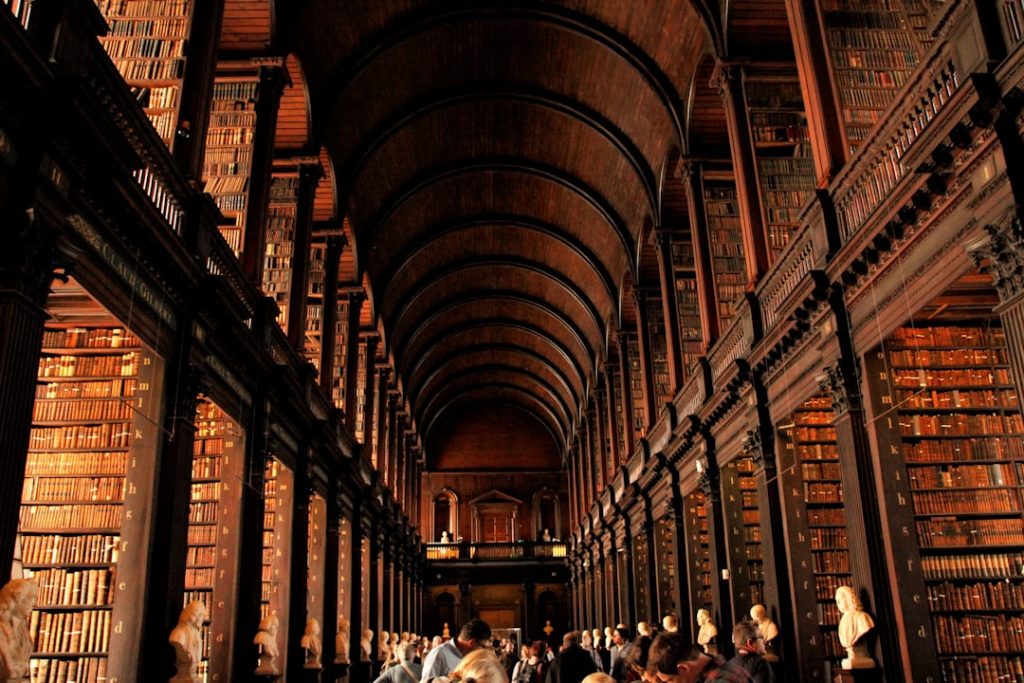
In the Long Room of Trinity College Dublin, beneath vaulted ceilings and rows of leather-bound volumes, sits one of the world’s most extraordinary manuscripts. The Book of Kells—created around 800 AD by Columban monks—is more than an ancient text. It’s a portal into medieval Ireland’s artistic genius, spiritual devotion, and sheer, audacious creativity.
Every year, more than half a million people queue to see it. And once you stand before those pages, it’s easy to understand why.
What Makes the Book of Kells So Special
The Book of Kells is a Gospel manuscript—the four Gospels of Matthew, Mark, Luke, and John, written in Latin on vellum made from calfskin. But calling it a “book” undersells what it really is: an illuminated work of art where every page pulses with detail, color, and symbolism.
The manuscript contains 680 pages, though only two are displayed at a time (they’re turned regularly to protect the pigments). What you see in those openings is astonishing: spirals and knots so fine they look woven rather than drawn, fantastical creatures tucked into margins, human faces peering from capital letters, and colors—lapis lazuli blue, verdigris green, orpiment yellow—that still glow after more than twelve centuries.
Scholars believe the book was created on Iona, the Scottish island monastery founded by St. Colmcille, and later brought to the Abbey of Kells in County Meath for safekeeping during Viking raids. It survived theft, neglect, and the centuries, and today it’s regarded as Ireland’s finest national treasure.
The Chi-Rho Page: A Masterpiece in Miniature
If you see only one page from the Book of Kells, let it be folio 34r—the Chi-Rho page. It depicts the Greek letters Chi and Rho, the monogram of Christ, exploding across the vellum in a symphony of spirals, interlace, and hidden figures.
Look closely (or study a high-resolution reproduction) and you’ll find cats, mice, angels, and otters woven into the design. Some art historians say the level of detail is so fine that the scribes must have used magnifying lenses—though none have been found from that period. It’s the kind of artistry that makes you hold your breath.
The page isn’t just decoration. It marks the beginning of Matthew’s account of Christ’s birth, a sacred threshold rendered with layers of meaning that medieval readers would have understood as visual theology.
Where to See It and What to Expect
The Book of Kells is housed in the Old Library at Trinity College Dublin, right in the heart of the city. Your ticket (around $18 USD) includes access to the exhibition *Turning Darkness Into Light*, which explains the manuscript’s history, creation, and conservation, as well as entry to the Long Room—a cathedral-like library hall that’s worth the visit on its own.
The exhibition is thoughtfully curated, with touchscreens that let you zoom into details you’d never catch through the glass case. You’ll learn about the pigments (some sourced from as far as Afghanistan), the tools, and the painstaking work of the scribes who spent years on this single project.
Expect crowds, especially in summer. Arrive early in the morning or late in the afternoon for a quieter experience. Photography isn’t allowed in the manuscript room, but postcards and reproductions are available in the shop—and they’re stunning.
Why It Still Matters
The Book of Kells isn’t just a relic. It’s a living connection to an Ireland that was, during the so-called Dark Ages, a beacon of learning and artistry. While much of Europe struggled through upheaval, Irish monks were copying texts, creating manuscripts, and preserving knowledge that might otherwise have been lost.
Standing in front of the Book of Kells, you’re not just admiring old pages. You’re witnessing the devotion of people who believed that beauty itself was a form of prayer, and that the Word deserved to be honored with every ounce of skill and imagination they possessed.
It’s no wonder the poet Seamus Heaney called it “a triumph of the spirit.”
If you love Ireland—its history, its artistry, its quiet layers of meaning—the Book of Kells is essential. It reminds us that this island has always been more than landscapes and legends. It’s been a place where craft, faith, and vision came together to create something unforgettable.
Want more stories that celebrate Ireland’s heritage, places, and culture? Subscribe to the Ireland Moments newsletter—a daily dose of the Emerald Isle delivered to your inbox.