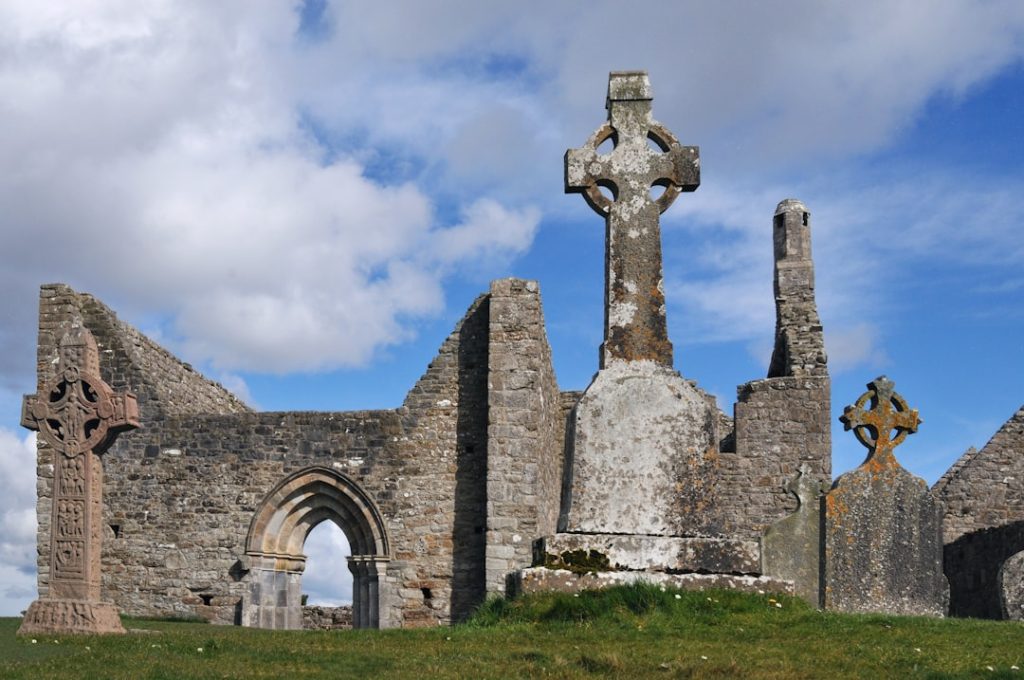
Drive through the Irish countryside and you’ll eventually encounter one: a tall stone cross, elaborately carved, standing in a field or churchyard, weathered but defiant after a millennium or more. These are Ireland’s high crosses, and they represent one of the most distinctive contributions to medieval European art.
Between the 8th and 12th centuries, Irish monks and craftsmen created these towering stone monuments across the island. Unlike the simple crosses found elsewhere in Europe, Irish high crosses are covered in intricate biblical scenes, geometric patterns, and symbolic imagery — essentially stone sermons designed to teach scripture to a largely illiterate population.
What Makes a High Cross
The classic Irish high cross is immediately recognizable: a tall stone shaft topped with a ringed cross, the distinctive circle connecting the arms. This ring isn’t just decorative — it likely provided structural support for the extending arms and may have symbolized eternity or the sun, blending Christian and older Celtic traditions.
Most high crosses stand between 13 and 20 feet tall, carved from a single piece of sandstone or granite. The western face typically depicts scenes from the New Testament — the Crucifixion almost always occupies the cross head — while the eastern face shows Old Testament stories. Every available surface is carved: geometric patterns fill borders, animals twist through knotwork, and human figures populate biblical narratives in remarkable detail.
Where to See Ireland’s Finest Examples
The High Cross of Muiredach at Monasterboice in County Louth is perhaps Ireland’s most celebrated example. Dating to the early 10th century, it stands over 17 feet tall and features some of the most sophisticated sculptural work you’ll find. The Crucifixion scene on the west face is extraordinary — Christ is surrounded by angels, Roman soldiers, and witnessing figures, all carved with expressive faces and detailed clothing.
Clonmacnoise in County Offaly, one of Ireland’s most important monastic sites, has three exceptional high crosses. The Cross of the Scriptures, standing near the cathedral ruins, depicts over 50 biblical scenes. The monastery setting, overlooking the River Shannon, makes the experience even more powerful.
At Ahenny in County Tipperary, you’ll find a different style entirely — crosses covered almost entirely in geometric patterns and spirals rather than figurative scenes, showing the earlier Irish tradition before biblical imagery became dominant. The paired crosses here, standing in a quiet churchyard, are mesmerizing in their intricacy.
The crosses at Kells in County Meath include the Market Cross, which once stood in the town square before being moved to the churchyard. Despite centuries of weathering, you can still make out scenes from Christ’s life carved into the stone.
Reading the Stone Stories
These crosses weren’t just decorative. They were teaching tools, outdoor illustrated Bibles for a time when books were rare and precious. Monks would gather communities around the crosses, using the carved panels to tell stories of Abraham and Isaac, David and Goliath, the Nativity, and the Resurrection.
Common scenes appear across multiple crosses: Daniel in the lions’ den, the three young men in the fiery furnace, the arrest of Christ, and the weighing of souls at the Last Judgment. Once you recognize these recurring images, you can read them from cross to cross across Ireland.
The carving quality varies — some crosses show sophisticated understanding of human anatomy and composition, while others have a more naive, folk-art quality. But all carry the same intention: to make sacred stories permanent and accessible.
Why They Matter Today
Standing before a high cross that has endured wind, rain, and over a thousand Irish winters creates a powerful connection to the past. These aren’t museum pieces behind glass — they stand where they’ve always stood, still performing their original function of telling stories in stone.
Many crosses show damage from centuries of exposure, and several of the finest examples have been moved indoors or replaced with replicas at their original sites. At Clonmacnoise, you can see original crosses in the visitor center and their weather-resistant replicas standing outside, ensuring these monuments endure for future generations.
The high crosses represent a unique moment when Irish artistic traditions — the spirals, knotwork, and patterns that decorated metalwork and manuscripts — merged with Christian imagery to create something found nowhere else in Europe. They’re distinctly, unmistakably Irish.
Whether you visit the famous examples or stumble upon a weathered cross in a rural churchyard, take time to look closely. These stones have stories to tell, carved by hands that have been dust for a millennium, still speaking across the centuries.
Want more stories celebrating Ireland’s heritage, landscapes, and culture? Subscribe to the Ireland Moments newsletter — a daily dose of the Emerald Isle delivered to your inbox.