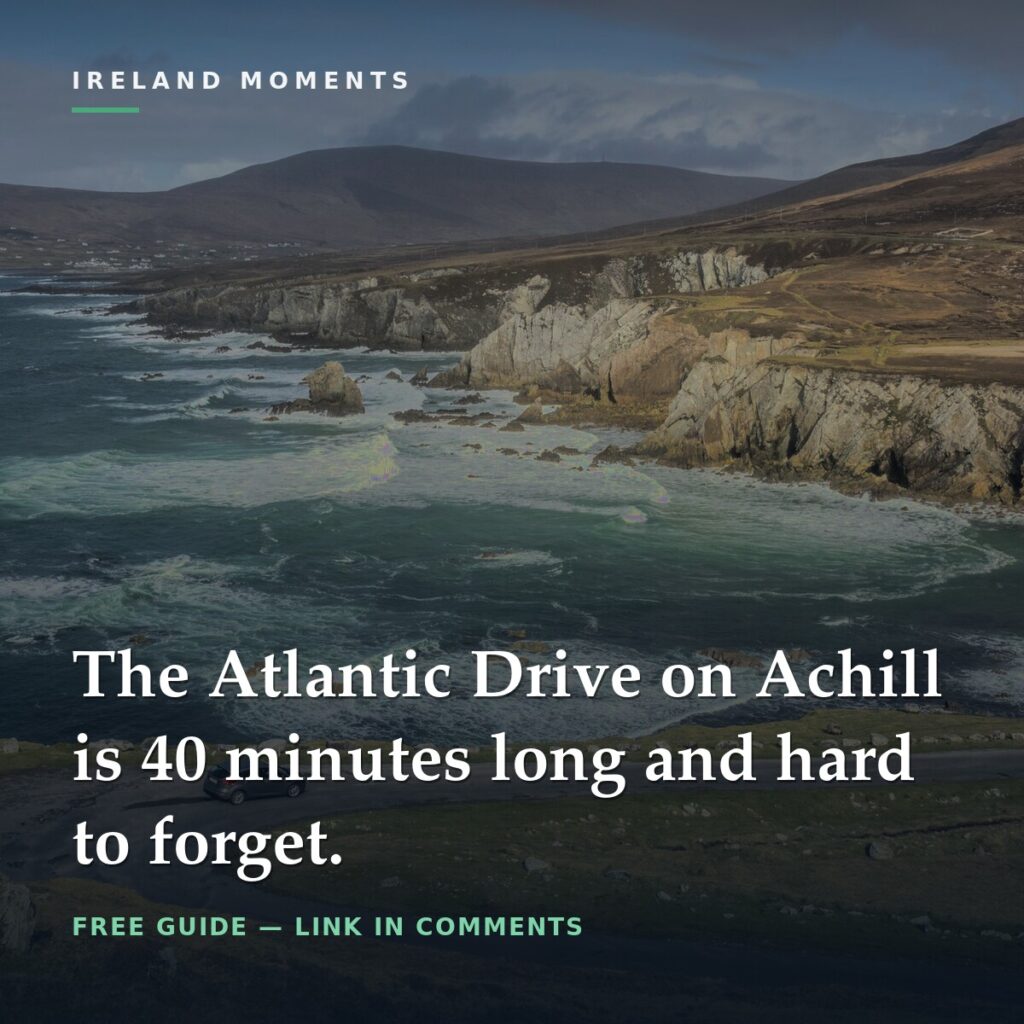
Achill Island sits off the coast of County Mayo like Ireland’s westernmost secret—connected to the mainland by a bridge but feeling utterly remote the moment you cross it. At 57 square miles, it’s Ireland’s largest island, and every inch of it seems shaped by the Atlantic winds and the ancient rhythms of those who’ve called it home for millennia.
This is where the Wild Atlantic Way delivers on every promise: soaring cliffs, beaches that stretch gold and empty even in summer, mountain roads that cling to impossibly steep slopes, and villages that carry the quiet dignity of a place that’s weathered storms literal and metaphorical.
Keem Bay and the Road That Gets You There
Keem Bay is Achill’s postcard moment—a horseshoe cove of turquoise water backed by cliffs so green they look painted. The beach itself is a crescent of sand that seems too perfect to be real, sheltered by the slopes of Croaghaun Mountain, which rises 2,192 feet directly from the sea in some of Europe’s highest ocean cliffs.
But the real magic is the drive. The Atlantic Drive from Keel to Keem is one of Ireland’s most dramatic coastal roads, winding past the abandoned village of Slievemore, over cattle grids, and along ridges where sheep graze at angles that defy physics. Park at the top and walk down to the beach—you’ll likely have it nearly to yourself, even on a sunny Saturday.
Keem was once a basking shark fishery, and locals still talk about the decades when the bay was thick with boats and the oil rendered from shark livers lit lamps across Europe. Today it’s just you, the waves, and maybe a seal bobbing in the surf.
The Deserted Village of Slievemore
Halfway along the Atlantic Drive, the Deserted Village of Slievemore sits in the shadow of its namesake mountain—a hauntingly intact collection of stone cottages abandoned during and after the Great Famine. More than 80 structures still stand, their walls open to the sky, their doorways facing the slope where families once grew potatoes and grazed cattle on common land.
This wasn’t a famine village alone—people lived here seasonally well into the 20th century, practicing booley, the ancient system of moving livestock to high pastures in summer. Walking through the roofless homes, you can still see the hearths, the divisions between rooms, and the small windows that framed views of Blacksod Bay.
There’s no visitor center, no interpretive panels—just stone, grass, wind, and the weight of history. It’s one of the most moving sites in Ireland, and it costs nothing but attention.
Dooagh and the Beach That Vanished and Returned
In the village of Dooagh, locals will tell you about the beach that disappeared in the 1980s, swept away by storms, leaving only rocks. For more than 30 years, children grew up without sand. Then, in 2017, a spring tide brought it all back—hundreds of thousands of tons of golden sand returned overnight, rebuilding the beach as if it had never left.
Today, Dooagh Beach is back in full form, a wide, flat strand perfect for walking, surfing, or simply sitting with a flask of tea and watching the light change over Achill Head. The village itself is small and working—fishing boats, a few pubs, a scattering of bright-painted houses—and feels like the Ireland visitors hope to find but rarely do.
Practical Notes for Visiting Achill
Achill Island is a 90-minute drive from Westport and just over three hours from Galway. You’ll cross the Michael Davitt Bridge at Achill Sound—there’s no toll, no ferry, just a smooth connection that somehow feels like a threshold.
Accommodation ranges from cozy B&Bs in Keel and Dooagh (from around $90 per night) to self-catering cottages with ocean views. The Beehive in Keel serves excellent chowder and brown bread, while Gielty’s Bar is the spot for a pint and whatever traditional music happens to break out on a given evening.
Bring layers—Achill’s weather can shift from sun to squall in minutes—and good boots if you plan to hike Croaghaun or Slievemore. The island has limited mobile service in some areas, which is part of the charm. Let yourself disconnect.
Why Achill Stays With You
Achill doesn’t shout. It doesn’t need to. This is an island that rewards slow travel—the kind where you take the long way, stop for sheep in the road, and pull over just because the light on the water looked a certain way. It’s a place where history lives in stone and story, where the landscape is both brutal and breathtaking, and where the Atlantic feels like a presence, not just a view.
Whether you come for a day or a week, Achill works its way into your bones. It’s Ireland at its wildest and most real, and it’s waiting just across the bridge.
Love stories like this? Subscribe to the Ireland Moments newsletter—your daily celebration of Ireland’s places, culture, music, history, and the moments that make the island unforgettable.