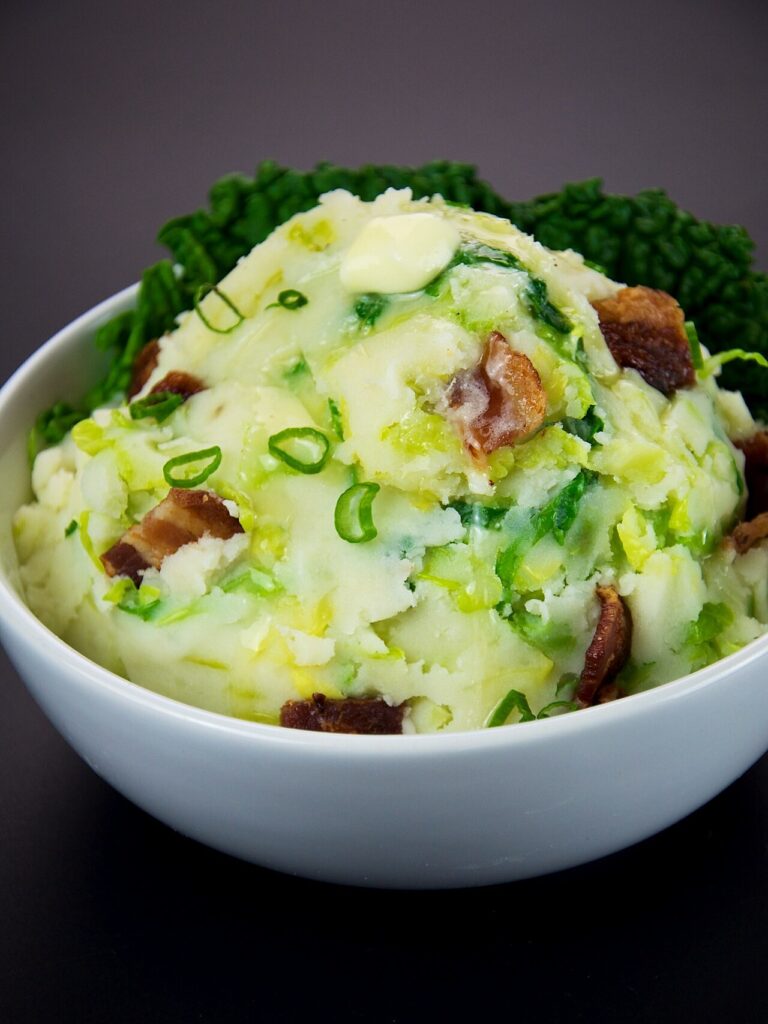
There are fancier dishes in the Irish repertoire, and there are certainly more complex ones. But few can match the simple, soul-warming satisfaction of colcannon—a dish that takes the humblest ingredients and turns them into something that feels like a hug from the inside out.
At its heart, colcannon is mashed potatoes enriched with butter, milk, and either kale or cabbage, all folded together until creamy and flecked with green. It’s peasant food in the best sense: born of necessity, perfected over generations, and still showing up on tables across Ireland because nothing else quite does the job.
The Building Blocks of Comfort
The foundation is floury potatoes—varieties like Rooster or Kerr’s Pink that break down into clouds of starch when boiled. They’re mashed with generous amounts of butter and warm milk until smooth, then mixed with finely chopped cooked kale or shredded cabbage that’s been softened in a pan with a bit more butter.
Some cooks add scallions, sautéed until sweet and tender. Others stick to the kale-and-potato version that’s been standard in Irish kitchens for centuries. Either way, the result is the same: a side dish that’s rich without being heavy, earthy without being plain, and capable of making even the simplest meal feel complete.
The key is not to skimp on the butter. Colcannon isn’t pretending to be health food—it’s embracing the fact that sometimes, the best thing you can do for a potato is give it the dairy it deserves.
A Dish With Deep Roots
Colcannon has been part of Irish food culture since at least the 18th century, when potatoes and cabbage were staples that kept families fed through long winters. The name likely comes from the Irish cál ceannann, meaning white-headed cabbage, though regional variations abound.
Traditionally, colcannon was associated with Halloween—Samhain in the old calendar—when it was served with small tokens hidden inside: a ring for marriage, a coin for wealth, a thimble for spinsterhood. Diners would dig through their portions, hoping for good fortune in the year ahead.
It was also a dish for lean times, when meat was scarce but potatoes and greens were plentiful. A well of melted butter in the center of the mound turned it into a meal in itself, eaten with a spoon and washed down with buttermilk.
How to Make It Right
Start with about two pounds of floury potatoes, peeled and cut into even chunks. Boil them in salted water until tender, then drain and let them steam-dry for a minute or two—this keeps the mash from getting gluey.
While the potatoes cook, melt a few tablespoons of butter in a pan and add four or five scallions, sliced thin, including some of the green parts. Let them soften without browning. If you’re using kale, strip the leaves from the stems, chop them finely, and add them to the pan to wilt. If you prefer cabbage, shred it and cook it until just tender.
Mash the potatoes with more butter and warm milk—about half a cup—until smooth and creamy. Fold in the greens and scallions, season generously with salt and white pepper, and serve immediately with a well of melted butter in the center.
The traditional approach is to eat from the outside in, dipping each forkful into the butter as you go. It’s indulgent, yes, but that’s the point.
Where to Find It Today
Colcannon has never gone out of style in Ireland, but it’s having a bit of a moment in restaurants that celebrate traditional cooking. You’ll find it at places like Chapter One in Dublin, where it’s served alongside roast meats, and at Ard Bia at Nimmos in Galway, where it appears as a seasonal side made with locally grown kale.
But the best colcannon is still the kind made at home, where the ratio of butter to potato is a matter of personal conviction and no one’s counting calories. It’s the dish that appears at Sunday dinners, alongside ham or corned beef, and at casual weeknight meals when something warm and filling is all that’s needed.
It’s also dead simple to scale up for a crowd, which is why it’s still a fixture at gatherings and celebrations, especially around Halloween when the old traditions get a nod.
Why It Endures
Colcannon endures because it does exactly what comfort food should do: it’s familiar, generous, and satisfying without trying too hard. It doesn’t need exotic ingredients or complicated techniques. It just needs good potatoes, fresh greens, and enough butter to make you momentarily forget that vegetables are involved.
It’s also endlessly adaptable. Add crispy bacon bits for richness, stir in some grated cheese for extra decadence, or keep it simple and let the quality of the ingredients speak for themselves. However you make it, colcannon is a reminder that Irish food at its best is about taking what’s on hand and making it sing.
If you love the honest, unfussy flavors of Irish cooking, subscribe to the Ireland Moments newsletter—a daily celebration of Ireland delivered straight to your inbox.