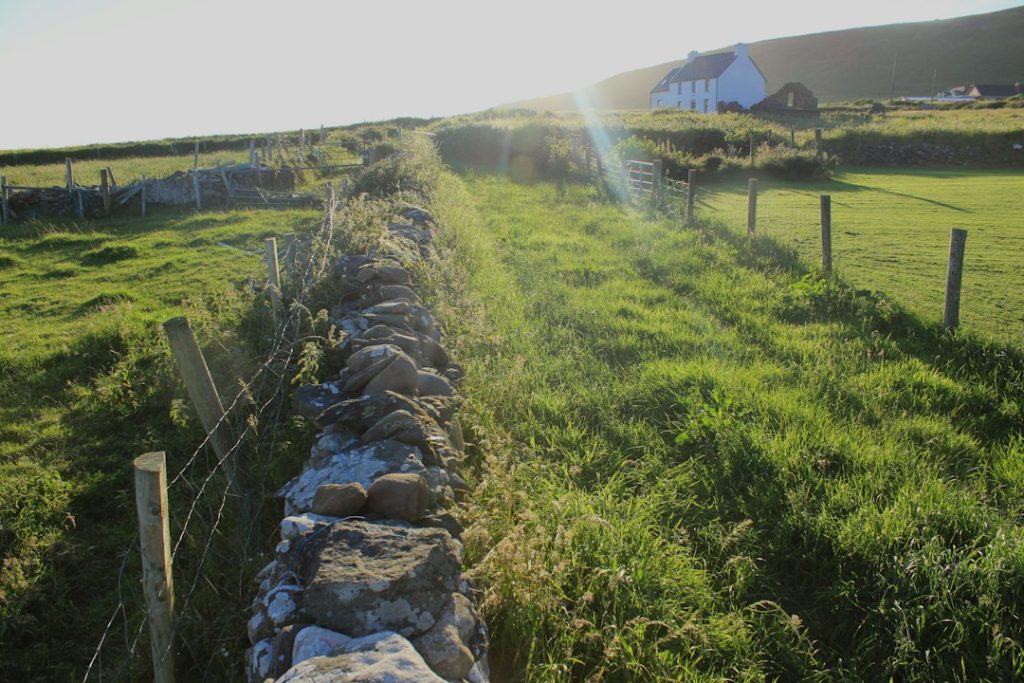
Drive through Connemara and you’ll notice them everywhere: low stone walls snaking across hillsides, dividing bogland from pasture, tracing the edges of tiny fields that look too small to farm. They’re so common you might overlook them. But every one of those walls is a monument—built by hand, stone by stone, by families who had no choice but to make something workable from the hardest landscape in Ireland.
These aren’t decorative. They’re survival, written in granite.
Built From What the Land Gave
Connemara’s soil is thin, acidic, and packed with rock. For centuries, farmers here couldn’t plow without hitting stone. So they cleared the fields the only way they could: by hand, pulling rocks from the earth and stacking them at the edges. What started as a necessity became a system. The walls marked boundaries, kept sheep from wandering, and sheltered crops from the Atlantic wind that tears across the bogs without mercy.
The stone itself is mostly granite, schist, and quartzite—dense, irregular, and difficult to work with. There’s no mortar. Each wall is dry-stack, meaning every stone is placed to interlock with the others, relying on weight, friction, and the skill of the builder. A well-made wall can stand for centuries. Many have.
Walk close and you’ll see the craftsmanship: larger foundation stones, smaller ones wedged as shims, capstones laid flat on top to shed rain. The best walls have a slight batter—a taper inward as they rise—that adds stability. It’s engineering learned through generations, passed from father to son, refined in the wet and wind.
A Landscape Shaped by Hardship
Connemara’s stone walls multiplied during the 18th and 19th centuries, as the population grew and marginal land was divided into smaller and smaller plots. By the time of the Great Famine in the 1840s, many families were trying to survive on holdings barely large enough to grow a few ridges of potatoes. The walls defined those desperate parcels.
During the Famine, relief work schemes employed starving men to build roads and walls—backbreaking labor in exchange for minimal wages or food. Some of the walls you see today were built under those conditions, by men too weak to lift the stones but with no other means to feed their families. The landscape itself became a record of that suffering.
After the Famine, emigration emptied much of Connemara. Fields were abandoned, cottages fell into ruin, but the walls remained. They still do, running up hillsides where no one has farmed in over a century, gray lines against green bog and purple heather, marking a human presence that has mostly gone.
Still Standing, Still Working
Not all of Connemara’s walls are relics. Many are still in use, maintained by farmers and landowners who understand their value. A good stone wall needs little upkeep if it’s built right, but when one does need repair, it’s often done the old way—by hand, with local stone, by someone who learned the skill from a parent or neighbor.
There’s been a quiet revival of dry-stone walling in recent years. Workshops teach the technique to newcomers and locals alike, and skilled wallers are sought after for restoration projects on heritage sites, national parks, and private land. It’s slow, physical work, but there’s pride in it—and a recognition that these walls are part of Ireland’s built heritage, as significant as any castle or round tower.
If you’re driving the Sky Road outside Clifden, or exploring the coast near Roundstone, or hiking in the Twelve Bens, take a moment to stop and look at the walls. Run your hand along the stone. Notice how tightly the rocks fit, how the wall follows the contour of the land, how it’s weathered smooth by decades of rain. Each one is a small, quiet testament to the people who worked this landscape, who made it livable against all odds.
What the Walls Still Say
Connemara’s stone walls don’t shout. They don’t have plaques or visitor centers. But they tell a story that’s central to understanding rural Ireland: the story of a people who stayed, who worked land that gave almost nothing back, who built with what they had because there was no alternative.
They’re beautiful, in their way—especially in late light, when the granite glows gold and the shadows deepen between the stones. But their beauty comes from function, from necessity, from the hands that placed each rock. They’re not romantic. They’re real.
And they’re still here, holding the land together, long after the families who built them have scattered across the world.
Love stories like this? Subscribe to the Ireland Moments newsletter and get a daily celebration of Ireland—its places, culture, music, and history—delivered to your inbox every morning.