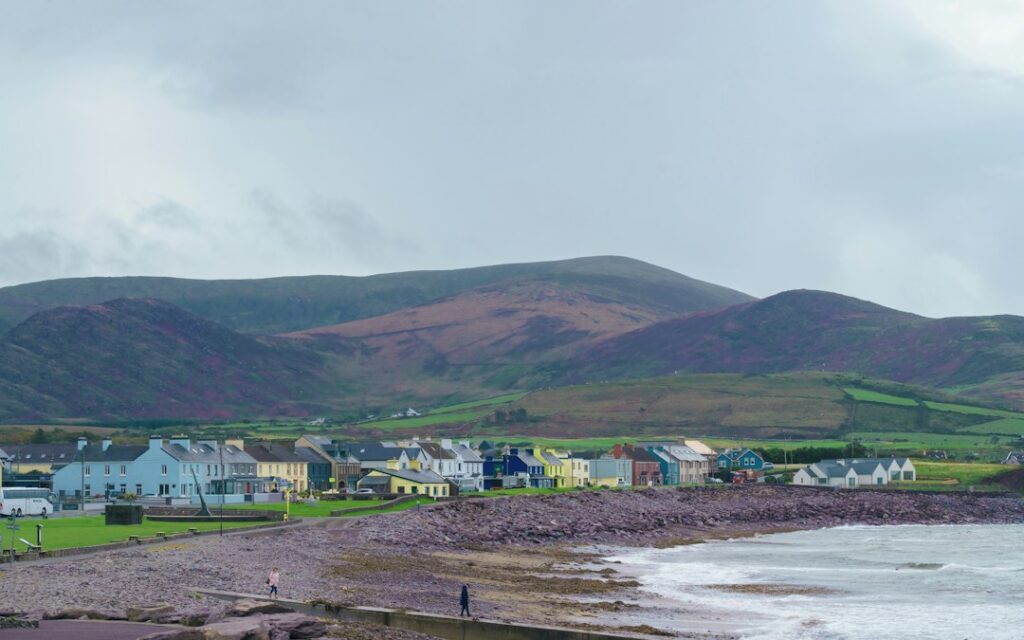
There are beautiful towns scattered all along Ireland‘s coastline, but Dingle holds something different. Perched on the southwestern edge of the Dingle Peninsula in County Kerry, this harbor town feels like the place where Ireland’s heart still beats in Irish—where the sea meets the mountains, where fishing boats unload the day’s catch beside pubs humming with traditional music, and where nearly every doorway is painted a different cheerful color.
With a population hovering around 2,000, Dingle is small enough to feel intimate but lively enough to surprise you. It’s a Gaeltacht town, meaning Irish is still spoken daily here, woven into shop signs, conversations, and the very fabric of local life. And it’s one of the few places in Ireland where you can hear a reel played on a fiddle, taste the freshest seafood you’ve ever had, and stand on a beach that looks out toward America—all in the same afternoon.
A Harbor Town with Soul
Dingle Harbor is the town’s beating heart. Fishing trawlers bob alongside pleasure boats, and the scent of salt and seaweed fills the air. The working harbor means the seafood here is as fresh as it gets. Restaurants like Out of the Blue and The Fish Box serve lobster, crab, and monkfish landed that morning, often with little more than butter, lemon, and respect for the ingredient.
Walk along the waterfront at sunset and you’ll see why artists and musicians have been drawn here for generations. The light over Dingle Bay turns gold and soft, the Blasket Islands rise dark on the horizon, and the whole scene feels timeless.
Dingle’s streets are narrow and winding, lined with brightly painted shopfronts—royal blue, sunflower yellow, deep red. It’s not just for show. The colors reflect the town’s character: vibrant, unpretentious, alive.
Music, Language, and the Craic
Step into any of Dingle’s pubs on a given night and there’s a good chance you’ll stumble into a session. Dick Mack’s, a pub that doubles as a leather shop, is legendary. Foxy John’s is both a hardware store and a bar. These aren’t gimmicks—they’re remnants of a time when rural Irish pubs served multiple roles in the community, and Dingle has held onto that spirit.
The music here is serious but never solemn. Locals and visitors pack in shoulder to shoulder, pints of Guinness and Murphy’s in hand, while fiddles, flutes, and bodhráns fill the room. Between tunes, you’ll hear Irish spoken as often as English, a reminder that this is one of the places where the old language didn’t just survive—it thrived.
Dingle also hosts the annual Blas na hÉireann, Ireland’s biggest food festival, and Other Voices, a renowned music festival that brings international and Irish acts to intimate venues each December. Both events reflect Dingle’s unusual combination: deep tradition and creative energy.
Gateway to Wild Beauty
Dingle isn’t just a destination in itself—it’s the gateway to the Slea Head Drive, one of the most spectacular coastal routes in Ireland. The 30-mile loop takes you past ancient beehive huts, Iron Age forts, white-sand beaches like Coumeenole and Coumeenoole, and sweeping views of the Atlantic that make you feel like you’re at the edge of the world.
You’ll pass through tiny villages where Irish is the first language and sheep graze on impossibly green hillsides. You’ll see the Blasket Islands offshore, once home to a thriving Irish-speaking community whose writers gave the world some of the most beautiful memoirs ever written about island life.
Back in town, Dingle Oceanworld Aquarium offers a family-friendly dive into marine life, and the Dingle Distillery crafts whiskey and gin using local barley and botanicals. But honestly, some of the best things to do in Dingle involve simply wandering—poking into craft shops, chatting with locals, and soaking in a place that hasn’t lost its soul to tourism, even as visitors flock here year-round.
Why Dingle Matters
Dingle matters because it shows what an Irish town can be when it holds onto its language, its music, its food, and its sense of place. It’s not a museum. It’s a living, working town where tradition and modernity sit comfortably side by side, where you can order your coffee as Gaeilge if you want, and where the person pulling your pint might also be the one playing the tin whistle later that night.
It’s the kind of place that makes you want to come back—and when you do, it welcomes you like an old friend.
Want more stories from the heart of Ireland delivered to your inbox? Subscribe to the Ireland Moments newsletter — a daily celebration of Ireland’s places, culture, music, and the moments that matter.